
Info: Machine translation This post was machine-translated from the Chinese original. Wording may be rough in places — the Chinese version is authoritative.
Summary 30 sessions are not 30 lessons. From a talking program, two AI winters, to models that can truly work on your computer: following a storyline, connecting knowledge, real products, and choices. HyphenTech · 2026-10-05
During that September test, I had a 64GB Mac with a local model complete five web problems. In the end, one was officially delivered, the other three were executable but not delivered, and one was left unfinished or couldn’t run. Black holes, cities, and ink scrolls were all released, but the acceptance sheets didn’t look good. **Being able to write, run, and finish tasks are three different thresholds. **
Originally, I wanted to see if the model could write code, but then I kept investigating: was it the model, tool parameters, the engine that ran, or my own proxy was the problem? These experiences come from records kept in September, not from today’s rerun. They made me want to connect the knowledge scattered across reviews, tutorials, and tool development into “Do You Really Know AI?” 》.
This series consists of 30 episodes, following the original panorama, origins, principles, iconic scenes, hands-on and boundary sequences of the knowledge base; Only merge adjacent materials suitable for discussion. Whether you are using ChatGPT or a local model, the goal is not to memorize 30 more sets of terms, but to know which step to check first when the answer is unreliable, costs are unclear, the model is underwhelmed, or the task is not completed. **The first issue not only gives you a complete reading route but also provides an answer demonstration: how knowledge turns into judgment and action. **
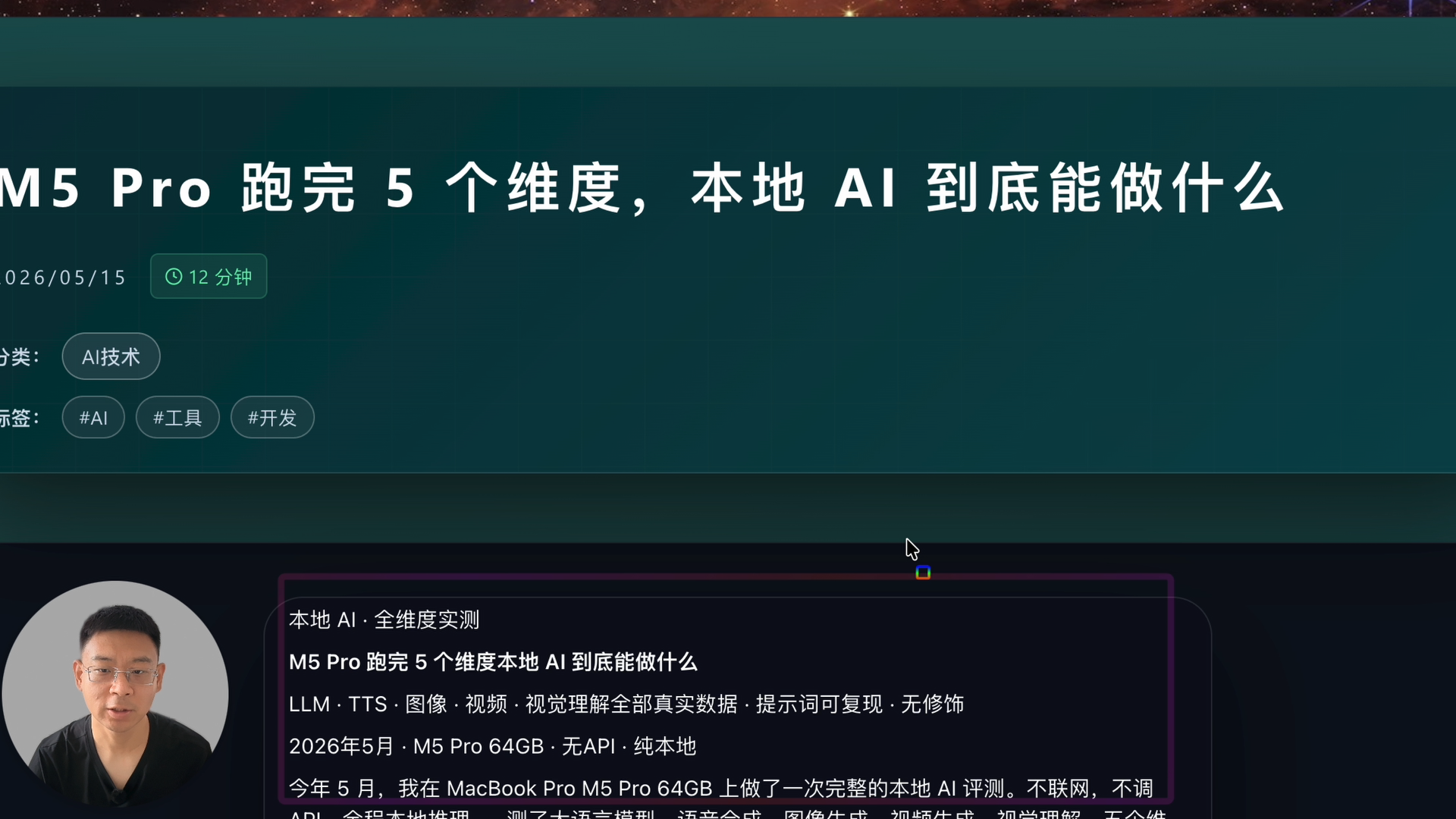
These 30 issues will help you go from “being able to ask questions” to “knowing how to judge.”
If you’ve encountered these situations—answers that sound real but can’t find the source, high benchmark scores but no results, models that can be loaded into a computer but the conversation slows down—this series is designed for those specific problems. You don’t need to learn programming first, nor do you need to change computers; Practice can start with an email, a short reply, or a small task.
- Issues 01–03: First, look at the panorama, then trace the race between two winters and open weight to trace the origins of AI.
- Episodes 04–16: Break down the network, word itself, vector, attention, training, reasoning, and a conversation in order, then look at the model layout, evaluation, files, and hardware.
- Issues 17–21 revisit these mechanisms through real, iconic scenes; Issues 22–27 cover native machine operation, quantization, knowledge bases, and tools; issues 28–30 discuss hallucinations, scale, and the boundaries of choice.
The first 10 episodes are planned and exercised in the table below. This article first lets you know: who the series is for, what HyphenTech has done before, and how understanding one answer can change how you use it today.
What does HyphenTech do? Bring AI from the launch event to your desktop
If it’s your first time here, this is HyphenTech. I have a Mac and also tinker with a regular computer and software I write myself. The mission is “make AI your superpower,” mainly doing three things: running locally, free to use, building your own. ** We will follow up on important model releases, but keep asking: what problems do they solve, what do ordinary devices have to pay for, how far do you get free to use, and how do you get a usable result?
| Main storyline | What will I say? | What should you get? |
|---|---|---|
| On-premises deployment | Model installation, memory and speed, utility calls, long tasks, and failure reviews | Know what your equipment is suitable for, and don’t mistake it for something that can start and be used long-term |
| Free resources | Free APIs, open-source alternatives, software and material entry points, clearly stating limits, licenses, and paywalls | There is a verifiable path to obtain and use it; a one-time bonus is not treated as permanently free |
| Homemade software | Turning repetitive operations into tools that showcase real features, bug fixing processes, and distribution boundaries | Don’t just look at the product name; you can judge whether it solves your problem |
| Key models and principles | Check the model’s open scope, capabilities, format, and hardware thresholds, using a hotspot interpretation mechanism | When facing new terms, you will ask about conditions, evidence, and costs; you don’t have to chase the largest model every time |
Complete tests and long videos are mainly on Bilibili, with YouTube synchronizing videos; Official accounts carry long articles, reviews, and selected reminders, while the official website centrally stores complete articles, tools, and resource portals. Different formats, the same standard: clearly distinguish between introductions and actual tests, look at successes and failures, and make sure results can be recorded.

Not Making a Wish from Scratch: What content and tools are already available?
As of October 5, 2026, the official website has published 63 original Chinese articles; Translations, drafts, and this ongoing series are not counted repeatedly. They cover model testing, deployment tutorials, resource reviews, and tool introductions. This is the content quantity, not 63 independent experiments; Below are the content entry points that can be directly accessed.

The two articles in the archive ask “How to choose between Mac, Windows, and Linux” and “How many free APIs are still usable?” The former splits computer selection into memory, compatibility, and maintenance; the latter breaks free into real requests, limits, and failure boundaries. One decides which machine to place the task, and the other decides which tasks are worth entrusting to online services. This series connects the underlying knowledge; after reading, you can go back to old reviews to reassess the conditions rather than just remember the conclusions at that time.
Currently, there are four publicly developed software programs that combine these issues into usable features: HyphenBox manages free model API candidates and local routing; LocalBrainLocalBrain manages local models and multimodal tools; ScreenLex organizes local film subtitles into an English learning vocabulary; HyphenScreen links recording, editing, and export checks. These are not the required checklists for learning this series, but rather tool entry points for some cases; For specific platforms, versions, and downloads, see the end of the article.
If you want to grab something useful today, you can start with the 8 content entry points below. These are curated paths for published content, not the other 8 homemade products.
| What do you want to solve? | Content is already available | How do you use it? |
|---|---|---|
| I don’t know how to clearly explain my needs | 12 Daily Scene Templates | Choose a scenario to replace your task conditions—don’t just copy exaggerated efficiency promises |
| Find available free model interfaces | Free AI API Retesting Record | First, check the test date, limits, and limits, then make your minimum request |
| I want to run models on a regular computer | 11 low-memory model old real-world tests | Compare devices and 8K context conditions, without extrapolating conclusions to arbitrary long conversations |
| Want to compare local AI capabilities | Test records for 6 local AIs | View different tasks and failure points, not just a speedometer |
| I want the model to accomplish one thing | 5 Web Game Tasks and Recreation Materials | Distinguish between delivery, being able to run, and abandoning based on the same acceptance conditions |
| Want to compare report writing skills | 5 models make the same movie report | Compare facts, analysis, and delivery, not just compare the length of the answer |
| I want to make an episode of AI animation | Animation Process and Cost Analysis | Calculate the investment along the stages of character, camera work, sound, and editing |
| Looking for design and development resources | Free Resource Site Directory | Entry points are found by purpose; licenses and current free policies still need to be reviewed |
You can start by choosing the path closest to you: when choosing a computer, check deployment and memory; write emails and reports daily, first check task templates and fact-checks; if you want the model to get hands-on first, first look at five questions and delivery checks. The template library covers 12 daily scenarios; interface lists, speed, and resource quotas have dates; expired records must be rechecked, without packaging old records as today’s new policies.
These old contents aren’t meant to be read all at once, but to help you find a focus for the following knowledge: how to verify free interfaces, how to choose computers, how to deliver models. Now, let’s open this article with the set of five questions, first look at the results, then unpack the parts behind them.
Let’s first look at a set of real works: why isn’t a beautiful piece considered finished yet?
Using five questions as an opening example because it simultaneously exposes the model’s capabilities and system boundaries. The question requires only one HTML file, no third-party libraries, no network loading, and can be opened even with double-click disconnected from the internet; It tests 3D gravity simulation, time loops, urban pathfinding, Chinese interactive long scrolls, and neural network visualization. Below are the results that illustrate different problems; complete rounds and reproduction materials can be found in Five-Question Test.
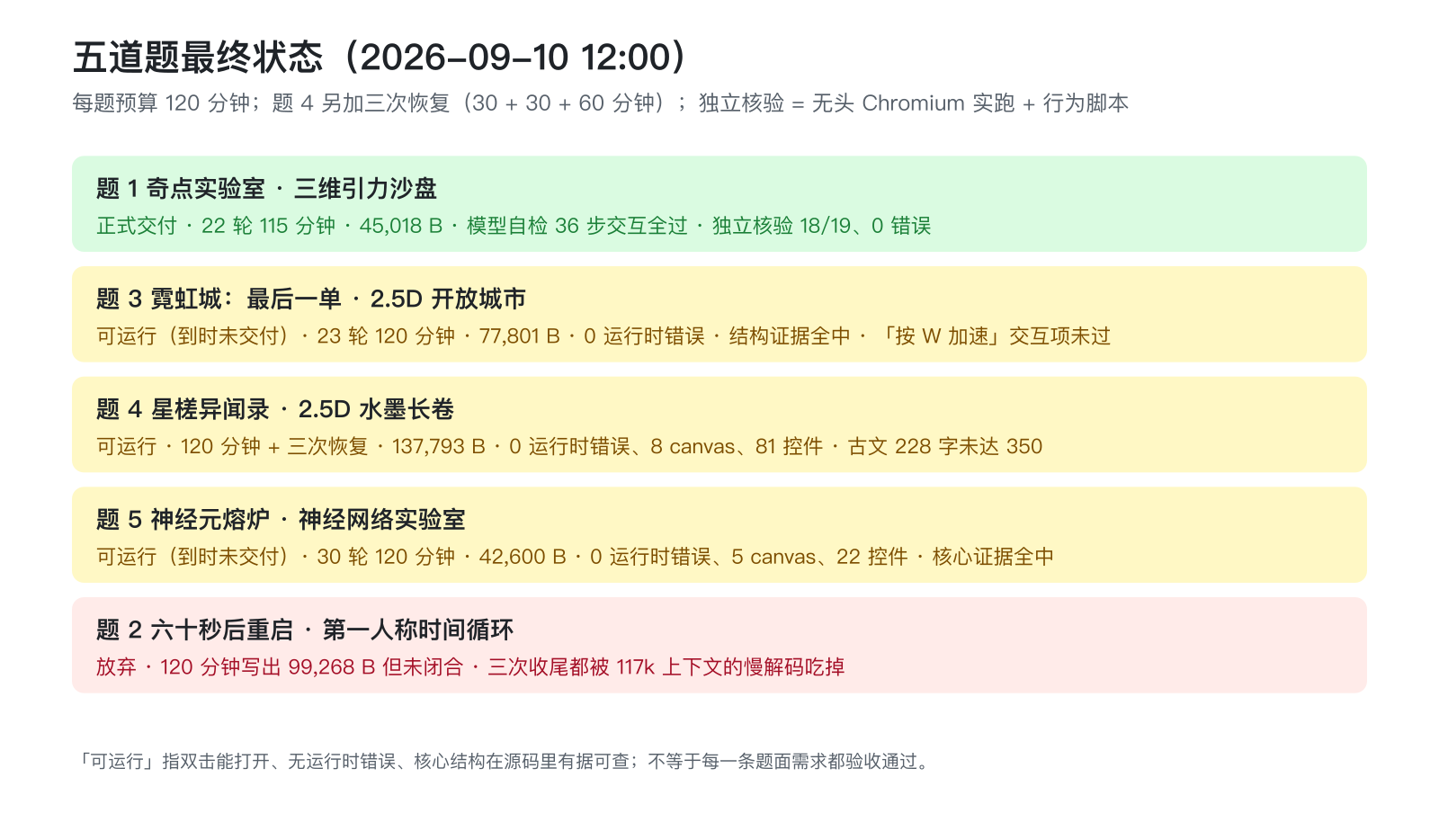
“Singularity Lab” was the only official delivery question: 22 rounds, 6902 seconds, about 115 minutes, final file 45018 bytes. The model passed all 36 interactive checks in the third set of 36 steps submitted by the model itself; Another independent script checked out of 19 items and passed 18, with no runtime errors on the page. This is not a “perfect score for 19 items”; the two checks tested different things, so one delivery cannot be rewritten to prevent errors from now on.

The appeal of this image lies in the fact that text requirements have truly become runnable programs. But if you only post screenshots and say “local AI handles physics simulation in one go,” it erases the 22 rounds and failure processing. Readers see only a few seconds, but what I pay is over an hour and a complete execution chain. **The work can be good, but the evidence cannot be the only attractive one. **
“Neon City” shows another threshold: roads, vehicles, mini-maps, and tasks all appear, with different states between day and night, yet the two-hour budget is not officially delivered before the deadline, and the “W acceleration” check still fails. Two maps show you status changes but cannot verify driver operation acceptance. This is the question to continue in issues 14, 24, and 26: What does the test cover, and who decides completion?


“Xingcha Chronicles” explains how constraints are omitted. Five scenes, ink parallax, classical and modern translations all appear; the page can run at the end, but the original imitation of ancient text only has 228 characters, and the title requires at least 350 words. This is not an ancient book, nor is it not undone, but it is incomplete. Beautiful pages and unqualified word counts can coexist; aesthetic satisfaction cannot be signed for the request.

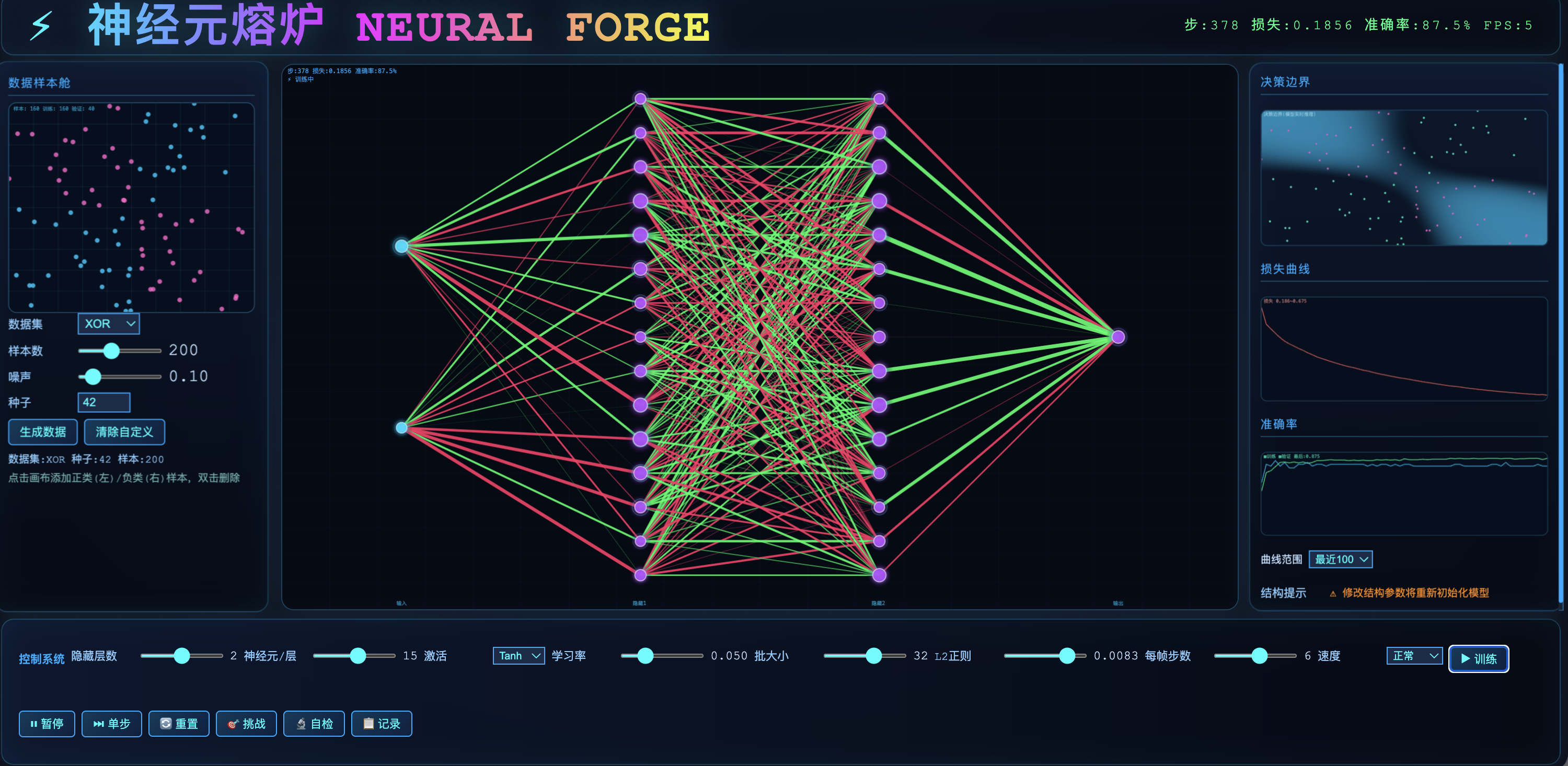
“Neuron Furnace” turns the neural network in Issue 4 into an observable picture: samples, connections, decision boundaries, loss, and accuracy are updated together. In the old check, it had 5 canvases and 22 controls, with no runtime errors, but it was not proactively delivered. 87.5% of the content in the screenshot belongs to the classification task in this demo, not the language model that generated it; This misunderstanding of “who exactly the score is scoring” will be received in Issue 14.
Now look at the problem that didn’t start: “Reboot in 60 Seconds.” In the old record, the final file reached 99,268 bytes and still wasn’t closed. The code was long, the process was busy, but the result couldn’t be delivered. I didn’t delete this failure from the results table because it reminded us that the amount AI outputs and what it actually completes are not the same metric.
| The evidence you see | Judgments that can support it | A judgment that cannot be supported for now |
|---|---|---|
| There is a piece of code | The model generated the program text | The file has been recorded, the syntax is correct, and it can run |
| The browser page opens | This version includes a runtime screen | All operations, performance, and boundaries are correct |
| Passed the self-inspection on the first try | This set of checks was passed in this edition | All requirements of the question are covered |
| Submit after acceptance according to the original question | This mission was completed under these conditions | Changing the topic, model, or next edition will definitely be completed |
Within the same set of works, code generation, state changes, missing conditions, and full delivery all coexist. In the first issue, we first grouped them together to distinguish these thresholds, then explained the reasons for each issue later. Returning to the question in the title: “How can you combine ‘guess the next word’ into a program?” The answer depends on how the model is generated and how the software executes; you can’t just give it a nickname like “advanced input method” or “all-knowing assistant.”
Look at the panorama first: don’t blame all 14 parts on the model
First, look at the elephant’s full-body photo, then study the trunk. This method is more effective than memorizing abbreviations from scratch: you first know where each noun lives, what it handles, and who should be checked if something goes wrong. **The object map tells you which parts the system has, and the series plan tells you where to go next; Neither map is a leaderboard. **
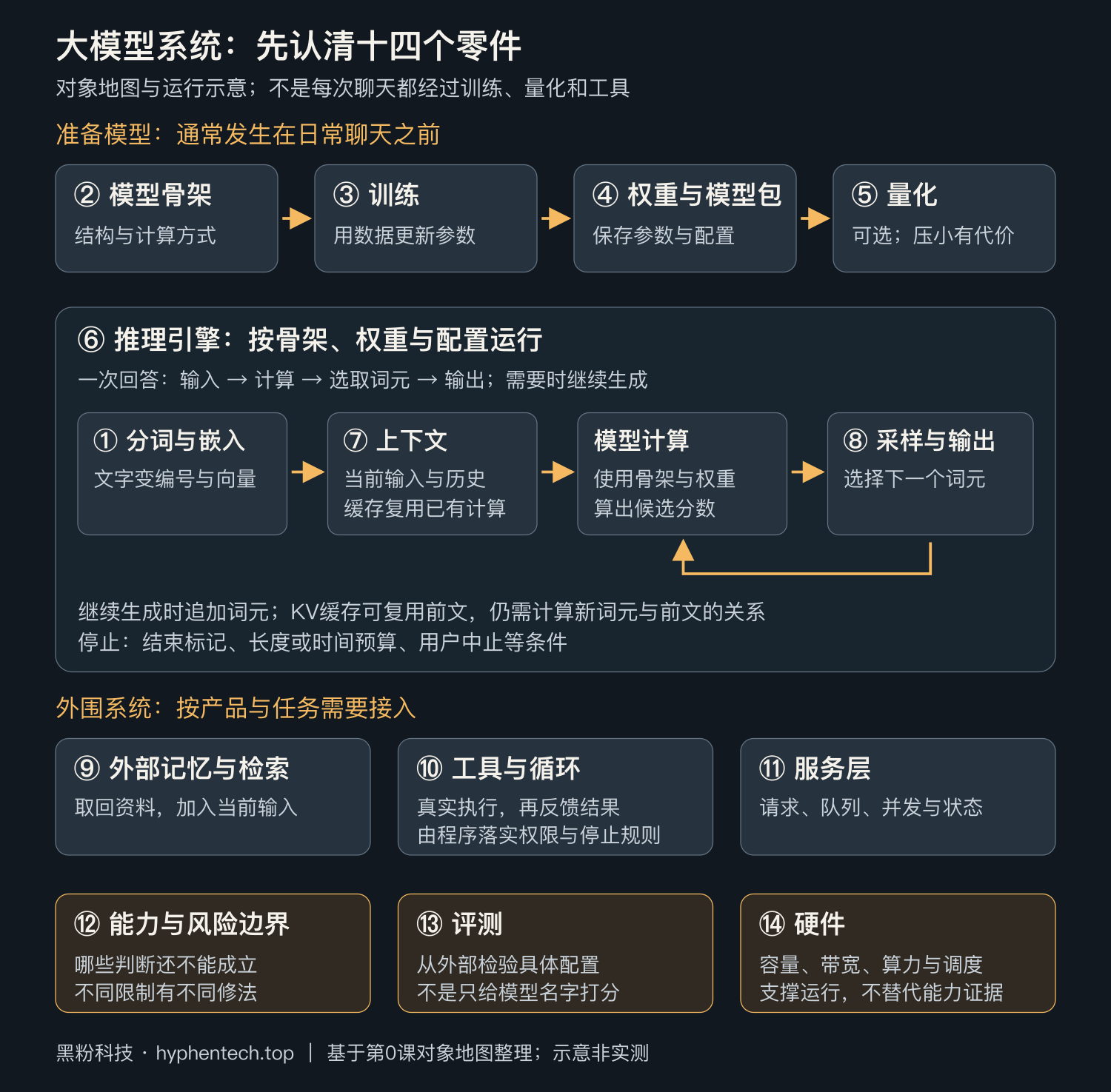
The most noteworthy part of the table below is the third column. Answering a random editor may not mean the search is broken; If the model doesn’t find a file, it doesn’t necessarily mean the intelligence is lacking; Just because the computer has enough memory doesn’t mean the toolchain can complete the task. Separate responsibilities for different parts so you won’t start downloading a larger model after one failure. Searching, tools, and quantization in the diagram are optional steps; not every conversation will go through them all.
| Parts and common terms | What does it mainly matter? | It doesn’t guarantee anything |
|---|---|---|
| (1) Segmentation and embedding: Word elements, vectors | Turn input into numbering and model usage | Completing the segmentation does not mean fact-checking; Vector similarity does not necessarily mean correctness |
| (2) Model framework: attention, expert network | Determines the structure of model calculations and the way information is exchanged | The capability of the finished product cannot be determined solely by the architecture name |
| (3) Training: Pre-training, fine-tuning, and preference optimization | Update parameters with data and goals | Regular chats do not automatically write new knowledge into fixed weights |
| (4) Weights: model parameters, checkpoints | Save the parameters obtained from training | Having weight does not mean having internet access, file permissions, or available services |
| (5) Quantization: Low bit weight | Reduces the storage and operational overhead of some weights | Not lossless compression; Quality and tool call performance may change |
| (6) Inference engines :llama.cpp, MLX | Load the model, perform calculations, and output results | Format recognition does not mean architecture can run; Implementation and template affect results |
| (7) Context and KV cache | Using current round input and history; Reuse existing key values for calculation | Long windows do not guarantee no omissions; Caching does not equal cross-session memory |
| (8) Sampling: temperature, candidate truncation | Select the next word from the output distribution | Lowering the temperature cannot stamp the facts |
| (9) External memory: Retrieval enhancement, knowledge base | Save the data, retrieve it, and then feed relevant segments into context | Saving does not mean retrieving it; Retrieving does not mean understanding or answering correctly |
| (10) Tools and Cycles: Agents | Hands the call to the program to execute, reads the result, and decides on the next step | Model completion does not mean the action is executed or accepted |
| (11) Service layer: interfaces, queues, timeouts | Allows clients to manage connections and tasks according to protocol requests | Endpoint readiness does not guarantee request success, low latency, or high concurrency |
| (12) Boundary: permission, authority, reliability | Clarify what can be done, what is permitted, and the scope that still needs to be verified | Opening up authority does not automatically mean arbitrary commercial use; Refusal to answer does not always mean a lack of capability |
| (13) Evaluation: samples, scoring, and acceptance | Check capabilities and task completion under clear conditions | A high score in a single subject cannot replace your actual work evaluation |
| (14) Hardware: memory, bandwidth, computing power | Resources are provided for weighting, caching, and computation | Loading capacity doesn’t mean fast enough; A single configuration can’t infer all tasks |
Try to locate three words in one minute: quantization at the model compression station; retrieval enhancement at the external data station; and agents at the tool execution and loop station. They can work together, but they solve three types of problems. **Quantization cannot replace data searching, data search cannot replace actual file saving, and file saving cannot replace acceptance. **Next, use an email to walk through this panoramic picture.
An email first unfolds the “AI.”
Suppose you send a collection email: “The other party is 10 days overdue and owes 8,000 yuan. Please be more polite, the amount and date cannot be changed, and no new commitments should be made.” This is an example of the process, not a new test.
The chat interface first assembles your request, the original email, and any conversation records you need to keep. Products that support system instructions may also include their own behavioral requirements. A sentence you see on screen may not be the entire content the model receives.
This explains a common misconception: why does the same model suddenly disobey when switching software? The model file may not change, but chat templates, default commands, and the history of screenshots may have changed. Hugging Face’s chat template documentation clearly reminds that message roles need to be converted into control tags accepted by the model; incorrect formatting can damage performance. Chat Template Explanation
Next, the word segment breaks the text into word elements and then converts them into numbers. Word elements can be words, characters, or smaller segments, not “a single Chinese character.” The model converts the numbers into vectors and, through a multi-layer network combining preceding information, calculates candidate scores for each word element next.
The sampling program selects output according to set rules, recalls new words back into context, and then generates subsequent content. Common autoregressive generation proceeds step by step; Several characters pop up at once on the screen, and due to transmission and interface buffering, screen animations cannot be counted internally.
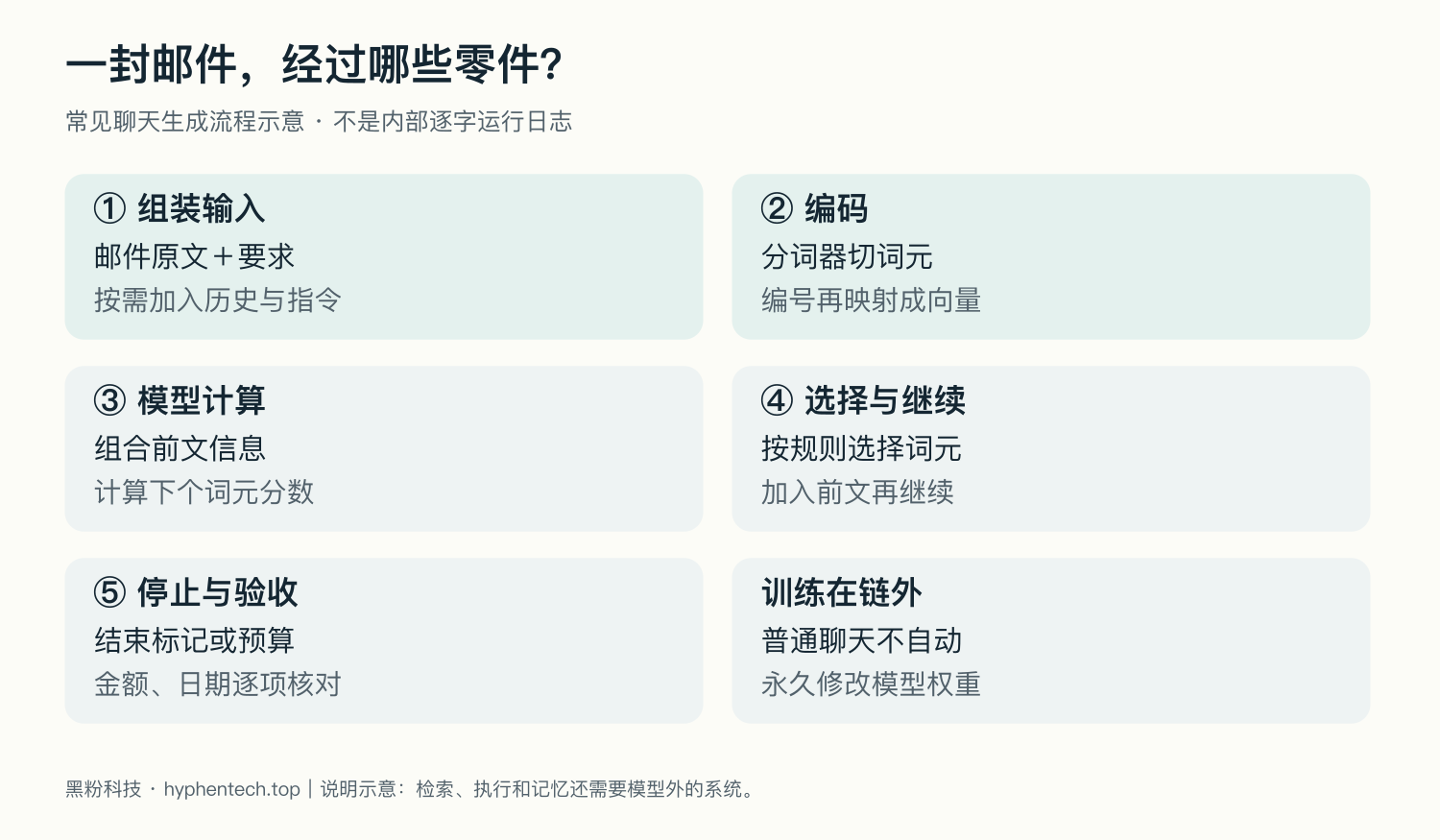
In this chain, word segmentation is encoding, network computing is the model, and sampling and stopping are the running rules. Training happens in another stage: ordinary chat reasoning does not automatically write your words into the model’s weight for every answer. Products can save chat records or user preferences, which is another layer of storage.
Grabbing the most important boundary in the email: to make it more polite is to generate a task; Whether the 8,000 yuan is maintained and if there is a new payment deadline is an acceptance task. The model writes a fluent piece of text, but it still doesn’t prove the email can be sent.
In 1966, it was just a rhetorical question, but people wanted to talk to it alone
You might think there’s something “knowing the answer” sitting across from the chat box. But there’s a long road between “answering like a person” and “understanding like a person.” In 1966, Joseph Weizebaum published a paper on the ELIZA program. It recognizes input by rules and turns some words into rhetorical questions, creating a sense of dialogue.
ELIZA has another intriguing story: Weiserbaum later recalled that his secretary wanted to talk to the program alone. What surprised him was not that the program suddenly understood life, but that people so quickly mistook the sense of conversation for understanding. Human trust sometimes outpaces the machine’s real capabilities.
Today’s models are far more complex than those rules, but that doesn’t mean the reminder is outdated. It says “I understand how you feel,” which first proves it generates a suitable sentence; Whether you can keep the amount, find the correct documents, and fulfill a task depends on the evidence separately.
Let a program that only remembers the previous character then write the “Three Character Classic”
import random
from collections import defaultdict

text = ("人之初,性本善。性相近,习相远。苟不教,性乃迁。教之道,贵以专。"
        "昔孟母,择邻处。子不学,断机杼。窦燕山,有义方。教五子,名俱扬。"
        "养不教,父之过。教不严,师之惰。")

follow = defaultdict(list)            # 记下:每个字后面出现过哪些字
for a, b in zip(text, text[1:]):
    follow[a].append(b)

print("“不”后面出现过:", follow["不"])

random.seed(7)
ch = out = "人"
for _ in range(30):                   # 一个字一个字往下“猜”
    ch = random.choice(follow[ch])    # 出现得越多,越容易被抽中
    out += ch
print(out)
True Output:
“不”后面出现过: ['教', '学', '教', '严']
人之道,性本善。性乃迁。苟不严,贵以专。苟不教不严,贵以专。教
“不” appears four times after “不,” twice being “教” (teaching), so the chance of drawing “教” is half the time. Every pair of adjacent characters it writes actually appears in the original text—“苟不” (not strict), “嚴”, “(strict)”—but when combined, they form a sentence like “If not strict, value focus.” **Because it only looks at the first character. **
A real large model does the same thing, but changes two things: it doesn’t look at the previous character, but the thousands or tens of thousands of words ahead; Its “next word list” isn’t counted, but calculated by a neural network with tens of billions to trillions of parameters.
This mini program is a reference, not a miniature GPT. It only counts adjacent characters; A true language model calculates more complex distributions through parameters and context. After laughing at “If not strict, focus is valued,” we have a specific question: it preserves partial collocations, so why can’t it preserve the meaning of the entire paragraph? The following questions about word types, attention, and training, then answer.
It’s all about “guessing the next word”—how can you handle complex tasks?
Mixing training goals with the skills you ultimately learn is where this problem tends to slip up the most.
To successfully connect “This code will report errors because of …,” training requires learning code structure, error patterns, and interpretation methods. To better predict across many different contexts, the network forms transferable patterns. Its output mechanism is still generating word tokens, but the output can express reasoning steps, algorithms, plans, and programs.
It’s like setting “writing the correct answer in the next line” as your practice goal; after practicing for a while, you’ll learn mathematical relationships, not just develop beautiful handwriting. This metaphor only explains the difference between goals and abilities, but does not imply that the model has the same understanding or awareness as humans.
Capabilities are not just based on pretraining. Instruction fine-tuning makes it more like answering requests, and subsequent training affects reasoning, preferences, and safety boundaries. The 2017 Transformer paper provided an important foundation for attention architecture, but today’s products also include engineering systems beyond the model. Original Transformer Paper
For users, the most valuable judgment is not whether it truly understands, but rather: can it still reliably complete the task by asking questions or using unfamiliar materials? If it can only repeat known answers and discard conditions when new constraints arise, the limits of capability are already exposed.
Search, memory, agents: Don’t let the model take all the blame alone
After the email is updated, ask it to “check the latest address of the other company.” This step requires current external information. Products that support search can call tools to bring the information back into the conversation; If you don’t call search and generate an address based solely on existing parameters, it shouldn’t be considered verified.
You also said, “Use this signature next time.” Whether it remembers depends on whether the software saves preferences and whether the preferences are handed over to the model next time. Remembering a conversation doesn’t mean you can restart, change accounts, or switch devices.
Finally, let it “send for me.” This skips the answer and goes into the tool to execute. It requires the email tool, account permissions, recipient confirmation, and the actual status after sending. A model saying “sent” and the inbox actually contain the email are two different pieces of evidence.
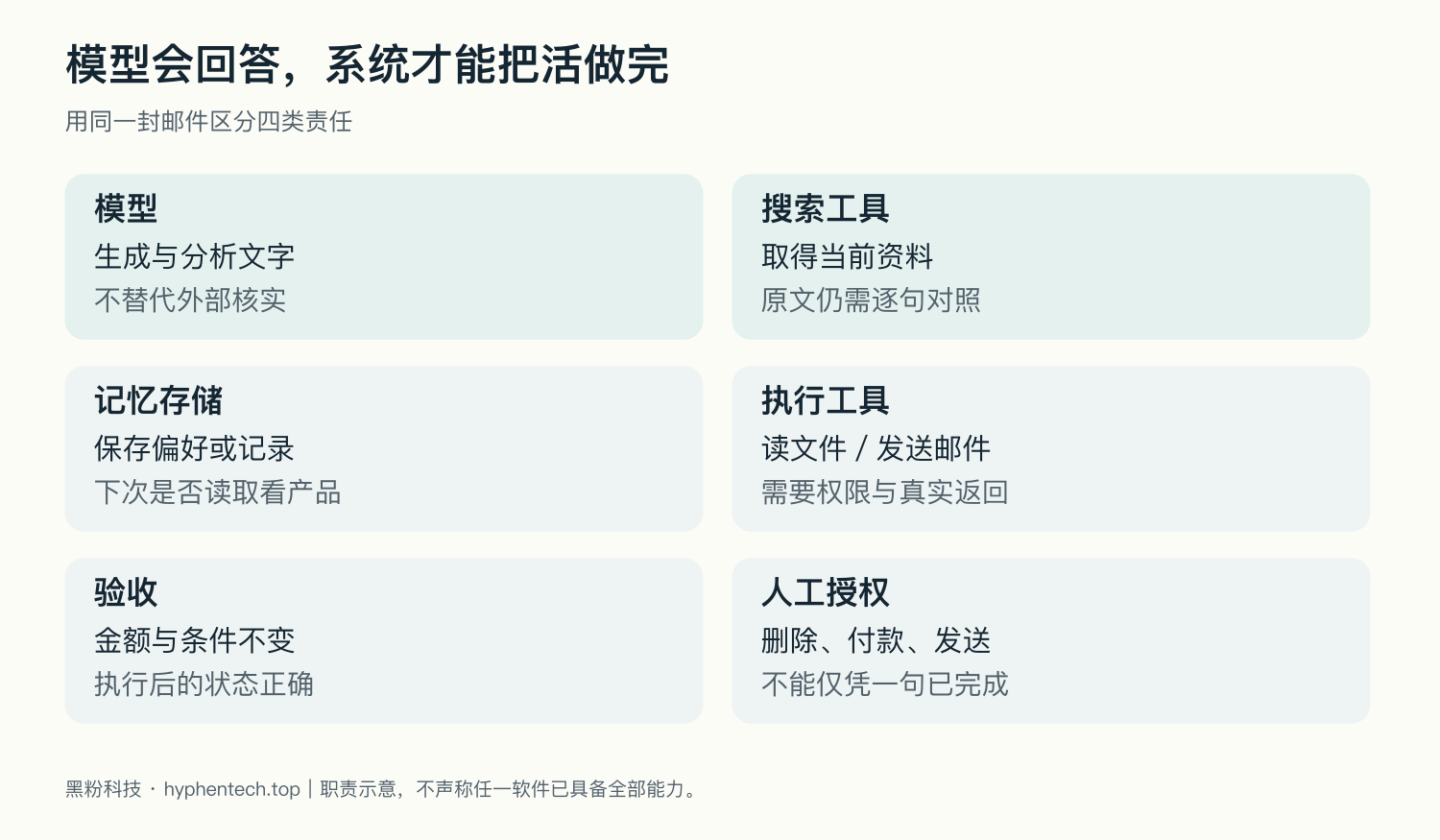
The same applies to local deployment. Toolboxes like LocalBrain connect models, voice, tools, etc.; Actual capability depends on the chosen model, running engine, and enabling tools. Having an entry point does not mean you have access to all the capabilities of every model.
Once responsibility is clarified, error-finding becomes clear: if you don’t know the latest news, check your search first; If you forget a signature, check your history and memory; If a tool isn’t running, check permissions and return values; The more you chat, the slower it gets, then check context, cache, and hardware. Every time you switch to a larger model, you might not fix these issues; instead, you might fill up the memory first.
A real error correction process: thinking, tools, and checking how to connect them
Below is not an abstract architecture diagram, but the old interface preserved in LocalBrain 1.4.6: the model first retrieves collision detection data, then writes to the file; the page self-checks errors, then after editing one place, it self-checks again, finally showing canvas presence, animation frame progression, and no console errors. The interface records a total time of 1 minute 30 seconds, 8 rounds, 9 tool uses, and 2 failures. From this image alone, you can distinguish “what the model says” and “what the tool does.”

In the screenshot, the error was reading the x attribute that did not exist for the object; The subsequent modification method first checks whether the object exists, then performs collision processing. The model’s generated explanation does not change the file itself; the real change is done by the editing tool. It says that after “fixed,” the next execution receipt must be checked; otherwise, it just writes hope in the past tense.
Breaking this process down into four parts makes it clear. The model proposes modifications based on existing evidence; Tools turn parameters into real file operations; Checkers report actual running status; Agents keep history and decide whether to continue or stop. They appear to work together like one person, but if any link fails, the answer can turn into a fake delivery.
Among the five problems, there is an even harder form: the model’s thinking has already said to fill in the input field, but the parameters still copy the failed text directly. Later, the system stopped leaving the error parameter for it to copy as is, but instead kept the failure fact and replaced invalid calls with placeholders. The smoke task in the original record changed from three consecutive timeouts to eight rounds of delivery. This change happened in the execution chain, not by secretly switching to a larger model.
This also explains why “think a little more” isn’t a cure-all. There are still several hurdles between correct analysis, correct parameters, successful execution, and acceptance. If you let AI create spreadsheets, it can explain formulas beautifully but write errors in the worksheet; If you ask AI to modify a website, it can accurately point out problems but fail to save files. Whether it’s smart or not ultimately comes down to action.
| Link | Evidence that needs to be preserved | Typical misjudgment |
|---|---|---|
| Analysis | Specific errors, original text, and correction methods | If the explanation is reasonable, just treat it as a solution |
| Call | Tool name, legal parameters, and scope of authorization | If you claim to carry it out, just treat it as real execution |
| The result | Tool receipts and current documents | Once the writing is successful, consider the content correct |
| Acceptance | Independent inspections covering needs are provided | If there are no errors, consider all functions correct |
| After the update | The new version revalidates | I changed one line and continued to use the old version’s passing result |
Of course, automation doesn’t mean people have nothing to do forever. Machines write documents for you, and the free time might be spent checking documents; They create a page for you, then want to make a whole set. Now I prefer to count the saved work together with the new reviews, rather than just counting “how many seconds it took to generate.”

Word meta, context, and cache: How to connect one knowledge point to the next
Word primitives sound like a basic lesson, context like another section, and hardware is the third section. In practice, they are a chain of cause and effect: text becomes word primitives, the topic, history, and tool responses occupy the context; The model processes input first, then generates output; Historical status requires caching and memory, and long tasks may repeatedly process input. In the end, it comes down to waiting, cost, and whether it can wrap up.
First, distinguish between two types of speed. Prefill is read from input, decoding is generated step by step. You see the model outputs many words per second, but that doesn’t necessarily mean it can deliver quickly: the wait time after sending, tool runtime, failed retrys, and final file check time are all wrapped in a single output speed number.
The depth scan I kept from September 27, 2026, is a good example of this. M5 Pro, Qwen3-8B Q4_K_M, llama.cpp b10357 generated 64 words at context depths of 0, 4096, 16384, and 32768 respectively, with two samples per level. The average generation speeds were 54.5, 48.9, 37.3, and 28.0 words per second, respectively. The model remained unchanged; after increasing depth, the last level was about 51.4% of the first level.
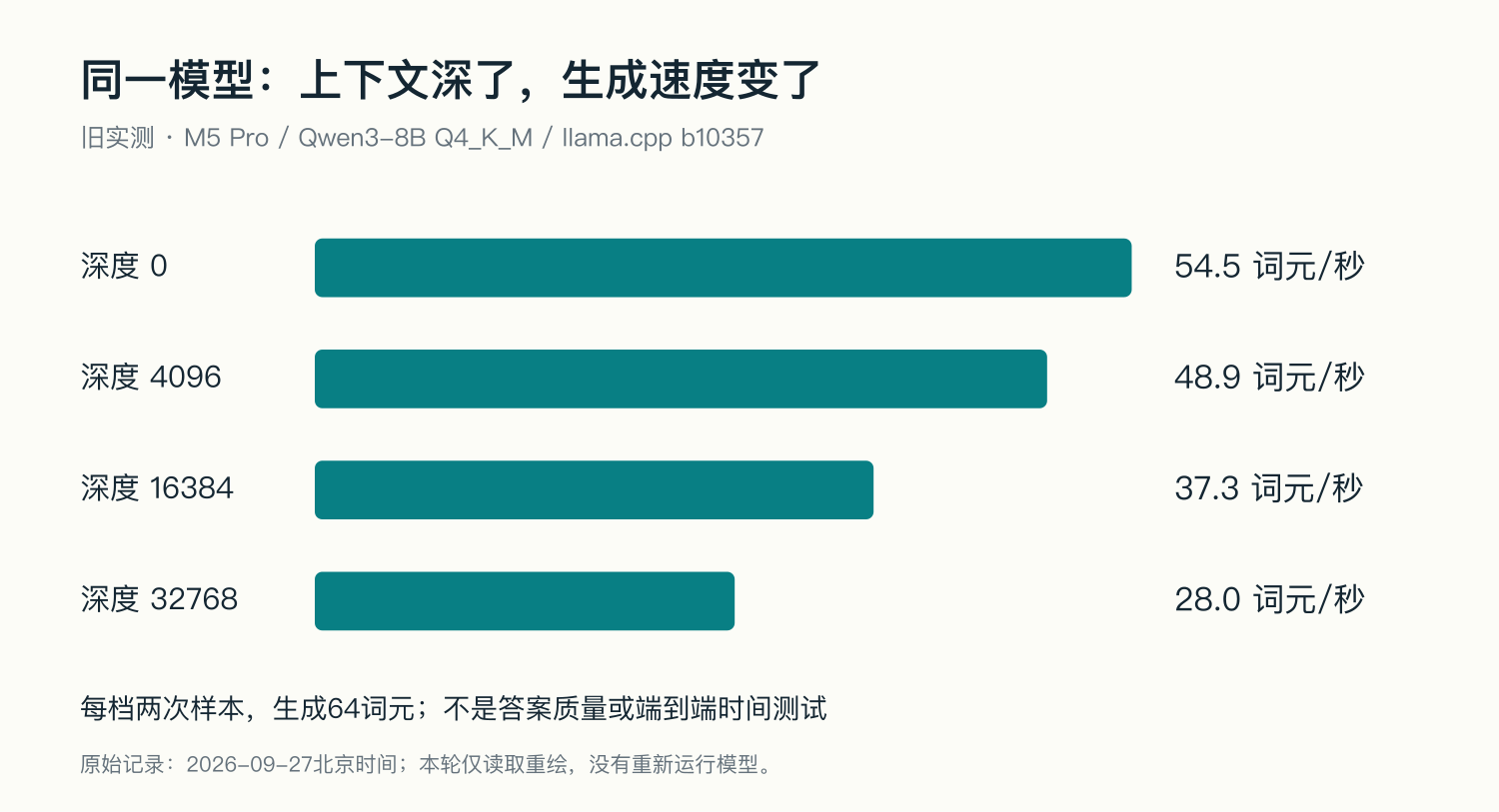
This is a specific configuration result, not “all long model dialogues are exactly halved.” But it is enough to break a misconception: the context window is only a capacity allowance, not a speed commitment. Labeling it as allowing long content doesn’t mean it’s worthwhile to cram dozens of failed rounds in. Repeatedly reading old errors each round wastes computation and may cause the model to keep copying errors.
In the recovery records for five questions, the system organizes the long history of 129446 word into 22418, allowing for more concentrated reading and error localization. This isn’t about clearing the past completely: original requirements, current products, and necessary states must be preserved. Excessive compression can forget constraints, so “less history” isn’t a rule that can be executed without looking at the task.
Caching is also often called magic. It can reuse prefixes that have already been computed when conditions are met, saving some redundant work; But if the previous message changes, the template changes, or the service restarts without restoring its original state, the benefits will change. Chat memory is responsible for saving and retrieving information, while calculation cache is responsible for reusing calculations; the two are not the same thing.
| A common saying | What was missed | What should you look up? |
|---|---|---|
| The word ‘primitive’ refers to the number of characters | Different text, leading spaces, and word segmentation will change the splitting | Actual counting and charging caliber for the same encoder |
| The bigger the window, the better | Memory, speed, effective information density, and recovery costs | Your own mission depth, delay, and failure record |
| If you have memories, you don’t need to repeat the request | Did the preferences be saved, and was it retrieved this time? | Will the new dialogue truly bring key constraints? |
| With cache, you don’t need to read history anymore | Cache matching and restart recovery conditions | The actual cache hit and input time on the server side |
| Local models have no cost | Equipment, disks, electricity, time, and maintenance | End-to-end time-consuming, occupying, and manual rework |
This is how the process unfolds from then on: word comes length, context, and cost; context then forgets, stall, and cache; tool then permission, execution, and acceptance. In the first issue, we first identify the connection points, then cover issues 5, 9, 16, and 22–26 in detail. You don’t need to memorize all parameters today; first know which level your problem should return to.
“Only knowing how to guess words” and “knowing everything” can easily mislead people from both sides
The first misconception is treating the output mechanism as the capability limit. The model generates word tokens, but these words can represent code, mathematical steps, and tool parameters. Just like we see in web problems, short output mechanisms can be combined into complex programs. The ability it requires comes from patterns learned through training; you can’t judge content as simple just because the output interface is simple.
The second misconception is exactly the opposite: because you can write complex programs, you assume it understands all the requirements. The ink scroll has images and interactions, but the classical text doesn’t reach the word count; The city has cars and roads, but a speed check fails. This shows that ability can be very strong, but it can also be overlooked in the same task. A single highlight cannot be signed for other conditions.
The third misconception is mistaking fluency for reliability. The goal of generating the target affects expression, but the truth of facts must correspond to the external world: company addresses need to be sourced, quotes must be based on dates, documents must be opened in the original text, and programs must be running. Models can say correctly and incorrectly in the same smooth tone, so “it answers confidently” can only describe the tone.
The fourth misconception is treating the product entry point as a model skill. Searching, reading local files, saving preferences, sending emails—all rely on software and tools. Equipping the model with a set of tools changes the boundaries of capability; Without these interfaces, no matter how large the model is, it won’t actually change the hard drive files with just one sentence.
The fifth misconception is assuming the demo passes as long-term reliability. A single page running is just a sample; Legal tool parameters don’t mean all business conditions are met; A one-minute success doesn’t mean it’s successful even after peak times, network outages, or reboots. To truly hand over the work, at least accept a complete task first, then gradually increase length, complexity, and permissions.
For individuals, these differences ultimately affect the choice: writing a copy you can check yourself and having a proxy edit dozens of documents for you are risky. Money isn’t just “cloud payment, local free.” Pay-as-you-go earns revenue through requests and usage, with hardware and software each having costs; What matters most to you is which path can complete tasks with less waiting, rework, and information exposure, rather than siding with a single company.
If stuck, first find parts, then look for the corresponding first phase
There’s also a more practical way to find them: don’t sort by terminology, but directly find entry points by symptoms. I’ve brought common questions into this 30-issue plan. The following are priority inspection directions, not the only cause of failure; The same symptom may be caused by different stages.
| The symptoms you encounter | What to investigate first | Corresponding to the series of content |
|---|---|---|
| The answer is confident, but the source doesn’t exist | Whether the original materials support the claim should not be used as evidence in a confident tone | Issue 28: Reliability and Verification |
| The same word count, but the bill is different | Segmentation, input/output tokens, and charging standards | Issue 5: Word Elements and Costs |
| After thinking for a long time, the mistakes were still remaining | Whether accuracy, wait time, and task rewards improve together | Issue 9: The Price of Reasoning |
| High scores on the leaderboard, yet endless tasks to complete | Whether the sample and scores meet the job requirements | Issues 14 and 24: Evaluation and Medical Examination |
| It says the file is saved, but it can’t actually be found | Tool calls, permissions, paths, and final readback | Issue 26: Tool Circulation and Acceptance |
| The parameters haven’t changed, but the answer suddenly diverges | Sampling settings, input templates and software versions | Issues 23 and 24: Sampling and Engines |
| They downloaded the model, but the software refused to recognize it | File formats, architecture support, and conversion conditions | Issues 15 and 24: Model Packs and Engines |
| The model can start, but longer tasks run out of memory | Weights, caches, working buffers, and system margins | Issues 16, 22, 23: Hardware, Caching, and Quantization |
| The more we chat, the slower it gets; after restarting, things change again | Context depth, cache hits, and recovery conditions | Issues 16 and 22: Speed and Cache |
| The knowledge base has already been installed, but the answer still misses the condition | Whether the retrieval segments are relevant, complete, and genuinely submitted to the model | Issue 25: Knowledge Base and Retrieval |
| The service shows ‘ready’, but the client still times out | Request paths, model loading, queuing, and service logs | Issue 26: Model Services |
| Not sure whether to choose a large model or a small model | Constraints on your own tasks, reliability, time, cost, and equipment | Issues 25 and 30: Model selection and final judgment |
This is how to complete the entire process in ten minutes: first find the position of an unfamiliar word in the panorama, then use a real symptom to find the inspection entry, and finally perform acceptance of a task. Today, you are not required to master all 14 parts; After reading, breaking down a failure into several checkable problems is already one step beyond ‘trying another model.’
How should 30 episodes be arranged? Each paragraph corresponds to a practical event
After seeing one answer and one delivery, now looking at the 30th issue’s plan, each name has its place. Issues 01–03 explain the panorama and origins; Episodes 04–16 break down the principles in original order; Issues 17–21 delve into real famous scenes; Issues 22–27 move into practical work; Issues 28–30 discuss boundaries. New models and hot topics are only added when understanding or choices can be changed, without following the press conference to disrupt the order of articles.
| Stage | Period | The problem you need to solve |
|---|---|---|
| Panorama and origins | 1—3 | Understanding the expectations of models and people, and looking back at the race between two winters and open weights |
| Disassemble the machine | 4—16 | Parameters, word values, vectors, attention, training, reasoning, followed by evaluation and hardware |
| A classic scene | 17—21 | Practice judgment through real breakthroughs and mistakes |
| Make use of it | 22—27 | Deployment, caching, quantification, sampling, evaluation, knowledge base, and services |
| Boundaries and choices | 28—30 | Illusion, scale, and your own choice |
Read them in order, and you’ll see how concepts connect layer by layer; You can also jump into the pitfalls you’re already stepping into. If the bill suddenly gets bigger, check out issue 5; if your model scores are nice but can’t get things done, check out issues 14, 24, and 26; if your answers aren’t reliable, check out issue 28. Below, I’ll clearly write about issue 30—there’s no need to buy new equipment just to read this series.
| Period | The article and the original text are the clues |
|---|---|
| 01 | Do you really understand AI? 30-issue overview: From a single answer, to models, evaluations, and local deployment; Original clues: Completed in ten minutes; You’re already using it—what exactly is a large model? |
| 02 | AI has experienced two winters, so why did it only make a comeback in 2012? Graphics cards, data, and the story of a game; Original clues: Three waves and two winters |
| 03 | GPT-2 was once considered too dangerous, but six years later it opened up its weighting? A download link behind the AI race; Original clues: The race between open source and closed source—2017 to present |
| 04 | Are neural networks really “brain-working”? Two knobs break down machine learning and chat memory; Original text clue: What exactly is a neural network supposed to? |
| 05 | Can the same strawberry be cut into 1 or 3 pieces? Token, movable type printing, and AI—three accounts; Original clue: token—the world through the eyes of the model |
| 06 | Embedding: Is similarity correct? 3 words, a vector space, and a misunderstanding of knowledge bases; Original text clue: How language became mathematics |
| 07 | Can Transformer remember 128K just because it can read it? Three misconceptions about the 2017 paper and QKV; Original clue: Transformer—the 2017 paper |
| 08 | AI can continue writing but refuses to answer? Pre-training, SFT, and preference optimization—how to train assistants through three steps; Original clues: from predicting the next word to being able to chat |
| 09 | Does the more reasoning models think, the more accurate they are? From 17.7% to 78.7%, the value and cost of a draft; Original text clue: Thinking models—what are reasoning models thinking? |
| 10 | Why does AI jump word by word? Following one answer, it passes through word segmentation, attention, and sampling; Original text clue: a journey through a conversation |
| 11 | Today’s territory; Original text clue: Today’s territory |
| 12 | The object being tested is a configuration; Original text clue: The object being tested is a configuration |
| 13 | Degree of openness - open source license vs. no censorship; Original text clue: degree of openness - open source license vs. no censorship |
| 14 | Three types of numbers on the transcript + benchmark map - Why scores can be deceiving; Original text clue: Three types of numbers on the transcript; Benchmark map - Why scores can be deceived |
| 15 | Open a model folder—what each file manages; Original clue: Open a model folder—what each file manages |
| 16 | Model of how big a computer can run—the three walls of memory, bandwidth, and hashrate + speed is calculated—from bandwidth to how many words per second; Original clues: Model of how big a computer can run—the three walls of memory, bandwidth, and hashrate; Speed is calculated—from bandwidth to how many words per second |
| 17 | AlexNet - The game won by two gaming graphics cards; Original clue: AlexNet - The match won by two gaming graphics cards |
| 18 | AlphaGo Move 37 - The move humans cannot understand; Original text clue: AlphaGo Move 37 - The step humans cannot understand |
| 19 | ChatGPT Million Users in Five Days - A Change in an Input Box; Original Clues: ChatGPT Millions of Users in Five Days - A Change in an Input Box Event |
| 20 | An open weighting model caused chip stocks to plummet in a single day; Original clues: An open weighting model caused chip stocks to plummet in a single day |
| 21 | A version specially tuned for the charts; Original text clue: A version specially tuned for the charts |
| 22 | First time running a model on your own computer + KV-cache video memory ledger; Original clue: First time running a model on your own computer; KV-cache video memory ledger |
| 23 | Quantization - Give model compression weight + sampling parameters to speak plainly; Original clue: Quant - Give model compression weight; Sampling parameters speak plainly |
| 24 | Conduct a health check on your model +MLX-llama.cpp-vLLM engine cross-sectional review; Original text hint: Conduct a health check on your model; MLX-llama.cpp-vLLM engine cross-sectional review |
| 25 | Ten models retained and who deleted whom + knowledge base external memory and RAG; Original text clue: Ten models retained and who deleted; Knowledge base external memory and RAG |
| 26 | Agent tool memory and feedback loop + service-ization—concurrent queue health check and resource arbitration; Original text clue: Agent tool memory and feedback loop; Service-ization—concurrent queue health check and resource arbitration |
| 27 | Give your machine a stat table; Original clue: Give your machine a stat table |
| 28 | Why illusions cannot be eradicated; Original text clue: Why hallucinations cannot be eradicated |
| 29 | Will the law of scale hit a wall? Original clues: Will the law of scale hit a wall |
| 30 | There is no best model; Original clues: There is no best model |
Issue 30 will follow the original sequence: first look at origins and competition, then break down principles, and finally move into iconic scenes, hands-on practice, and boundaries. Issue 4’s network, Issue 6’s Vector, and Issue 7’s attention will be rewritten as answers in Issue 10; Issue 8’s training and Issue 9’s reasoning will also be followed by evaluations and reliability assessments. Stories are not isolated, and concepts do not differ in each story.
These are plans, not the 30 already published articles. Each issue includes real-life examples, common misconceptions, and small exercises, with stickers and real stories added where appropriate; Formulas are provided when needed, and conditions are explained when results are needed. No promise of rushed daily releases: when explanations or evidence are insufficient, first clarify the issues; don’t treat readers as word count judges.
Why follow HyphenTech, and why bookmark the official website?
If you only want to solve one thing today, the previous articles and tool entry points are enough to get you started; If you want to judge for yourself later, just follow this series and continue reading. The official account and website offer two ways to read it: one reminds you of important content, the other lets you come back anytime to check all your knowledge and records.
I will continue to distinguish between official introductions, my own tests, and inferences, keeping the failure conditions useful for selection. What you get from paying attention here should be the criteria for judgment and available paths, not being pressured by a “stronger” adjective every few days.
**The official website and WeChat account arrange for complete articles to be synchronized, without creating a full version on one side and a shortened version on the other. ** All issues in the series, daily articles, self-made tool introductions, and publicly available resources are within the same scope. The official website regularly updates all publicly available content; The official account series articles will be organized as a collection under the theme “Do You Really Know AI?” "Compilation. The formatting and attachment entry points can vary; knowledge, evidence, and key explanations are not deleted; Private knowledge bases, vouchers, and internal logs are not within the public scope.
The purpose of subscribing is to avoid having to look up again every time you remember something. **The first issue of this series will be pushed, and subsequent issues will continue to be published, but not mass-posted individually. ** Additionally, important changes, test-worthwhile tests, practical resources, and stage summaries will be regularly compiled; Some highlights will not be publicly promoted to everyone, but will only be pushed to readers who follow or subscribe via the official account. Following “HyphenTech” is the gateway to receive these selected messages and series reminders.
| How do you want to read it? | Recommended entry | What can you gain? |
|---|---|---|
| Don’t want to miss important content | Follow and subscribe to the HyphenTech official account | Featured pushes, important updates, and stage summaries; Not every post is posted in bulk |
| I want to make up the lessons in order | The official website series directory, along with the official WeChat account plan compiled “Do You Really Know AI?” “Collection.” | Read the complete text synchronized with regular reading; Follow-up content will be supplemented as it is published |
| Come back when problems arise | Add hyphentech.top to your browser favorites | Complete articles, previous content, tools, and public resources; Regularly updated and browsed |
“Pushing only to subscribers” refers to message reach, not a lock where you can only read public articles after being followed. Public articles can still be read through links; Whether you receive notifications each time also depends on WeChat settings and platform display. You can use selected reminders like official accounts, or actively watch full updates on the official website—these two methods complement each other.
If this approach is helpful to you, follow “HyphenTech” and add HyphenTech official website to your favorites. The official account is used to receive featured content and stage reminders; The official website is for checking full content, catching up classes, and finding resources. Subsequent articles and supporting materials will be continuously updated as they are published, so it’s worth opening them regularly rather than just saving today’s article. On a computer, press Ctrl+D; on Mac, usually Command+D; In WeChat, you can copy the URL to your preferred browser for favorites.
Today, let’s do a little exercise: take a piece of email you can publish or desensitize, list “what needs to be changed” and “what must never be changed,” then check the model’s output item by item. You’ll find that smoothness, correctness, and send-out ability need to be checked separately. Next time, we’ll break it down from here: Why can it make errors look so real?
Verify sources and boundaries
- Official Explanation of Chat Templates
- Transformer Original Paper
- Complete official website content entry
In the next issue, we’ll rewind to around 1958: Why did a thoughtful learner endure two winters to reach today?
Next article: In 1958, people were already expecting machines that would learn. It took decades before it truly changed the industry. The middle was not a straight upward curve, but a story of promise, disappointment, and old ideas finally meeting the conditions.
🧰 Tools I build
I maintain all of these tools myself. Preview builds are clearly labeled; the release pages are the source of truth for downloads, updates and known limits.
Info: HyphenBox Status: Official releases
A radar for free LLM APIs: availability is re-tested continuously, one local interface for all of them, and keys stay on your machine
Info: LocalBrain Status: Official releases
A multimodal MCP toolbox for local models: TTS, Whisper and video generation in one place
Info: ScreenLex Status: Official releases
Learn new words while you watch shows. Free, for Mac and Windows
Info: HyphenScreen Status: Official releases
Screen recording and smart editing in one: a DaVinci-style timeline, automatic redaction and a check of the finished video before export. Free
Quote: HyphenTech Make AI your superpower Local deployment · Free resources · Self-made software https://hyphentech.top
Late nights and burned API credits went in,a cup of tea comes back out — only if you feel like it.
Scan with WeChatPress and hold to save the image, then open it from your album in WeChat Scan

Comments
Loading comments…