
Info: Machine translation This post was machine-translated from the Chinese original. Wording may be rough in places — the Chinese version is authoritative.
Summary It’s easy to lose middle numbers in mental arithmetic, but vertical math is more reliable. The model also learned to leave a draft first, but waiting a few seconds for the same problem means you get the correct answer or a longer incorrect explanation. HyphenTech · 2026-10-05
17.7% to 78.7%: A zero-shot chain-of-thought study in 2022 reported such accuracy changes in MultiArith tasks. The numbers are beautiful, but what exactly do they prove? It’s not that just letting any model “think more” will be more accurate; rather, specific models, prompts, and answer extraction processes have clear benefits in specific problem sets. Let’s break down this difference from decimal problems, paper equations, and reasoning training.
The previous article separated the training objectives of the completion machine and the assistant; This article continues to ask: Why might writing about intermediate processes help, what extra is done in specialized reasoning training, and what extra calculations are worthwhile? The issue isn’t that longer drafts are better, but whether the extra budget can be exchanged for acceptable results.
For the same decimal question, the knowledge base leaves two answers
Let’s first look at a famous “point giveaway question”:* which is bigger: 9.11 or 9.9? **
The knowledge base record from September 11, 2026, is handed over to Qwen3.6-35B-A3B-Uncensored-4bit (Qwen3.6), first turning off the “Think” switch to ask once, then turning it on again to ask:
| Time | How many tokens were output | Answer | |
|---|---|---|---|
| Reflection Barrier | 0.3 seconds | 4 | 9.11 ❌ |
| Think it over | 6.2 seconds | 456 (of which 450 are “wants”) | 9.9 ✅ |
These are two questions with four old records, not for this round of retesting, nor for a general success rate. In the records, the switch and recommended sampling configuration change simultaneously, so the differences cannot be entirely attributed to the switch. **With the switch off, it gave an incorrect answer in 0.3 seconds; When the switch was on, it first wrote a draft of 450 tokens, took twenty times the time, and got it right. **
The value of this table is not in accuracy statistics, but in concretizing costs: one time gives 4 words in 0.3 seconds, another in 6.2 seconds to generate 456 words, with 450 words marked as thinking. It takes about 20.7 times the time, and output about 114 times more; These two multiples cannot be mixed into the same ‘cost’. The complete original output needs to be completed, and switching and recommended sampling change simultaneously, so you can’t attribute all differences to thinking.
Compare carefully, at least fix the problem, model version, tools, sampling and evaluation rules, then explain which reasoning settings were changed, and repeatedly count success rates and delays. Explain the control variables clearly to understand what this extra calculation regains.
Comparing by decimal, 9.9 is 9.90, which is greater than 9.11; by software version, “9.11” may be later than “9.9”. The same string can enter different rules. Version number interference is a possible explanation, but without analyzing the internal calculation, it cannot be determined that it was the actual reason for the wrong answer. Clearly stating the question type first is more useful than writing a mental activity for the model.
Then look at another question: “When I was 6, my sister was half my age. Now I’m 70, how old is my sister?” This time, both models were answered correctly (67). But the time I started thinking, it still took 7 times longer and I wrote 384 more tokens of draft.
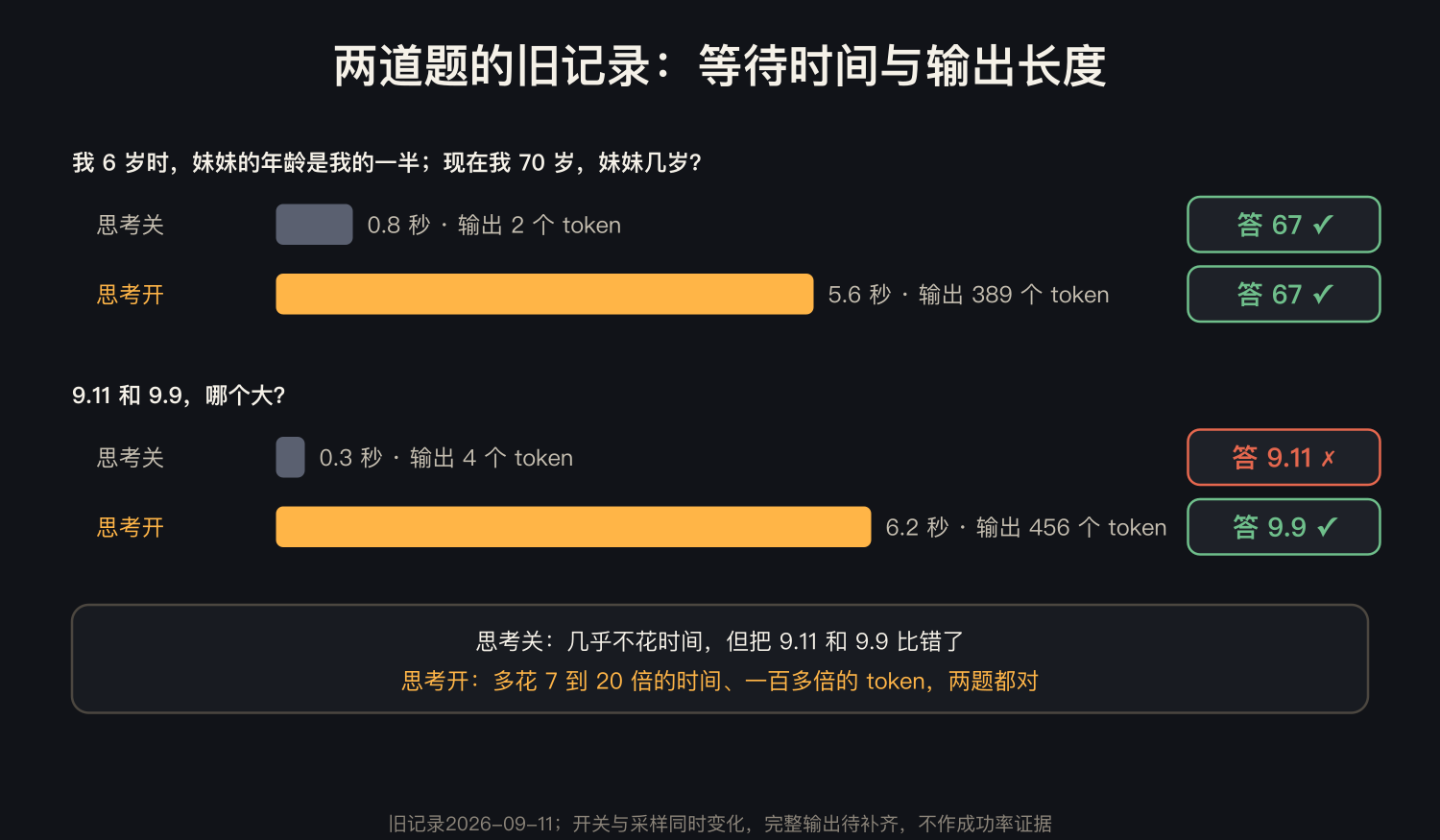
Two questions and four old answers show a very intuitive trade-off: thinking might change the answer, but it also changes the waiting and generation overhead. Four records are insufficient to estimate reliability, and you can’t deduce “the switch is right as soon as you flip it.”
“Thinking” actually means drafting the idea first
After starting to think, what exactly is the model doing? Let’s dig through the draft of those 450 tokens, and it starts like this:
Here's a thinking process:
1.  **Analyze User Input:**
    - Question: "9.11 和 9.9 哪个大?只回答那个数。"
This old record reveals part of the draft text, indicating that intermediate steps can appear as word sequences. But the English draft does not prove it “finds English more user-friendly,” nor does it guarantee that interface text is the entire internal process. Whatever is observed, it is said first.
Why can writing steps sometimes help? First, compare with something you can independently check, rather than relying on a model’s self-statement.
Think about your own mental arithmetic 37×48: You have to remember several intermediate results in your mind at once, which makes it easy to make mistakes; Take a piece of paper and write a vertical diagram for it, and you’ll be much more stable. **Vertical calculation doesn’t make you smarter; it just writes the intermediate results on paper, so you don’t have to remember everything at once. **
Generating drafts adds prefixes that intermediate steps can be used for subsequent calculations. This gives the model the opportunity to continue deriving from the results already written; The KV cache can reuse part of the previous computation, rather than redoing everything from scratch. **Drafts can help like vertical or pass down the first step errors all the way. **
Write 37×48 as 37× (50 − 2), resulting in 1850 − 74 = 1776. At this point, the two middle numbers remain on paper, so there’s no need to rely solely on “I calculated it” afterward. You can also check in reverse: Is 1776÷37 48? This is a manual calculation case, not the current model test.
But if you write 37×50 as 1800 in the draft, the details will follow the wrong number. The actual check should be recalculated or verified using independent methods, not just a single sentence of “confirmed correct.” For the model, visible steps increase the chance of checking, and it does not automatically prove those steps are the true causal explanations for the answer.
| What you change | What it might offer | Nothing can be launched yet |
|---|---|---|
| Step-by-step tips | Explicit intermediate steps | Model weights have been updated |
| Reasoning training | Useful problem-solving strategies are more common | Every question is more accurate |
| Multiple candidates plus validation | Compare different answers with test results | Free and with no extra budget |
| Summary of Interface Thinking | Some notes are provided for readers to check | A complete internal verbatim process |
One sentence, “think step by step,” quadrupled the accuracy
Two representative studies in 2022 made “writing out the intermediate steps” a widely discussed prompt method. They are not the historical starting point for all stepwise reasoning ideas.
In early 2022, Google researchers found that when the model was shown several example problems with “write out the steps to solve the problem,” it would follow along and perform much better on math problems. They called this approach the chain of thought—having the model write out the intermediate steps of reasoning.
In a 2022 research report by Kojima et al., MultiArith improved its accuracy from 17.7% to 78.7% on text-davinci-002. The method generates an intermediate process by step-by-step thinking prompts and then extracts the answer; It cannot be compressed into “all else unchanged, just add one sentence in Chinese.” Original paper
In 2022, besides MultiArith, the experiment also reported GSM8K scores ranging from 10.4% to 40.7%. The two groups of improvements differed, reminding us not to replace a beautiful number with a universal guarantee. The paper’s zero-shot chain of thought process also included answer extraction, not just adding a Chinese reminder to any chat box.
This method uses existing models and changes the answering method through prompts and processes, which does not mean retraining parameters. Results are not purely luck: tasks, models, prompts, and extraction rules are all worth systematically comparing; But a single successful example cannot replace measurements on representative question sets.
2024: From “Let It Think” to “Teach It to Think”
On September 12, 2024, OpenAI released o1, placing trained reasoning behavior and the computational input before answering at the core of the product. Compared to the “think step by step” prompt method, this also involves training how to reward problem-solving strategies, rather than just having it automatically write an extra paragraph.
OpenAI’s o1 study also puts “how to answer” alongside the scores: in AIME 2024, the average o1 sample was about 74%, 64 samples reached about 83% consensus, and about 93% of 1,000 samples were rearranged using the learned scoring function. The same model has different calculation methods and different numbers. You can’t write 83% as the accuracy rate for randomly asking once; This just shows that the budget during testing is also part of the score. Official Research Explanation
Training hash power affects how the model learns, and during testing, hash power affects how much computation is willing to invest in the same task. OpenAI observed the relationship between the two and improved performance in the o1 study. **Giving a little more time sometimes leads to better results, but it’s not a one-dimensional answer for every problem. ** This is the value of hash power during testing, and the reason budgets need to be recorded separately.
It’s like allocating checking time when solving the same question: you can submit the paper directly, write out formulas, recalculate, or compare several independent drafts. Whether the extra effort is valuable depends on whether it finds errors, not just how many words are written on paper. For the model, the extra calculations added during answering may be used for longer intermediate steps, more candidates, or validation; Different methods lead to different scores and waits. The previous sets of numbers are meant to be read together with these answering conditions.
How do you teach it to check drafts?
How o1 is trained has not been officially released as a complete formula. Four months later, the DeepSeek-R1 report revealed another approach; It can help us understand reasoning training, but it cannot be the answer to o1’s internal practices.
In January 2025, DeepSeek will publicly release R1 and its training methods. The experimental version of R1-Zero starts with the already pretrained DeepSeek-V3-Base, and does not include supervised fine-tuning before this stage of reinforcement learning; It is not a blank sheet of paper that has never read any problem-solving materials. Official Training Introduction
The official R1 isn’t just a simple renaming of Zero. The official training process includes cold start data and multi-stage reinforcement learning and supervised fine-tuning. Treating all the features of the experimental version as the training process for the official product erases key differences.
R1-Zero trains with rewards such as verifiable correctness and formatting. You can think of it as feedback that scores results and rules—not just the teacher checking the last line and ignoring everything else.
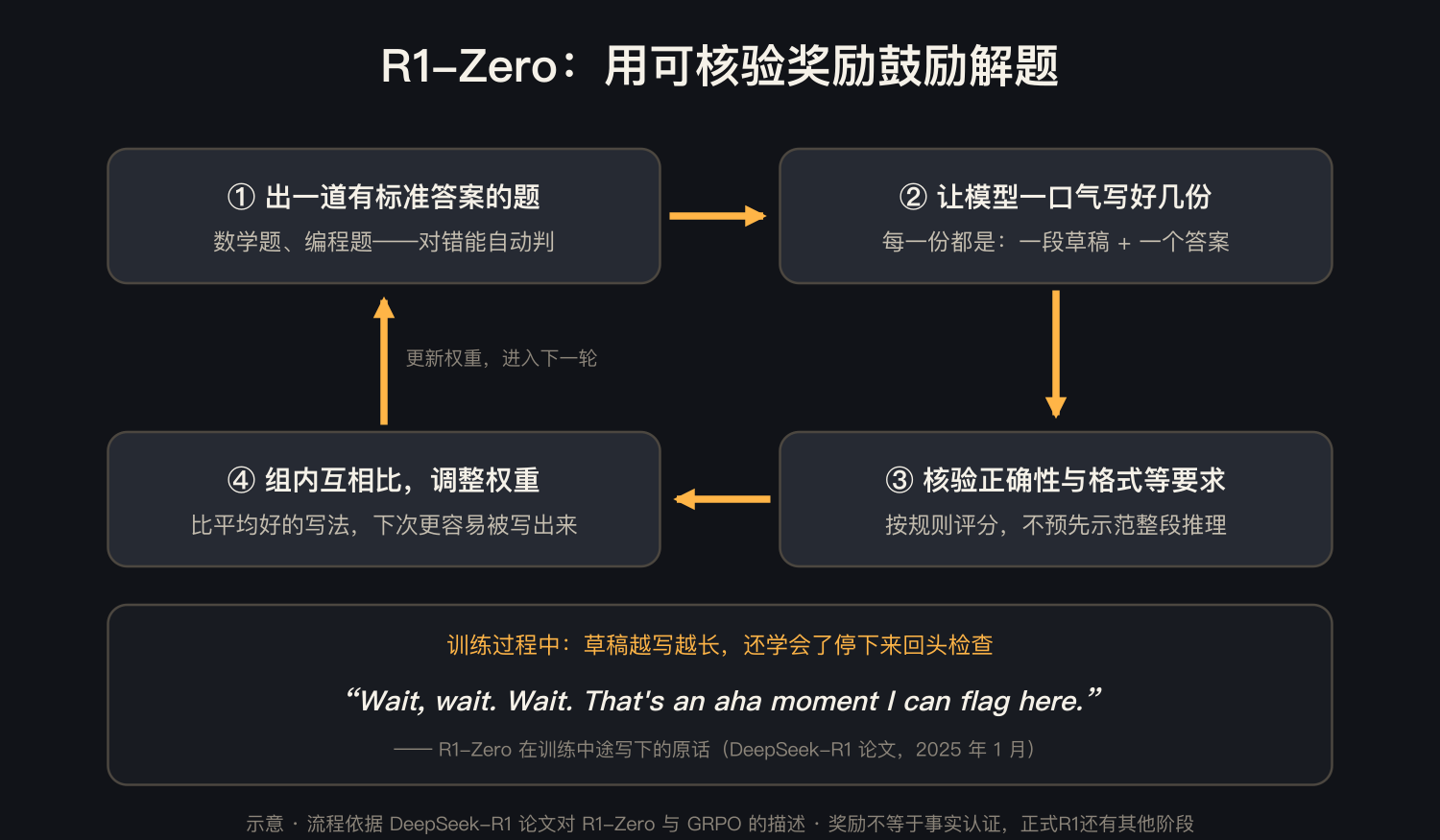
If certain checks, recalculations, and splits are rewarded more frequently, training may increase the likelihood of these behaviors occurring. It requires a large number of candidates, evaluations, and parameter optimizations, not just mastering general thinking out of thin air after getting it right on the first try.
R1-Zero is trained with rewards, such as rule-based correctness and formatting. Mathematical answers can be verified, and programming questions can be checked through tests; Group relative strategy optimization GRPO compares the rewards of a group of candidates for the same problem to drive more favorable behavior. It does not require training a value model of the same scale as the strategy, but this does not mean no scoring is needed, nor does all reinforcement learning only look at the last line.
Group relative strategy optimization can be understood by borrowing several drafts of the same problem: first evaluate according to rules, then compare which group is relatively better, and use these signals to adjust subsequent generation tendencies. Here, it’s not about who writes the longest, but about what the evaluation rules actually reward. Reinforcement learning updates parameters; Giving the trained model a bit more time to solve problems is considered computational input when answering. One is to change the approach during training, the other is to spend extra effort on this task; the two budgets should not be mixed.
No one told it to “think step by step.” But halfway through training, the researcher noticed its draft getting longer and longer, and even started to review its own train of thought. The paper recorded a sentence it wrote in the middle of a problem:
Wait, wait. Wait. That’s an aha moment I can flag here. (Wait, wait, wait.) This is a “moment of insight” that can be marked. )
The paper presents this kind of self-checking behavior as an interesting observation. It can explain that the generation strategy changes after training, but it cannot simply say “wait” to identify the owner’s epiphany experience as the model’s own. The story is interesting, and the boundaries of evidence must also be left behind.
Thinking about it costs money
Back to the table at the beginning. Thinking isn’t free; it comes at least three costs:
- Slower. After opening the two questions, I started thinking about them and were 7 times and 20 times slower, respectively.
- More expensive. Drafts are also word elements. Whether it is visible, how to bill, and how to enter the completed budget depend on specific service rules; do not guess the bill based on screen word count.
- Consume the quota and context. When running on your own computer, this is the easiest to overlook: you set “write up to 400 tokens,” but all 400 are eaten by the draft, leaving not a single word in the official response—this is a truncation risk to check. If the software re-feeds the draft into subsequent input, multiple rounds of context may continue to bloat, so Qwen’s model card specifically recommends: only the final answer is left in the history, not the thought process.
Inference budgeting increases the input for generation or other calculations, thereby affecting waiting and costs. Whether specific services are charged by word elements and how to limit the budget depends on the version and instructions used; This article does not treat any old rate as the common bill for all products.
Some models and products offer think switches or budget settings. Qwen3, released in April 2025, can be switched by the enable_thinking overall switch or by adding /think or /no_think after a sentence to switch by round; Many models also support “think budget,” limiting the maximum number of tokens it can consider.
When to turn it on and when to turn it off?
| Perfect for thinking | Suitable for Guan Xiang |
|---|---|
| Mathematics, logic, multi-step reasoning | Idle conversation and pleasantries |
| Write code and find the mistakes in the code | Translate, rewrite, and polish |
| Issues that require comparison and trade-off | Look up a simple fact |
| Getting the wrong answer comes at a high cost | Scenes requiring instant reply |
**What does this have to do with reviews? ** For the same model, 9.11 and 9.9 questions are answered incorrectly while thinking, and correctly answered with the answer open. Therefore, “whether you started thinking and how much thinking budget was given” are configurations that must be clearly stated on the transcript — if not clearly stated, scores cannot be compared at all. When comparing two report cards, also clearly state reasoning budget, tools, and sampling configurations.
Also, pay attention to differences in question types. If facts are outdated, even thinking for ten minutes won’t get a newly issued notice out of thin air; At this point, you should check the source. The problem requires precise calculations, so you can hand the steps to the calculation tool for verification. If action is needed, read back the file, outbox, or target object. Increase the budget for reasoning; do not replace these three types of verification.
So I prefer to ask first: which step is most likely to go wrong, and what kind of evidence can detect it? Then decide on the budget. When comparing models, separate the initial word wait, thought length, tool time, and final correctness. One correct answer is worth keeping, but to make it evidence of stable capability, it needs to be repeated and covered.

Flip the switch with your own hands
The easiest way: open any chat app with a “Deep Thinking” button (DeepSeek, Doubao, Qianwen, etc.) and ask with the button off, then ask again when the button is open:
- “Which is bigger, 9.11 or 9.9?”
- “Fold a rope in half, fold it again, fold it again, then cut it down the middle. How many segments does it make in total?”
Pay attention to three things: Are the answers the same both times? How long did you wait when you opened the button? In its thought process, did you mention words like “Wait” or “I’ll check again”?
If the rope question uses the usual setting of aligning both ends, folding it three times in a row, and cutting the middle section after folding, it will pass through 8 layers, equivalent to 8 cuts on the original rope, resulting in 9 segments. If the question changes the cutting position, rope end, or folding method, you cannot directly cover 9 segments. Keeping the conditions is more useful than memorizing a “bonus answer.”
Back to the question at the beginning
Nor do all reasoning systems write only one long draft. Some generate multiple candidates, call validation tools, or assign calculations through other strategies. The “thought summary” shown by the interface is not necessarily a complete verbatim record of internal processes.
Ordinary step-by-step prompts require existing models to write out intermediate processes; Specialized reasoning training can reward generative behavior that has a higher chance of obtaining correct results. The two can be combined, but they are not the same thing. The previous 17.7% to 78.7% of historical experiments first show that the prompting method was effective for that set of tasks; you can’t just use this number to declare that all reasoning training has been explained.
Drafts provide usable intermediate results, reasoning training can encourage more effective checking behaviors, and additional candidates and validations can change computational allocation. All of these may have benefits and require validation. What is truly worth preserving is not “waiting longer means smarter,” but the relationship between time, configuration, and verifiable results within the same task.
Several terms that appear in the story
| Terminology | Plain speech |
|---|---|
| Reasoning models | Specifically optimized for multi-step reasoning and similar behaviors; Internal processes may not be fully visible |
| Chain of thought | Write out the intermediate steps of reasoning step by step |
| Test-time compute | The calculated budget invested when answering; Returns vary depending on the task and method |
| Reinforcement Learning RL | A training approach that updates and generates strategies based on reward signals, allowing the model to figure out its own methods |
| GRPO | DeepSeek’s reinforcement learning method: write several copies of the same problem and compare them within the group |
| Think about the budget | How many tokens can be considered for a limited model? |
| enable_thinking | Some switches used by Qwen templates; Cannot be applied to all models |
Next article: The parts have been disassembled, now put them back. Follow “Today’s Weather Really True” into a translation agency that only recognizes numbers, see how a sentence turns into probability, then into text on your screen.
References
Self-made software
Versions, changes and supported installers all come from the same public release records.
LocalBrain
Turn your Mac into a private AI toolbox for transcription, speech, images, video and MCP tools.
View public downloads and updates ↗HyphenBox
A free model API radar and local router, with ongoing availability checks and keys kept on your device.
View public downloads and updates ↗ScreenLex
Turn subtitles from your own films and shows into an English vocabulary library, entirely offline.
View public downloads and updates ↗HyphenScreen
Screen recording and editing with a Resolve-style timeline, automatic redaction and pre-export checks.
View public downloads and updates ↗Late nights and burned API credits went in,a cup of tea comes back out — only if you feel like it.
Scan with WeChatPress and hold to save the image, then open it from your album in WeChat Scan



Comments
Loading comments…