
Info: Machine translation This post was machine-translated from the Chinese original. Wording may be rough in places — the Chinese version is authoritative.
To keep adding objects, changing scenes, and then having shots move along a specified path during generation, it used to require re-generating or stitching together multiple clips. The problem Tencent Hy-Nomas aims to solve is to keep the same video world developing continuously with text and camera commands.
Currently, the most noteworthy aspect isn’t just a demo image, but two entry points that have already been implemented: Hy-Nomas official model page lists model assets and offline inference instructions, and also provides configurations for a single NVIDIA GeForce RTX 4090. However, “single card support” only means the official runtime path is provided; it doesn’t mean ordinary graphics cards can run it, nor has the generation speed been independently verified.
It doesn’t generate a blocked video
Hy-Nomas generates worlds by segments. Each round allows users to continue inputting subjects, actions, appearances, styles, and environmental changes, and can also provide camera trajectories, changing observation positions and movement patterns. The official calls this capability free-form multi-turn interaction.
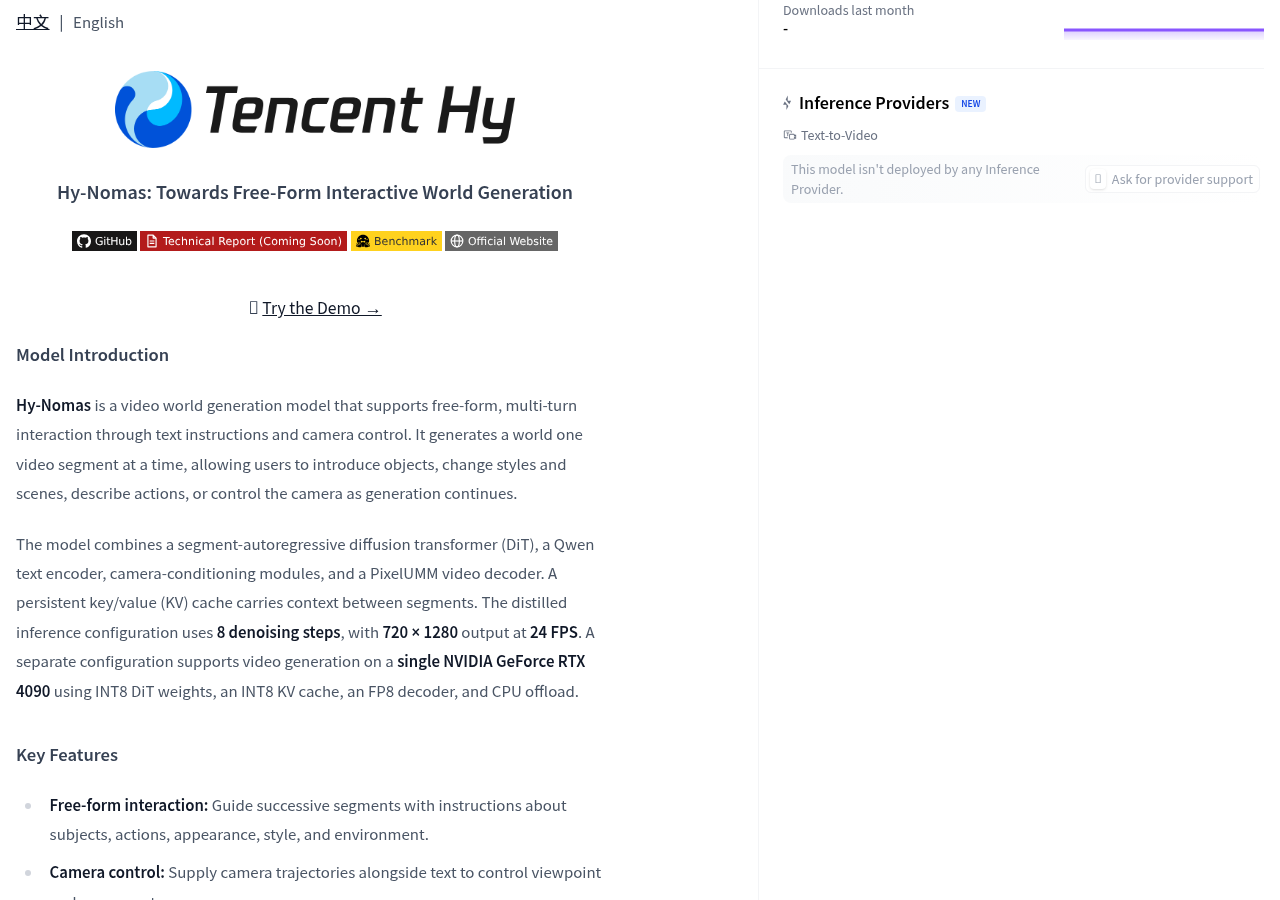
You can think of it as a continuous conversation in WeChat: the later message doesn’t open a new chat window, but continues from the previous context. Hy-Nomas also generates segments in sequence, preserving the context of previous segments through KV caching. This analogy only explains “how to generate next”; The model does not truly understand a world because of this; its continuity is still affected by caching, prompting, and generation errors.
- Text can add objects, actions, or scene changes in subsequent clips.
- Camera trajectories can control perspective and movement along with text conditions.
- The same world can continue to expand without starting from a completely blank state every time.
- Distillation inference uses 8 DiT denoising steps, with default output of 720 × 1280, 24 FPS.
The weights have been listed, but “open” does not mean “one-click operation”
The official model page lists assets such as distilled DiT, INT8 quantized DiT, basic autoregressive DiT, DCAE-V, PixelUMM decoder and its FP8 version, and states that the DiT, VAE, and PE directory structures in the repository should be retained. Standard offline inference also requires matching PixelUMM checkpoints and Qwen/Qwen2.5-VL-7B-Instruct text encoders.
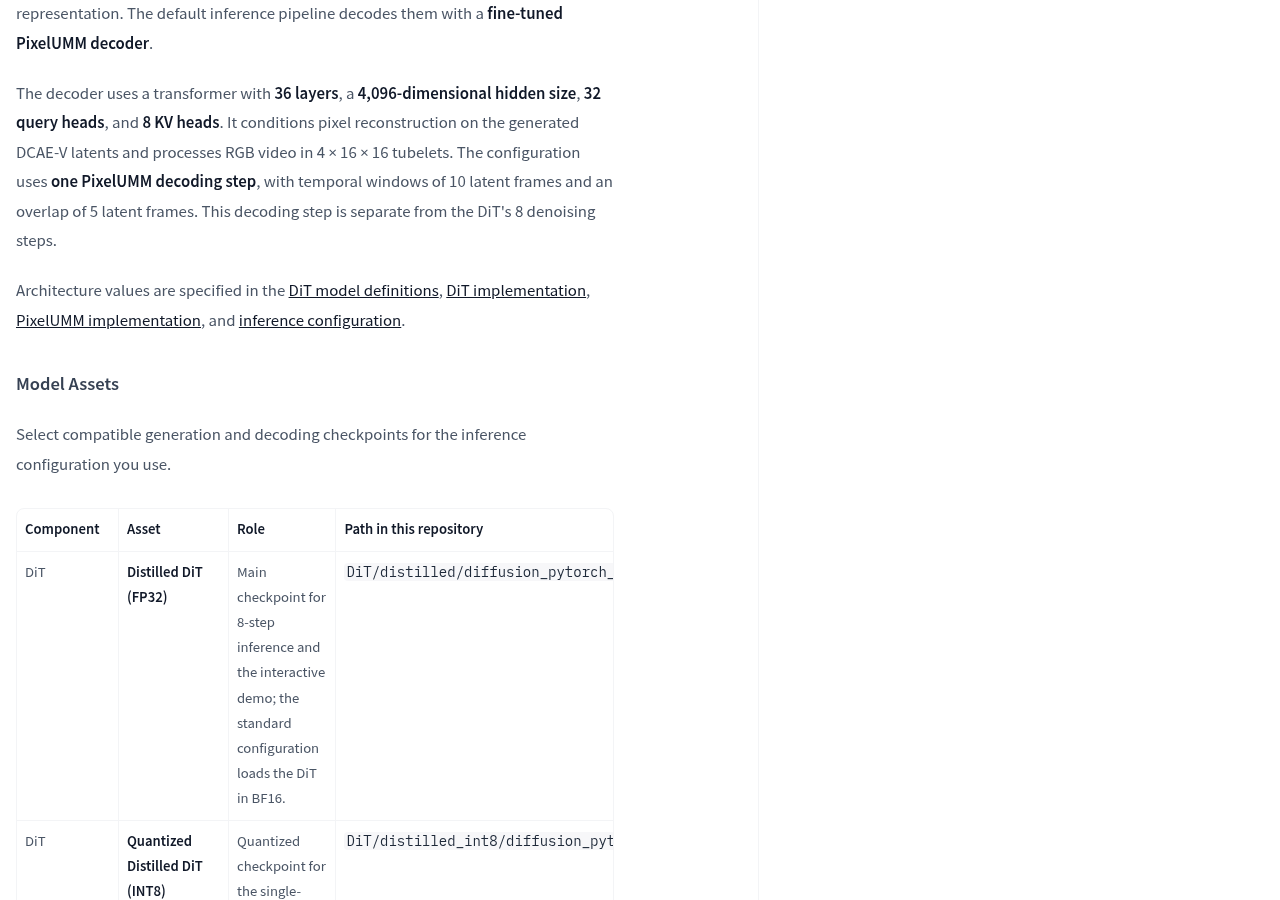
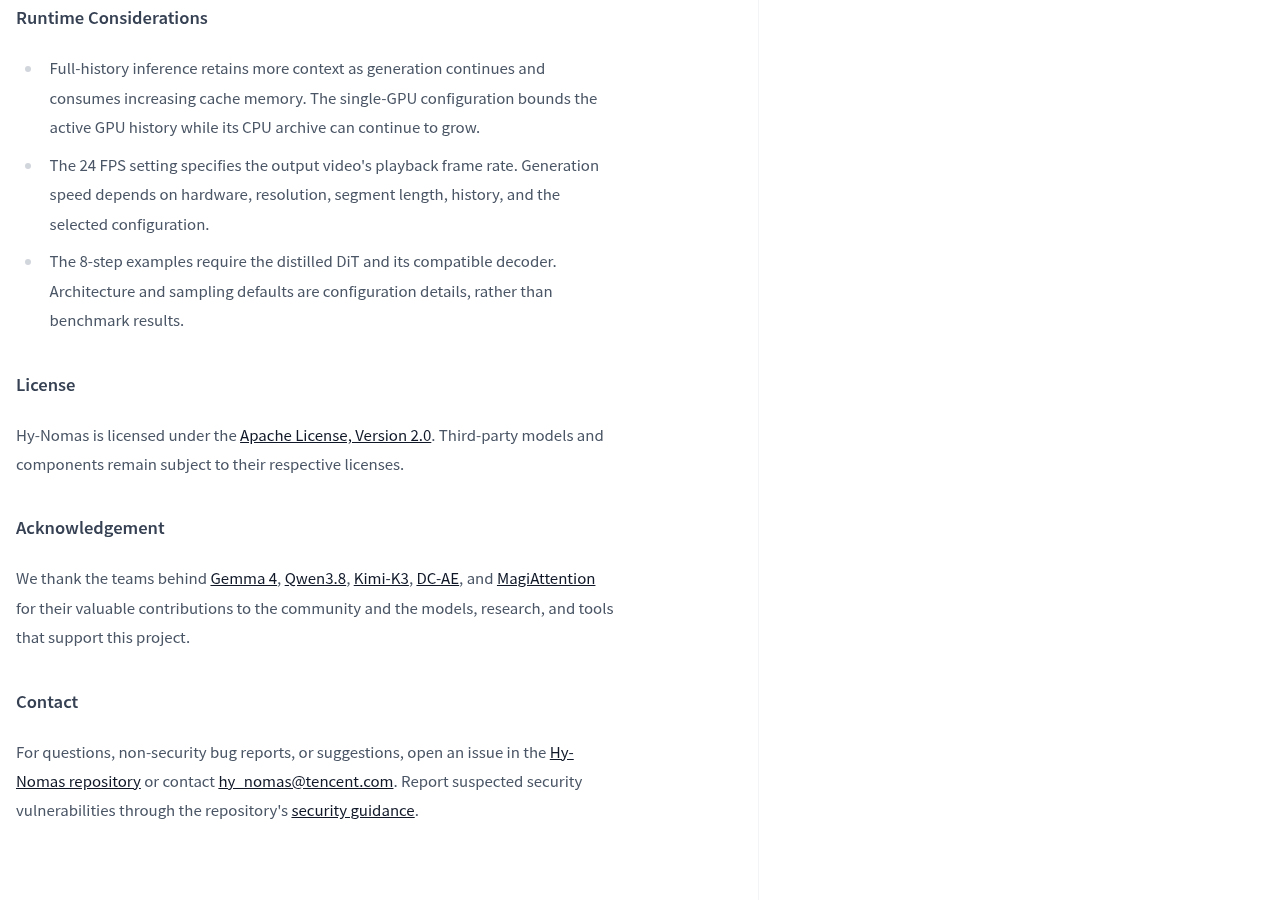
The model uses the Apache License 2.0, but third-party models and components are still subject to their respective licenses. Therefore, being able to download Hy-Nomas files only addresses the level of “whether the file is open”; Whether the license, runtime environment, supporting components, and hardware are suitable still needs to be checked separately.
The standard plan and the single-card plan do not cost the same package
The standard configuration uses 8-channel serial parallelism and distributed PixelUMM decoding, with eight GPUs from the same inference group required by default. The official recommendation is to use a prepackaged Docker environment; Manual installation requires Linux, Python 3.12 or above, CUDA 13.0, C++ compiler, and the corresponding PyTorch and attention kernel.
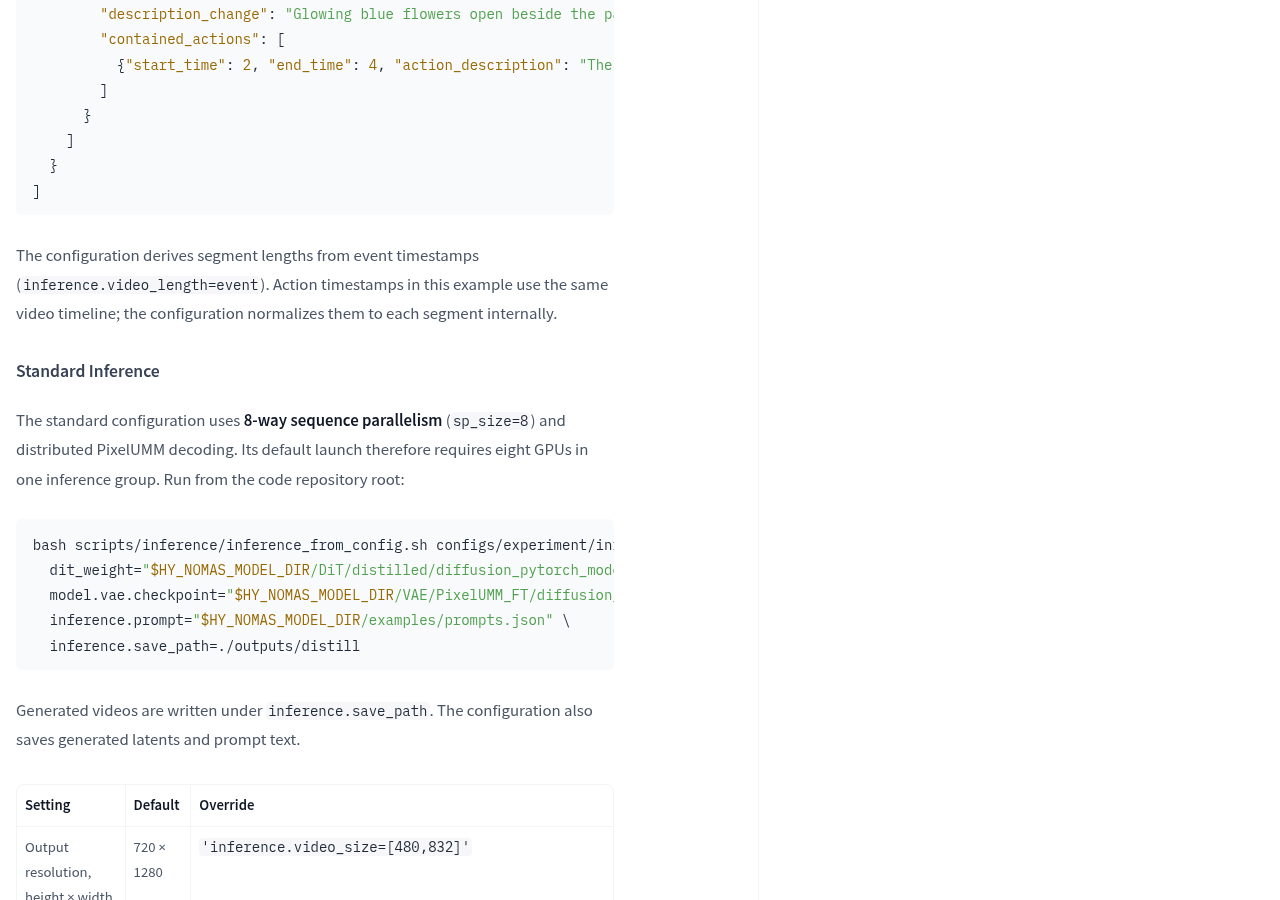
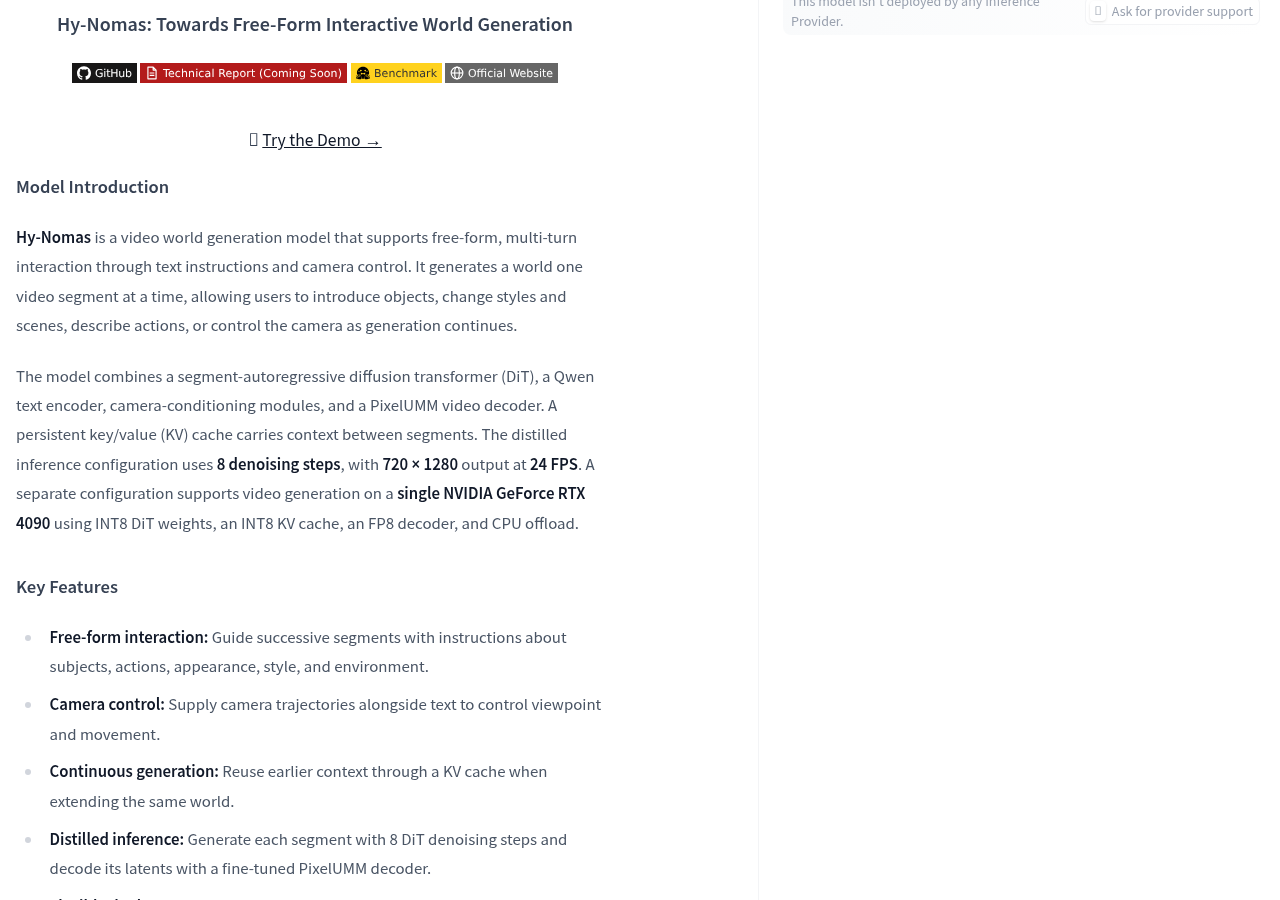
The single-card configuration is for an NVIDIA GeForce RTX 4090: DiT weights and KV storage use INT8, decoders use FP8, and text encoder, DiT, and decoder are transferred between CPU and GPU in processing stages. It changes sequence parallelism to sp_size=1, while retaining default settings like 720 × 1280, 24 FPS, and 8-step DiT denoising.
| Project | Standard configuration | Single RTX 4090 configuration |
|---|---|---|
| Parallel method | 8-channel sequence parallel | sp_size=1 |
| DiT checkpoints | Distilled DiT, standard configuration loaded with BF16 | INT8 quantifies distillation of DiT |
| Video decoder | Matching PixelUMM checkpoints | FP8 PixelUMM |
| Historical context | Preserving the complete history | The GPU can select up to 18 historical latent variable frames, with earlier historical archiving to the CPU |
| Additional cost | Eight GPUs are needed to form an inference group | Relying on CPU offloading and increasing transfer latency between CPU and GPU |
All of the above are official configuration descriptions and are not standalone performance comparisons.
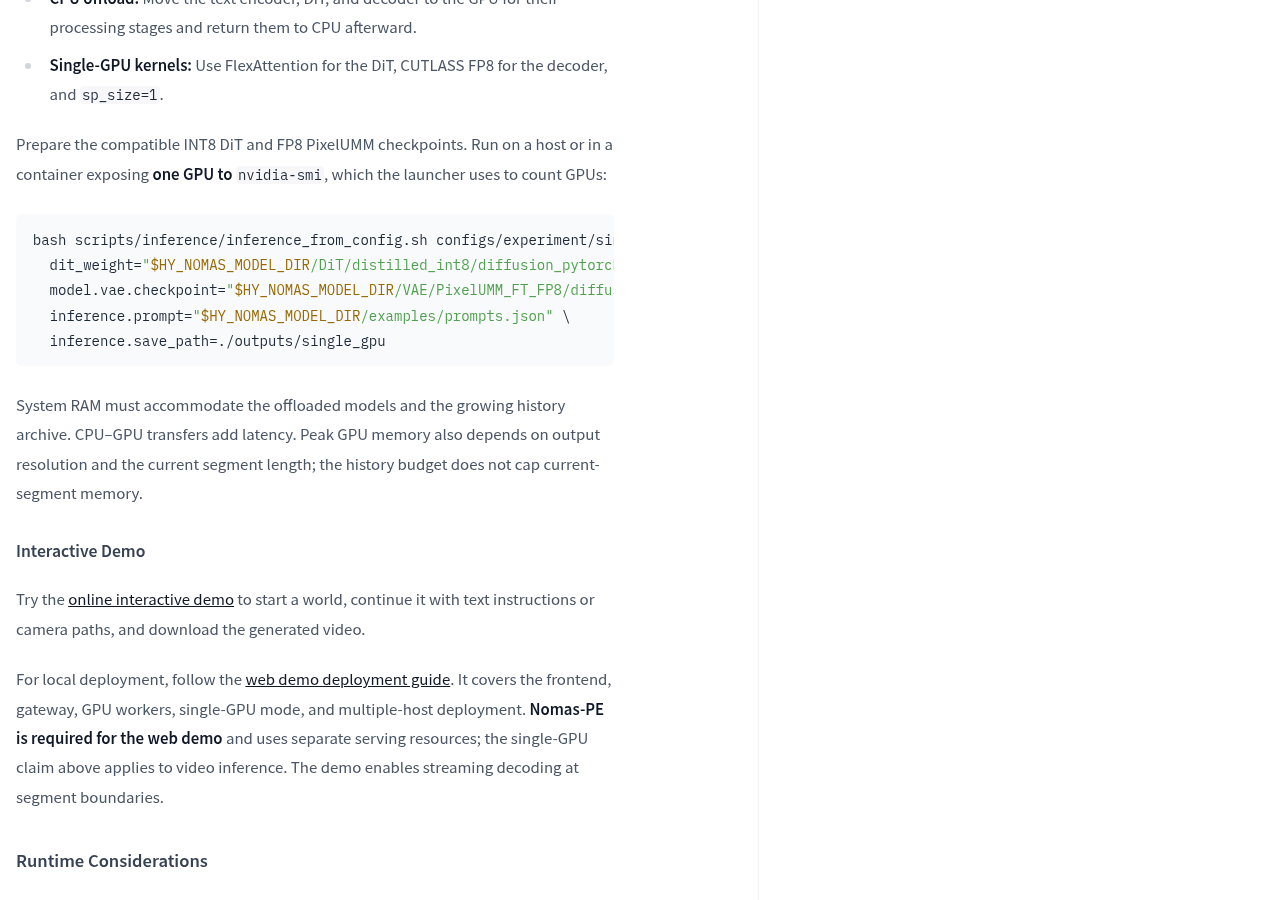
Warning The official does not label a “single RTX 4090” as light operation. System memory must accommodate uninstalled models and continuously growing historical archives; peak video memory is also affected by resolution, current segment length, and selected configuration. The official statement also clearly states that the 18-frame historical budget only restricts historical context and does not limit current segment usage.
KV cache keeps the world connected and leaves bills
KV cache can be analogized to a courier station storing pickup records: when a new package arrives, the system can check previous records without having to re-register all information. Hy-Nomas reuses the attention keys and values of previous clips when generating the next segment, allowing the new clip to reference the generated history.
Saving records also takes up space. Standard configurations retain complete history; the longer the world is generated, the more cache memory may increase; Single-card configurations limit active GPU history to a certain range, but earlier content is still archived to the CPU. This reduces GPU side pressure but does not eliminate system memory growth and data transfer delays.
Online demos, offline reasoning, and evaluation suites should be viewed separately
Online demos use a separate Nomas-PE service to convert user instructions into structured prompts; Offline inference can directly read prepared prompt files. Nomas-PE is an independent service required for web presentations, so the official claim of single-GPU video inference cannot be directly expanded to “a complete web service that only requires one card.”
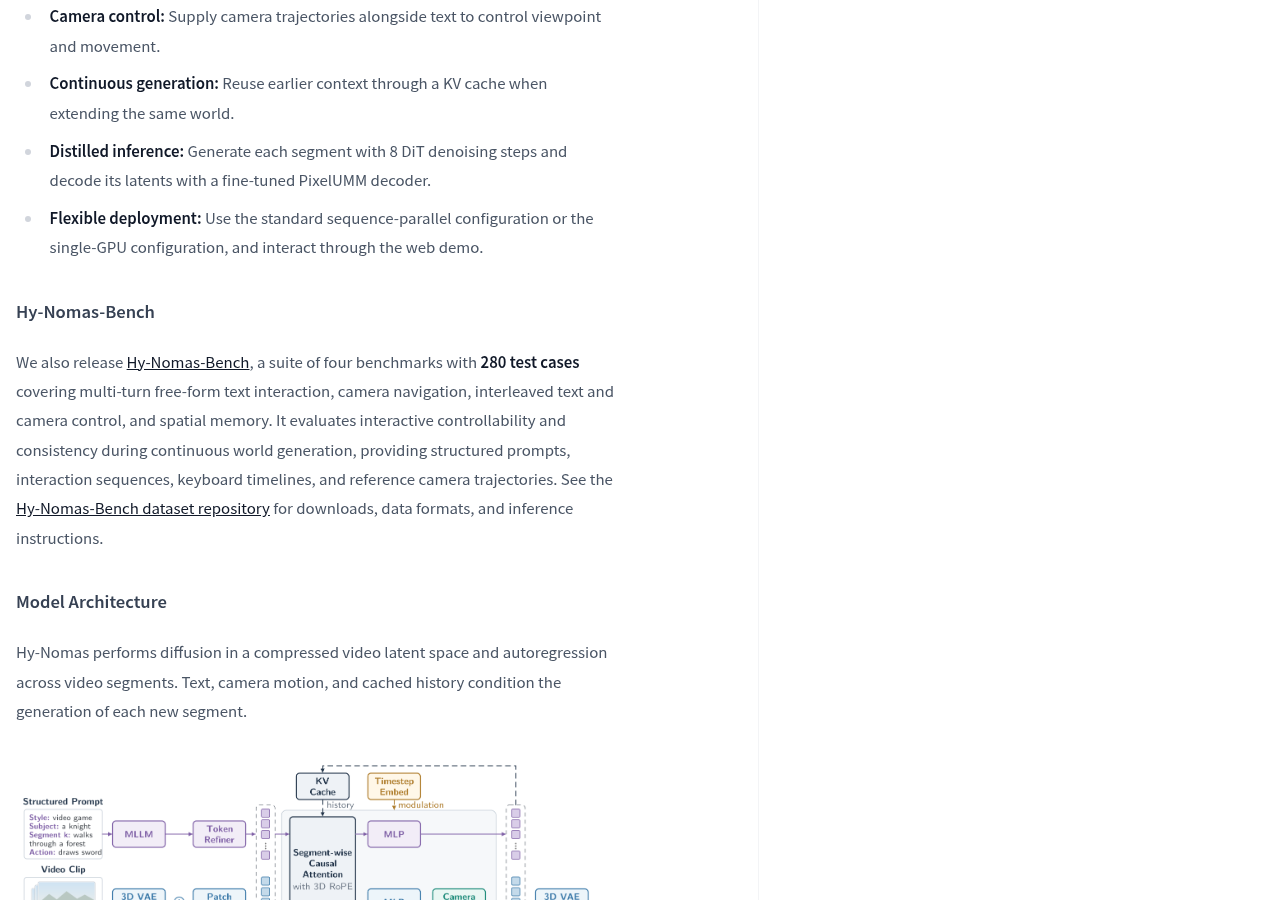
The official Hy-Nomas-Bench has also been released, containing four sets of benchmarks and 280 test cases, covering multi-turn free-text interaction, camera navigation, text-camera interleaving control, and spatial memory. The current material describes the test scope and data structure, but does not provide scores for independent horizontal evaluation, so it cannot be inferred that it has outperformed other video world models.
Now is the right time to choose
- If you just want to see the interaction first: you can use the official online demo to observe whether continuous clips, text modifications, and camera controls meet the needs of the task.
- Prepare for local deployment: First, confirm that Linux, NVIDIA drivers, Docker or CUDA 13.0 environments, model assets, and Qwen text encoders are all complete.
- Only one RTX 4090: using official single card configurations and matching INT8 DiT and FP8 PixelUMM, you can’t freely mix standard checkpoints.
- Long-term generation is required: focusing on recording system memory, peak memory, single-segment time, historical growth, and continuous changes; This data currently cannot be directly derived from the configuration description.
- Using LoRA: The official explanation states that the INT8 loader does not support loading LoRA separately during inference. Before selecting the quantization scheme, confirm whether an adapter is needed.
Hy-Nomas has already moved beyond the stage of “concept demos only, no model assets” and has provided a clear inference path for RTX 4090. It is better suited for users willing to handle Linux, quantization checkpoints, CPU offloading, and multi-component dependencies; If you expect an ordinary computer to generate an infinite world with one click, current official materials do not support this judgment. The next truly useful acceptance step is not to look at the sample again, but to record on the target machine whether it can boot, the time spent per segment, memory growth, lens control accuracy, and whether the world remains consistent after multiple rounds of modification.
Official information
Self-made software
Versions, changes and supported installers all come from the same public release records.
HyphenAssistant
Continue your computer’s DeepSeek Harness session from a phone browser. The service, computer and network must stay online; model costs follow your existing setup.
View public downloads and updates ↗LocalBrain
A local AI toolbox for transcription, speech, images, video, and MCP tools. Features vary by platform version.
View public downloads and updates ↗HyphenBox
A free model API radar and local router, with ongoing availability checks and keys kept on your device.
View public downloads and updates ↗ScreenLex
Turn subtitles from your own films and shows into an English vocabulary library, entirely offline.
View public downloads and updates ↗HyphenScreen
Screen recording and editing with a Resolve-style timeline, automatic redaction and pre-export checks.
View public downloads and updates ↗Support HyphenTech
Late nights and burned API credits went in,a cup of tea comes back out — only if you feel like it.
Save the QR codeScan with WeChatPress and hold to save the image, then open it from your album in WeChat Scan

WeChat tips · Any amount welcome



Comments
Loading comments…