
Info: Machine translation This post was machine-translated from the Chinese original. Wording may be rough in places — the Chinese version is authoritative.
DeepSeek has launched DeepSeek-V4.1-Flash-1017 on Hugging Face. Officially, it is a minor update to DeepSeek-V4.1-Flash, but the release notes mention a note: the model has improved in reasoning, programming, agent tasks, and visual benchmarks, and the official statement clearly states “reducing task execution time and output length,” aiming to help users complete tasks faster and at lower cost.
This statement deserves more attention than the score increase. Scores are the results on the exam paper; execution time and output length represent the actual waiting time and costs. The official inclusion of the latter in the release goal shows that this optimization direction is not just “smarter” but also “more economical.”
Which official ratings do the improvements actually help?
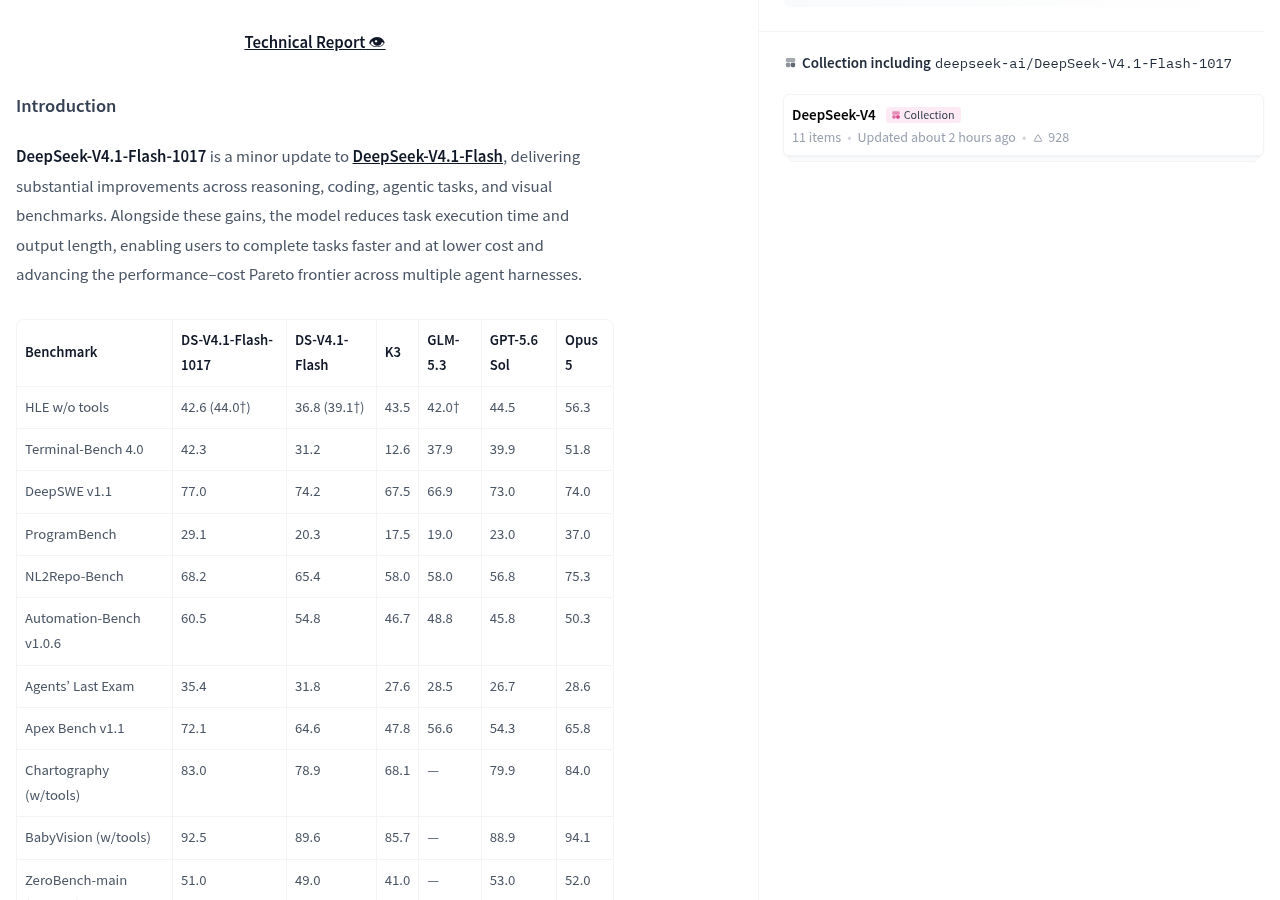
The official technical report lists comparisons with the previous generation DeepSeek-V4.1-Flash, as well as the results of models like K3, GLM-5.3, GPT-5.6 Sol, and Opus 5. Here, we’ll only focus on the few items most directly related to daily use.
Terminal-Bench 4.0 measures the model’s ability to complete tasks in the terminal, such as executing commands, debugging scripts, and handling files. DeepSeek-V4.1-Flash-1017 rose from 31.2 to 42.3 in the previous generation, making it one of the projects with the largest improvements in the official list. For reference, Opus 5 in the same table is 51.8, and GPT-5.6 Sol is 39.9.
ProgramBench rose from 20.3 to 29.1. DeepSWE v1.1 increased from 74.2 to 77.0, a Mini-SWE-V2 testing framework that examines model performance in real software engineering tasks.
It should be noted that all these results come from official reports, and testing conditions are controlled by the authorities. Official reports can tell you how the model performs on standard tasks, but they cannot directly equate to your actual success rate in your own project. Different access methods, different prompts, and different task types will have different results.
If you want to connect yourself, you need to know about this first
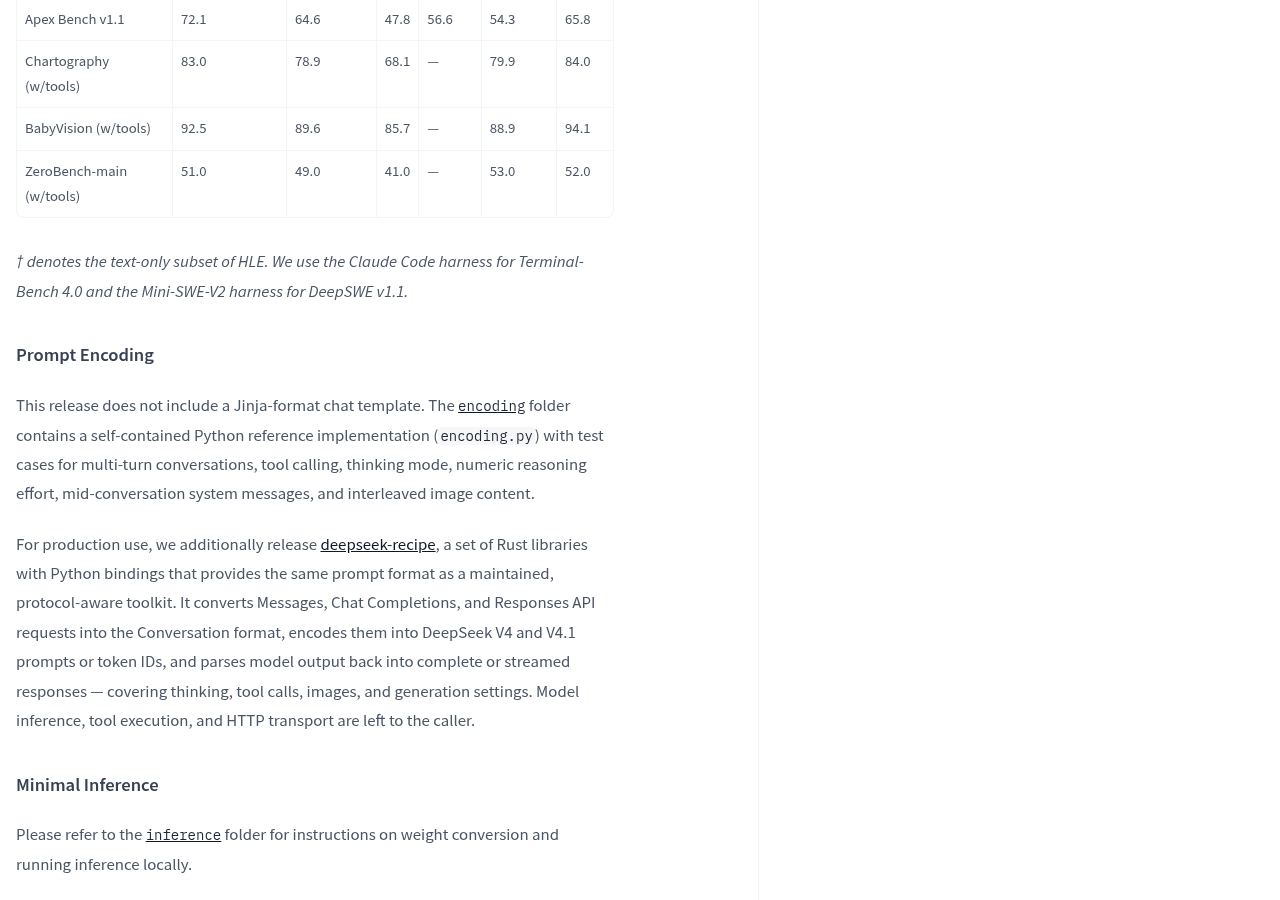
This release differs from most open-source models: the official model does not provide a Jinja-style chat template.
A chat template is a tool that converts your conversation records into a format the model can understand. Without a standard template, using an existing reasoning framework directly may cause the model to fail to correctly recognize the dialogue structure.
The official alternative has two layers: the encoding folder in the model repository contains a self-contained Python reference implementation, covering multi-turn conversations, tool calls, thought patterns, and other scenarios; Additionally, the official release includes deepseek-recipe, a Python-bound Rust library responsible for converting requests in formats like Messages, Chat Completions, and other formats into prompt formats needed by the model and parsing the model’s output.
For users who only call via API or off-the-shelf clients, this issue has little impact. For those who want to deploy or deeply customize access, this is a step that must be addressed before starting work.
Weighting is now open, but let’s first take a look at the scale
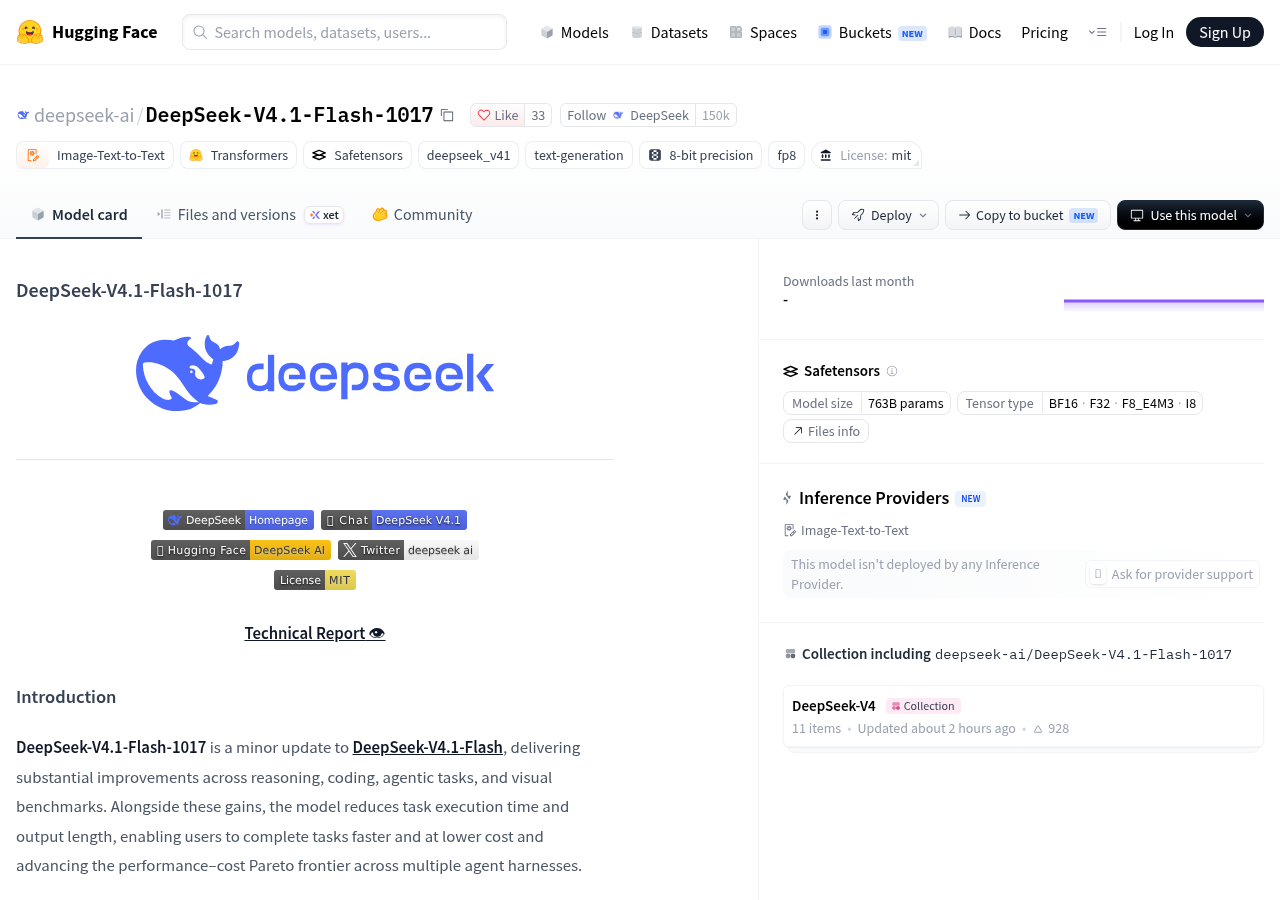
Model weights have been made public on Hugging Face, licensed under MIT licenses, with no additional restrictions on commercial use or modification.
But the model size is 763B parameters. What does this number mean? Currently, models that can run locally on consumer-grade graphics cards usually have parameter counts within a few dozen B, and 763B exceeds the capacity of ordinary personal devices. The official source has not provided the minimum hardware configuration, nor has it stated whether the quantized version can significantly lower the threshold.
So for most readers, the current usage is via API calls or waiting for service providers to connect. The significance of opening weights is more that research institutions and teams with infrastructure can deploy and audit themselves, rather than individual users being able to run locally immediately.
What can be done now, and what cannot be done yet
Weights and permissions can already be viewed in the Hugging Face repository. The model is currently not deployed by any Inference Provider, meaning it cannot be directly called through Hugging Face’s managed inference for now; it must wait for the provider to connect or deploy it yourself.
The official recommended parameters have been announced: temperature 1.0, top_p 1.0, context window 1M tokens, max_tokens recommended not less than 256K. These parameters are valuable for users calling via API, but whether the API has been simultaneously opened for this version is not included in this information and should be based on the actual status of DeepSeek’s official channels.
If you’re considering switching from the previous generation, the official data shows improvements in Terminal-Bench and ProgramBench as the most convincing argument, but it’s recommended to conduct small-scale validation on your actual tasks before deciding whether to migrate.
Official information
Self-made software
Versions, changes and supported installers all come from the same public release records.
LocalBrain
A local AI toolbox for transcription, speech, images, video, and MCP tools. Features vary by platform version.
View public downloads and updates ↗HyphenBox
A free model API radar and local router, with ongoing availability checks and keys kept on your device.
View public downloads and updates ↗ScreenLex
Turn subtitles from your own films and shows into an English vocabulary library, entirely offline.
View public downloads and updates ↗HyphenScreen
Screen recording and editing with a Resolve-style timeline, automatic redaction and pre-export checks.
View public downloads and updates ↗Late nights and burned API credits went in,a cup of tea comes back out — only if you feel like it.
Scan with WeChatPress and hold to save the image, then open it from your album in WeChat Scan




Comments
Loading comments…