
Info: Machine translation This post was machine-translated from the Chinese original. Wording may be rough in places — the Chinese version is authoritative.
Tencent Hunyuan’s official model list has added tencent/Hy-Memory-30B-A3B-GGUF, and three tiers of quantization files have been made public, with the smallest Q4_K_M only 18.24 GB. It’s not a chat model, but a dedicated ‘writer’ for long-term memory frameworks: deciding which conversations are worth recording, what format to write, and how to update old memories. This article answers only one question—can you run it on your own machine now, and what it actually does for you once it starts?
What is it: a model specifically designed for writing memories
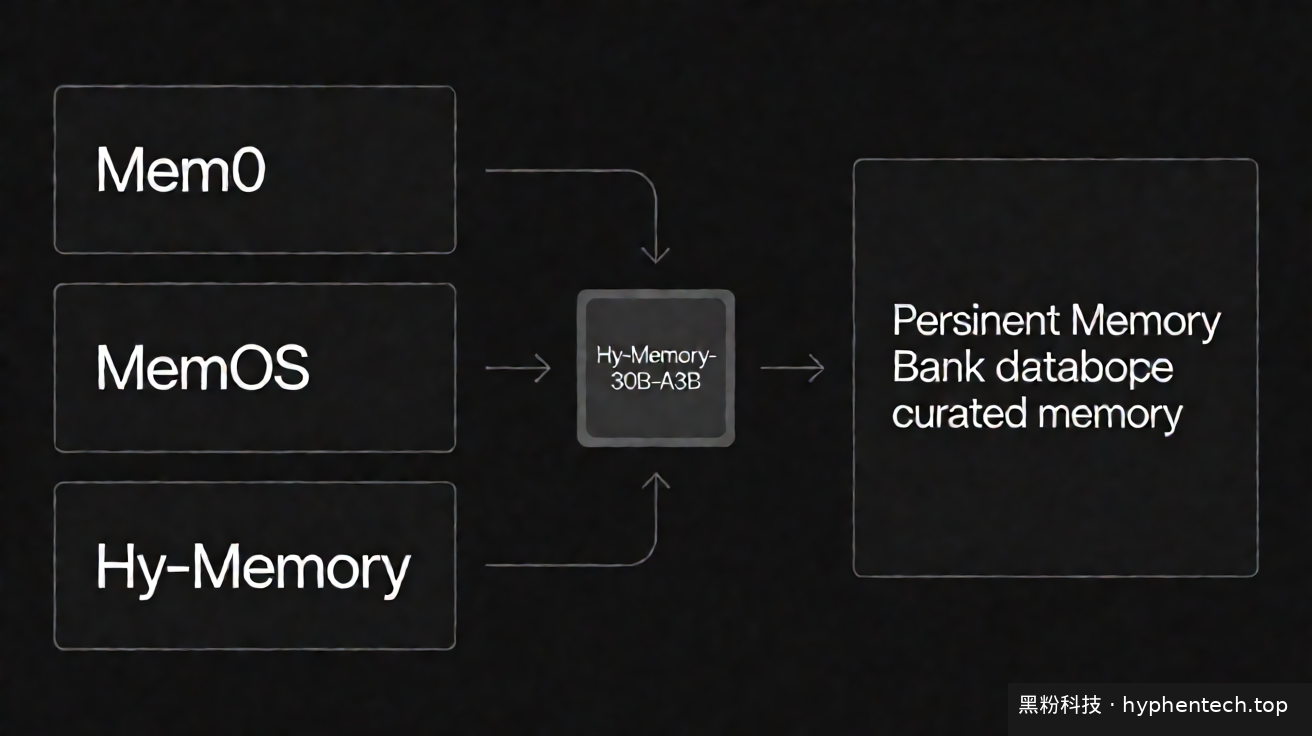
Hy-Memory-30B-A3B is a compact long-term memory writing model developed by Tencent Hunyuan. According to the official statement, it directly replaces the general large models from Mem0, MemOS, and Hy-Memory frameworks, covering Chat, Working, and Coding scenarios. You can think of it as someone in a courier sorting center responsible for labeling: when a package (conversation) comes in, they decide which item to put on the long-term shelf, what to write on the waybill, and whether to tear off and reapply old ones. The total parameters are 30B, but each activation takes about 3B, meaning the sorting center is huge, with only one assembly line actually working.
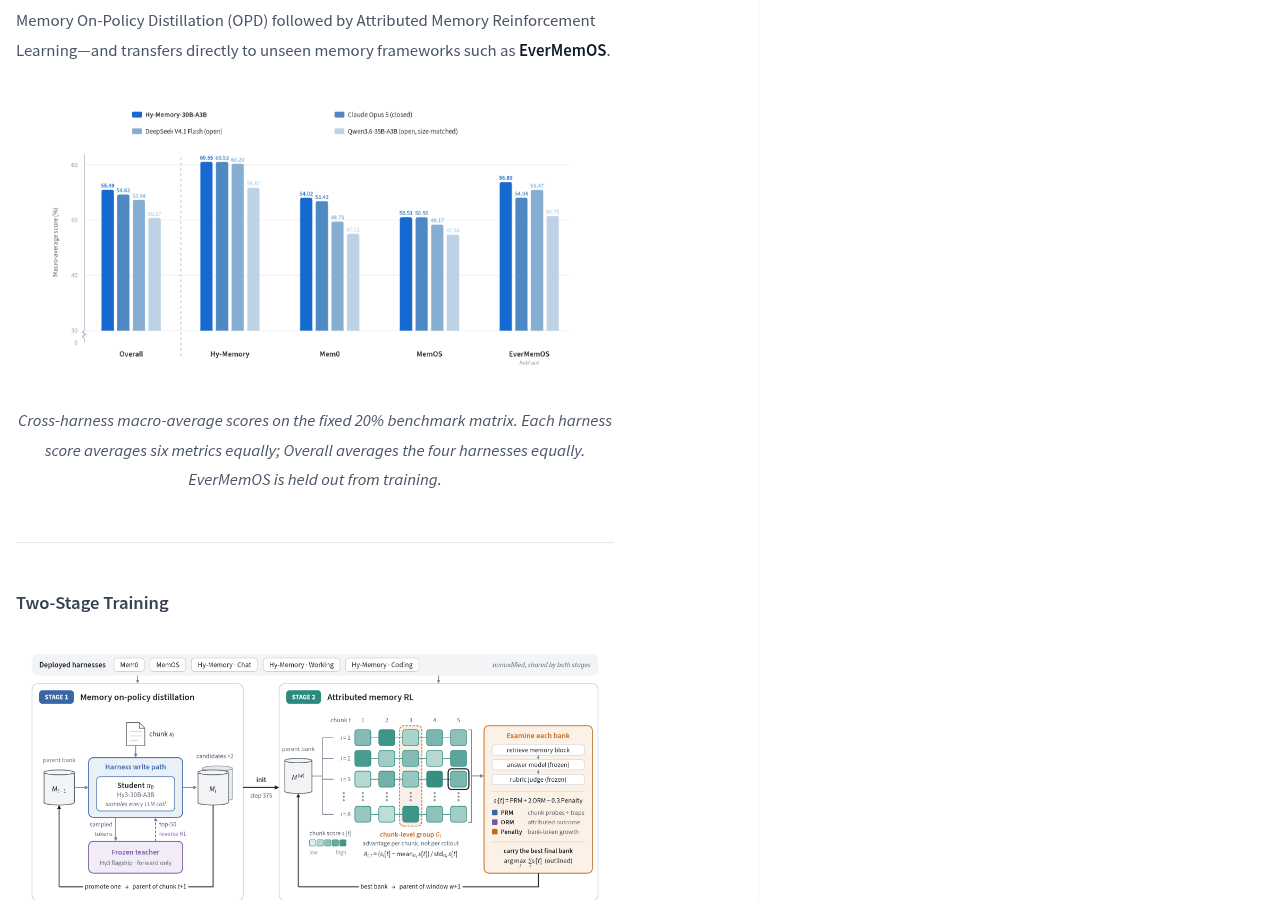
Training is divided into two stages: first, Memory On-Policy distillation, where the model learns to write state chains by following the teacher’s signals in the real-world framework configuration; Next, Attributed Memory Reinforcement Learning, scoring by memory block, and moving the selected memory library to the next window. The official statement says the trained model can be directly transferred to the unfamiliar EverMemOS framework.
Three levels of quantification and official results
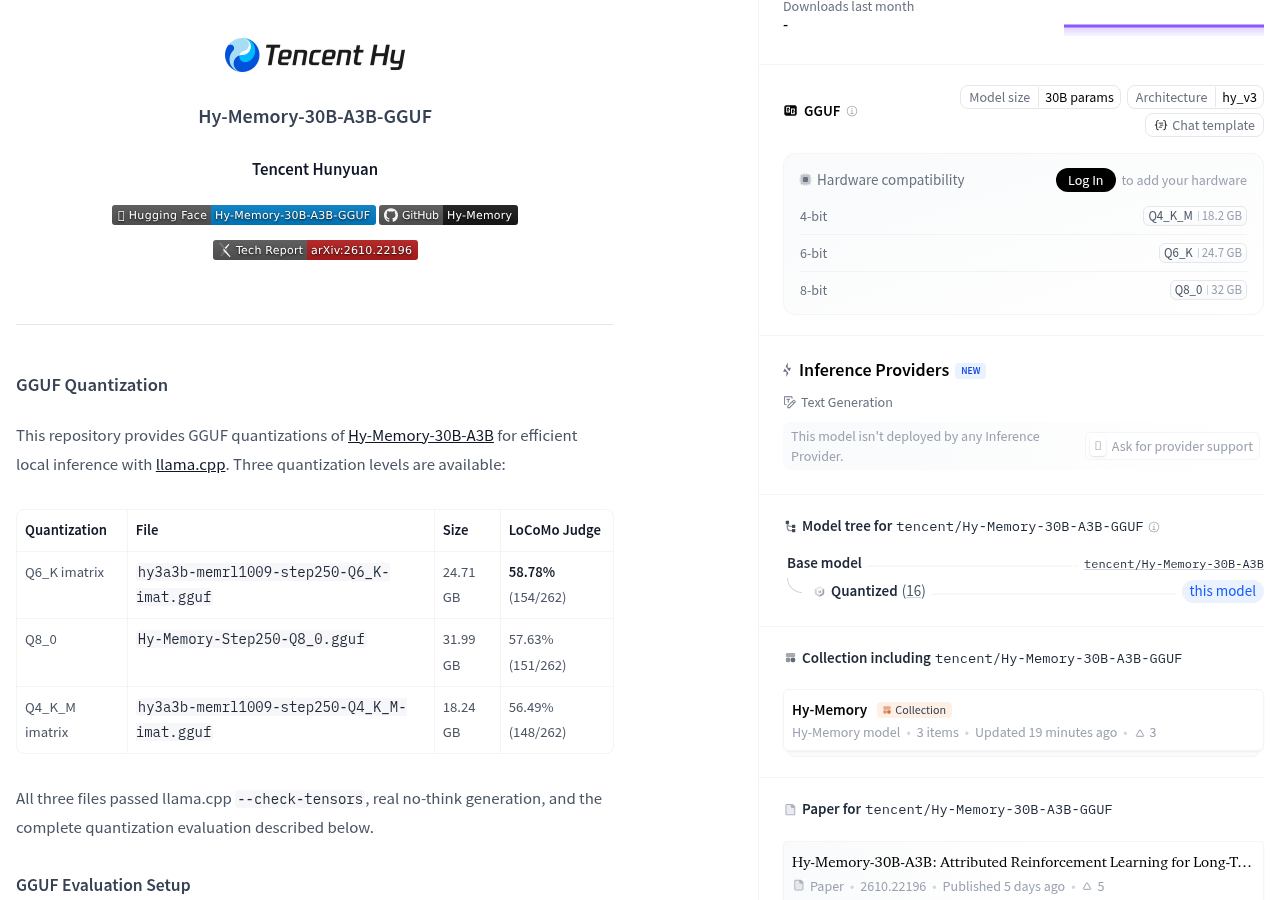
The repository offers three types of GGUF quantization, all generated through llama.cpp --check-tensors, real no-think generation, and complete quant evaluation:
| Quant Levels | File name | Volume | LoCoMo Judge |
|---|---|---|---|
| Q6_K imatrix | hy3a3b-memrl1009-step250-Q6_K-imat.gguf | 24.71 GB | 58.78% (154/262) |
| Q8_0 | Hy-Memory-Step250-Q8_0.gguf | 31.99 GB | 57.63% (151/262) |
| Q4_K_M imatrix | hy3a3b-memrl1009-step250-Q4_K_M-imat.gguf | 18.24 GB | 56.49% (148/262) |
The official review fixed the 20% LoCoMo test set, using 2 users, 262 questions, and 59 memory blocks, with retrieval top_k=10, memory temperature 0.7, embedding model qwen3-embedding-8b-for-online, judge model gpt-5.6-sol, inference framework using official llama.cpp specified commit, KV cache using F16. Q6_K imatrix was the highest quality tier in this review, while Q4_K_M imatrix had the lowest download and memory usage.
Official cross-frame results: What does it indicate?
The official comparison was made across frameworks on a fixed 20% benchmark matrix, using only memory writer. The framework version, prompts, search configuration, answer model, and judge were all fixed. Six indicators were averaged equally, and four frames were averaged again:
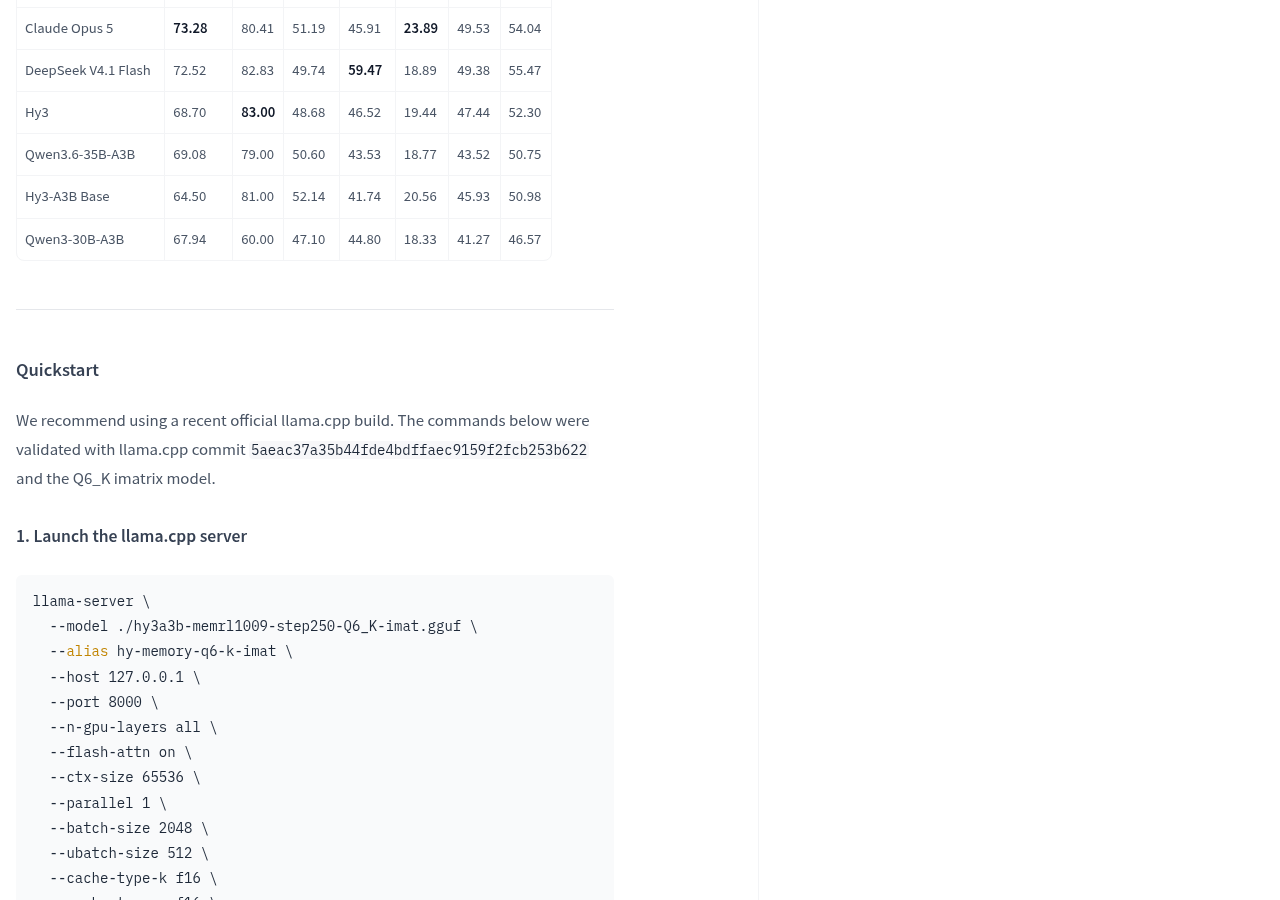
| Memory writer | Mem0 | Hy-Mem. | MemOS | EverMem. | Avg. |
|---|---|---|---|---|---|
| Hy-Memory-30B-A3B | 54.02 | 60.55 | 50.51 | 56.89 | 55.49 |
| Claude Opus 5 | 53.43 | 60.53 | 50.50 | 54.04 | 54.62 |
| DeepSeek V4.1 Flash | 49.73 | 60.20 | 49.17 | 55.47 | 53.64 |
| Hy3 | 45.99 | 58.06 | 50.19 | 52.30 | 51.63 |
| Qwen3.6-35B-A3B | 47.51 | 55.87 | 47.36 | 50.75 | 50.37 |
| Hy3-A3B Base | 40.20 | 50.39 | 49.05 | 50.98 | 47.66 |
| Qwen3-30B-A3B | 39.81 | 45.67 | 45.44 | 46.57 | 44.37 |
These numbers are official reported results, not independent third-party reproductions. It shows that, under official conditions, the average score of Hy-Memory-30B-A3B is higher than Claude Opus 5 and DeepSeek V4.1 Flash. It doesn’t mean it’s better in all real businesses, can’t compare competitors’ prices, and can’t just call it ‘strongest.’
The smallest path to run locally
The official recommendation is to build it with the latest llama.cpp, and provide a startup command verified on the specified commit. Core parameters are 64K context, single slot, F16 KV cache, no-think mode:
llama-server \
  --model ./hy3a3b-memrl1009-step250-Q6_K-imat.gguf \
  --alias hy-memory-q6-k-imat \
  --host 127.0.0.1 \
  --port 8000 \
  --n-gpu-layers all \
  --flash-attn on \
  --ctx-size 65536 \
  --parallel 1 \
  --batch-size 2048 \
  --ubatch-size 512 \
  --cache-type-k f16 \
  --cache-type-v f16 \
  --temp 0.7 \
  --top-k 0 \
  --top-p 1.0 \
  --repeat-penalty 1.0 \
  --jinja \
  --chat-template-kwargs '{"reasoning_effort":"no_think"}' \
  --check-tensors
If you want to open two concurrent slots, the official requirement is to set --ctx-size to 131072 to retain up to 64K context per request. After startup, you can call the request using the OpenAI Python SDK or directly curl the local 8000 port, explicitly adding reasoning_effort=no_think in the request for easier auditing.
What can be done now, and what cannot be done yet
- You can now download three levels of GGUF from Hugging Face, follow official commands to start service llama.cpp, and connect Mem0, MemOS, or Hy-Memory as the write model.
- Official results show it averages higher than Claude Opus 5 and DeepSeek V4.1 Flash on fixed benchmarks, but these are official calibers and require you to retest them yourself on real data.
- Allowing download of weighted files doesn’t necessarily mean your computer will run: Q4_K_M still needs 18.24 GB, and if you don’t have enough video memory or memory, you’ll need to downgrade or switch devices.
- It’s not a universal chat model, so don’t use it as a daily conversation assistant; Its value lies only in the long-term memory and writing pipeline.
- The next step is to run the memory write run using your own conversation data, check whether the memories are accurate and updated promptly, and then decide whether to replace the generic model in the existing framework.
Related resources: Framework code and evaluation tools on GitHub for Tencent-Hunyuan/Hy-Memory, GGUF weights and models stuck in Hugging Face’s tencent/Hy-Memory-30B-A3B-GGUF, original BF16 model on tencent/Hy-Memory-30B-A3B, technical report number 2610.22196.
Official information
Self-made software
Versions, changes and supported installers all come from the same public release records.
LocalBrain
A local AI toolbox for transcription, speech, images, video, and MCP tools. Features vary by platform version.
View public downloads and updates ↗HyphenBox
A free model API radar and local router, with ongoing availability checks and keys kept on your device.
View public downloads and updates ↗ScreenLex
Turn subtitles from your own films and shows into an English vocabulary library, entirely offline.
View public downloads and updates ↗HyphenScreen
Screen recording and editing with a Resolve-style timeline, automatic redaction and pre-export checks.
View public downloads and updates ↗Late nights and burned API credits went in,a cup of tea comes back out — only if you feel like it.
Scan with WeChatPress and hold to save the image, then open it from your album in WeChat Scan




Comments
Loading comments…