
Info: Machine translation This post was machine-translated from the Chinese original. Wording may be rough in places — the Chinese version is authoritative.
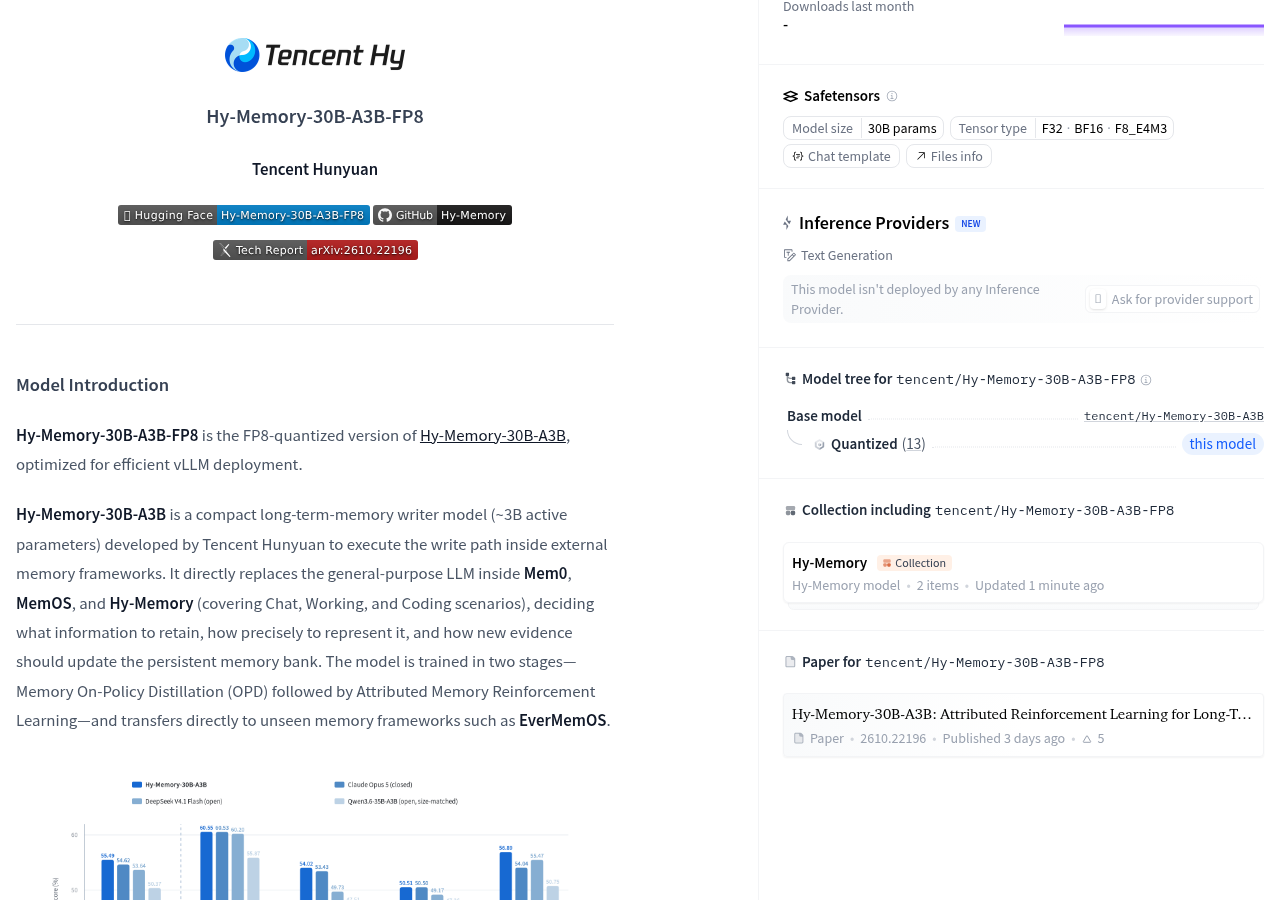
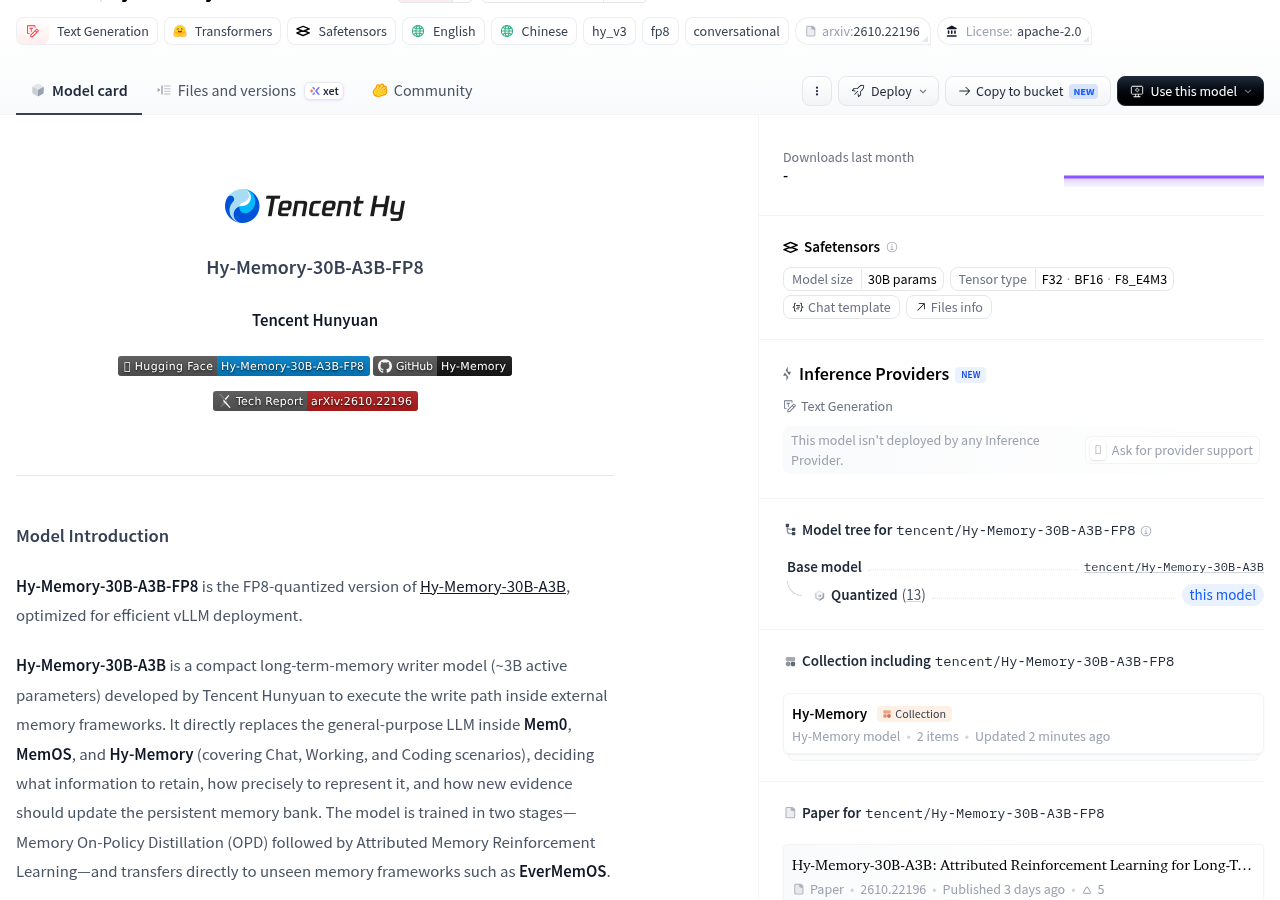
Tencent Hunyuan’s Hy-Memory-30B-A3B-FP8 weights, configurations, and model cards have already appeared in the official model repository. It is the FP8 quantization version of Hy-Memory-30B-A3B, and the official optimization direction is very specific: improving efficiency when deploying with vLLM. The model page does not specify a clear release date, so only the current resource status can be confirmed; the page discovery date cannot be used as the official release date.
This is not a general model mainly responsible for chatting or directly answering questions. It handles the “writing” part of the external memory framework: determining which information is worth keeping, how to express it accurately, and how to update old memories when new evidence appears.
It doesn’t address “how to answer,” but “what to remember.”
You can think of the external memory system as the shelves at a courier station. General large models handle immediate pickup needs, while memory writing models decide which packages should be stored, how labels should be filled, whether duplicate packages are merged, and whether new documents can overwrite old records. A large shelf doesn’t mean it’s well organized; If you write the wrong label, no matter how fast you search later, you might pick up the wrong item.
According to the official introduction, this model can replace the general large models in Mem0, MemOS, and Hy-Memory that were originally responsible for writing memory, covering chat, work, and programming scenarios. The official statement also states that it can be directly migrated to the EverMemOS framework, which was never seen during training. Here, “migration” refers to the experimental results in the official report and does not guarantee that any external system will naturally achieve the same performance after integration.
The model is trained in two stages: first, Memory On-Policy Distillation, where students learn the state chain provided by the teacher; Then Attributed Memory Reinforcement Learning, which allocates fragment-level feedback based on the final memory library. Simply put, the first stage is like organizing packages according to standards, and the second stage adjusts the organizing method based on whether it is easier to find the right package.
The official results are worth watching, but let’s first look at the test caliber
The official review only changes the memory writing model, fixing the framework version, prompt, retrieval configuration, answer model, judge model, and other framework components. Each write model starts from a blank memory bank and uses the same test samples and scoring rules. This design tries to focus differences on “who writes memory,” avoiding mixing changes in the retriever or answer model into the results.
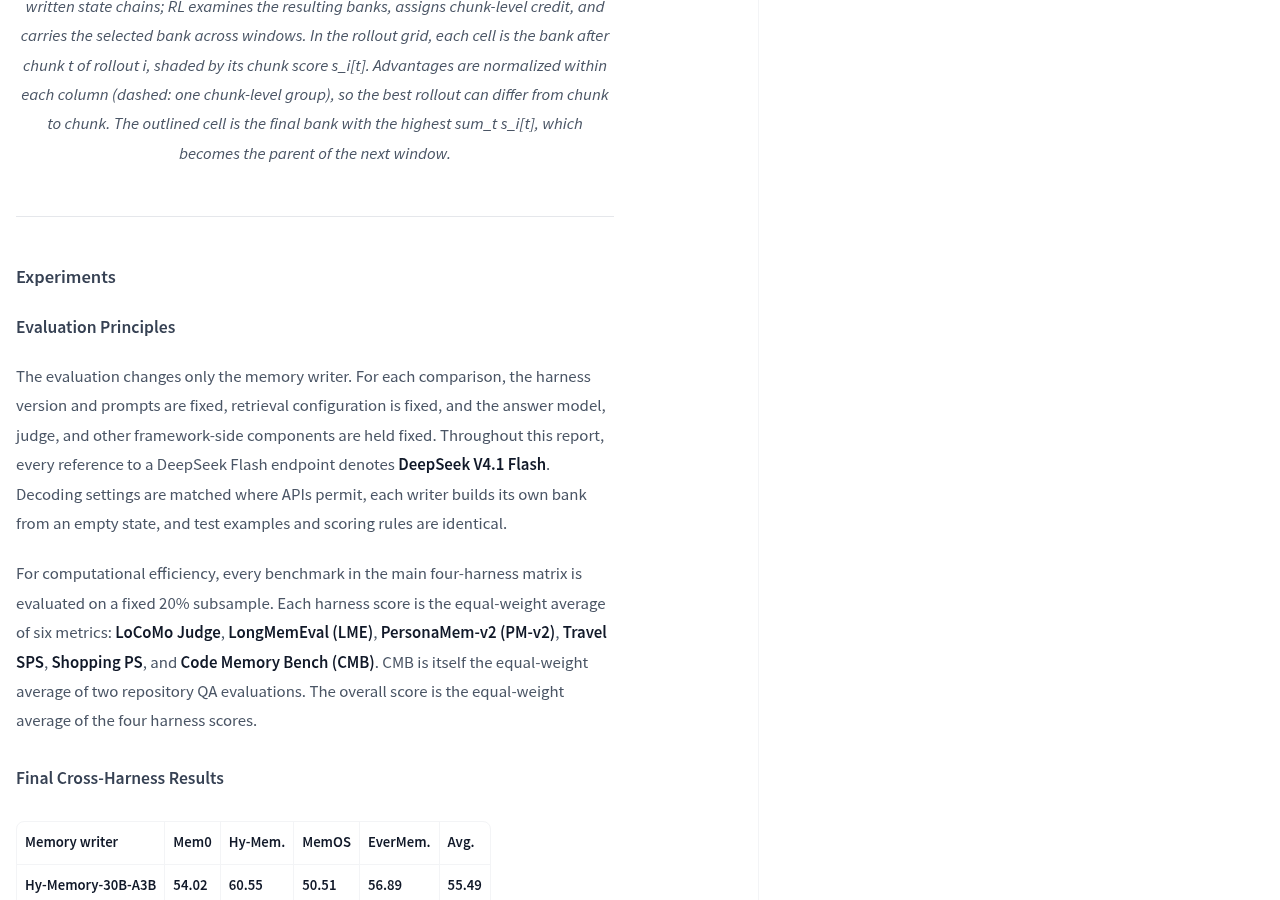
The main evaluation matrix uses a fixed 20% subsample. The scores of each framework are averaged equally weighted by six indicators, and the total score is then averaged equally across the four frameworks. Here, the macro average can be understood as four transcripts each bearing the same weight, preventing any one framework from automatically gaining greater influence just because it has more questions.
| Officially listed memory writing models | Mem0 | Hy-Memory | MemOS | EverMemOS | Average score |
|---|---|---|---|---|---|
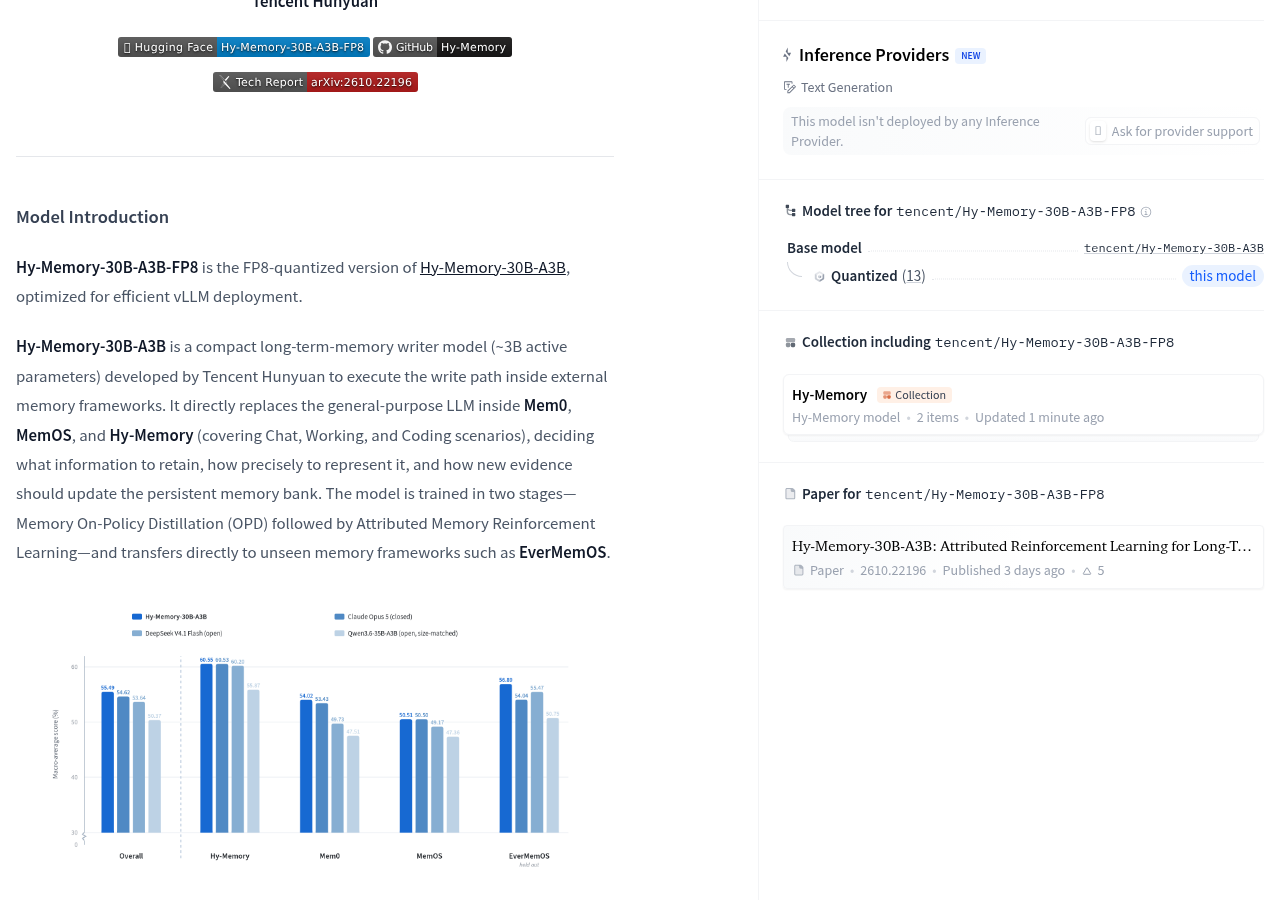
| Hy-Memory-30B-A3B | 54.02 | 60.55 | 50.51 | 56.89 | 55.49 |
| Claude Opus 5 | 53.43 | 60.53 | 50.50 | 54.04 | 54.62 |
| DeepSeek V4.1 Flash | 49.73 | 60.20 | 49.17 | 55.47 | 53.64 |
All of the above are fixed 20% subsample results listed in Tencent’s official Hunyuan report and are not independent retests.
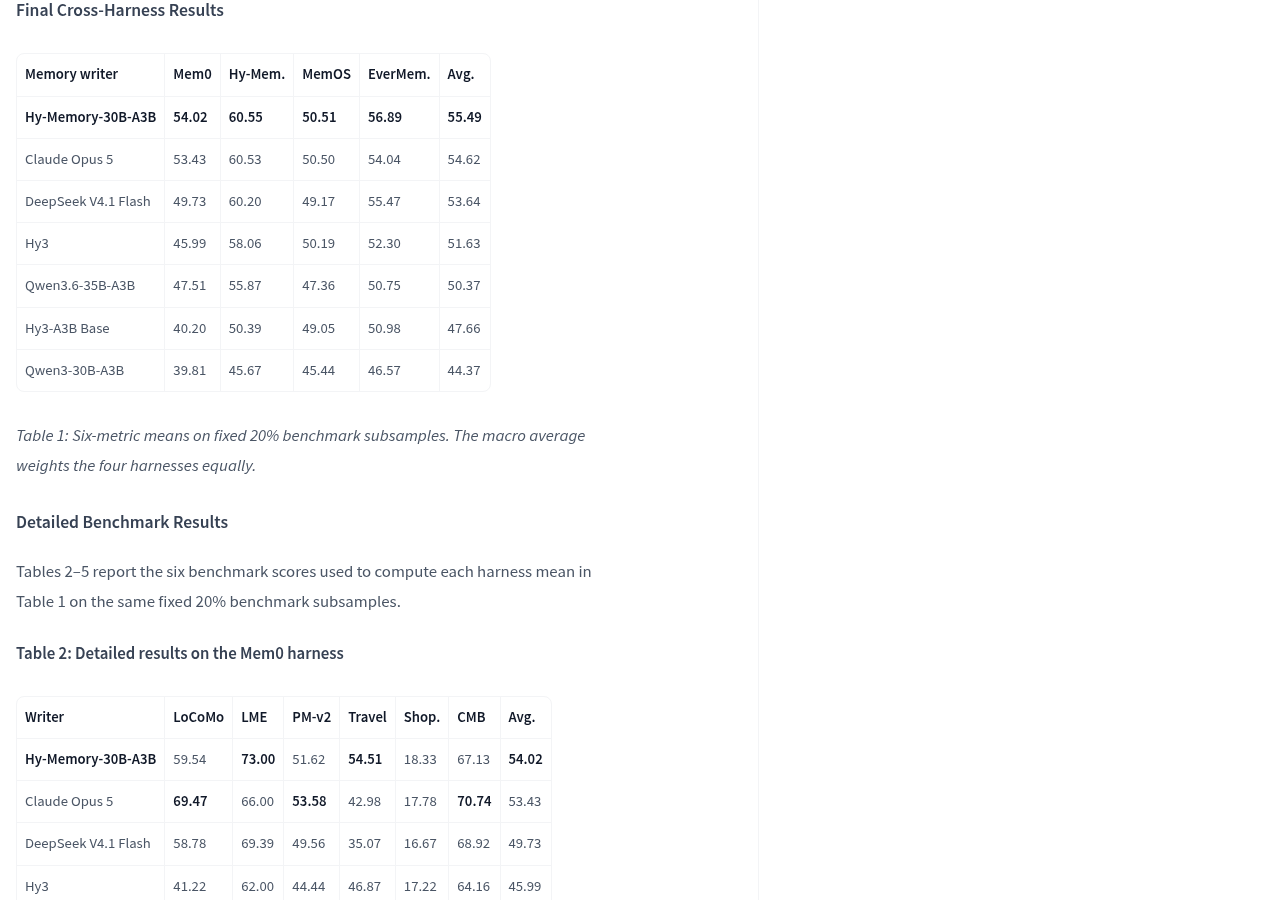
These numbers illustrate that, under the official fixed components, fixed subsamples, and equal weight scoring methods, the average score for Hy-Memory-30B-A3B is 55.49. They cannot independently prove long-term stability in different production environments, nor can they replace testing real business data, retrieval strategies, and response models. Especially since although EverMemOS is officially listed as an out-of-training framework, it still belongs to the same official experimental system.
Thirty billion parameters does not mean every time you use thirty billion parameters
The model page lists it as a 30 billion parameter model, with the official description noting about 3 billion activation parameters. You can think of this as a large express warehouse: the warehouse has many shelves, but when processing a specific waybill, only a portion of the area related to the current task is mobilized. The total parameter describes the overall capacity, while the activation parameter describes the actual scale of work involved in the calculation at once; the two cannot be confused with the same number.

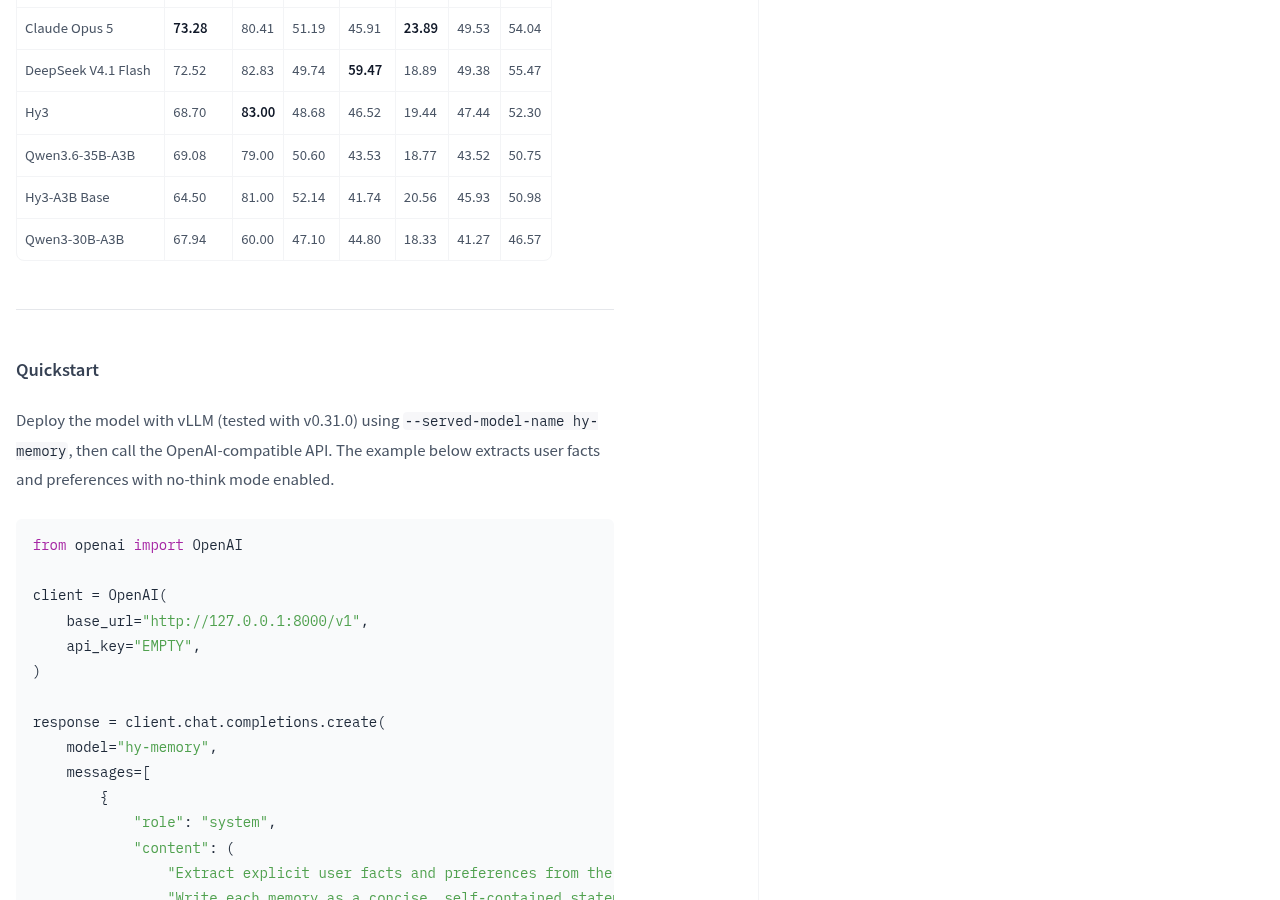
The official Quickstart is deployed using the tested vLLM v0.31.0 and is called via an OpenAI-compatible interface. The sample task is to extract explicit user facts and preferences from the conversation, require output of concise, independent memories, and prohibit inference or fabrication of information. This demonstrates the intended invocation method but does not constitute proof that other runtimes, devices, or configurations are already compatible.
Warning The current model page clearly shows that no Inference Provider has deployed this model. The page materials also do not provide minimum hardware thresholds, actual memory usage, or license terms that can be directly judged based on this. Weights are listed, but this does not guarantee that a consumer-grade computer will be operational; Licenses, runtime compatibility, and hardware requirements still need to be verified separately.
Who deserves further verification? Whoever is in a hurry to download is not rushed
- Developers who already use Mem0, MemOS, or Hy-Memory and whose write cost or memory quality is a bottleneck for general large models can consider this as a candidate.
- Teams that need to handle long-term chat preferences, work records, or code repository memories can build their own data collection using the official fixed-variable method.
- Users who only need a regular chat model won’t automatically get better answers just because they switch to a memory writing model; It is responsible for the memory library writing process.
- Users hoping for one-click access to the managed interface are currently not suitable for direct reliance, as the official model page shows that Inference Provider has not yet been deployed.
The next step is not to just reproduce the official average score. A more practical acceptance order is: first confirm the license and weight file, then check the target runtime and hardware conditions, then fix the retriever, answer the model and scoring method, and use real data to observe what it wrote, what is missing, and how old memories are updated. Official model and resource entry: Hy-Memory-30B-A3B-FP8 model warehouse.
Official information
Self-made software
Versions, changes and supported installers all come from the same public release records.
LocalBrain
A local AI toolbox for transcription, speech, images, video, and MCP tools. Features vary by platform version.
View public downloads and updates ↗HyphenBox
A free model API radar and local router, with ongoing availability checks and keys kept on your device.
View public downloads and updates ↗ScreenLex
Turn subtitles from your own films and shows into an English vocabulary library, entirely offline.
View public downloads and updates ↗HyphenScreen
Screen recording and editing with a Resolve-style timeline, automatic redaction and pre-export checks.
View public downloads and updates ↗Late nights and burned API credits went in,a cup of tea comes back out — only if you feel like it.
Scan with WeChatPress and hold to save the image, then open it from your album in WeChat Scan




Comments
Loading comments…