
Info: Machine translation This post was machine-translated from the Chinese original. Wording may be rough in places — the Chinese version is authoritative.
Let’s clarify the boundaries first: it’s a job search workstation, not an automated delivery machine
career-ops is an open-source AI job search project running in the local project directory where AI programming clients such as Claude Code, Codex, and OpenCode are located. According to the authors, it can read job descriptions and resumes, check if positions are still open, assess compatibility, generate resumes, cover letters, and interview preparation materials tailored to the position, and then record application status in a tracking form.
You can think of it as a job-hunting workbench placed on your own computer: the job description is like a newly arrived package, the career-ops is responsible for verifying the delivery information, sorting by importance, and arranging the materials that need to be processed; but whether to receive the package, whether the materials are accurate, and when to press the submit button are still up to the job seeker.
What can a complete process deliver?
| Link | Deliverables declared by the author | Manual confirmation is still required |
|---|---|---|
| Job Screening | Check the status of the position, assign a matching rating of 1 to 5 based on your resume, and organize gaps and application suggestions | Whether the position is worth investing in, and whether the rating matches your actual choice |
| Application materials | Generate resumes, cover letters, application answers, and PDF files tailored to the position | Whether facts, figures, job titles, and wording are accurate |
| Company and interview preparation | Organize company information, contact leads, interview stories, and prepare plans | Whether the information is reliable and whether the communication target is appropriate |
| Application management | Record application status, analyze rejection patterns, and prompt follow-up matters | Check if your status is truly updated, and whether your recommendations match your current job search goals |
The scope of features comes from the project README and skill entry documentation, and has not yet been verified for local operation.
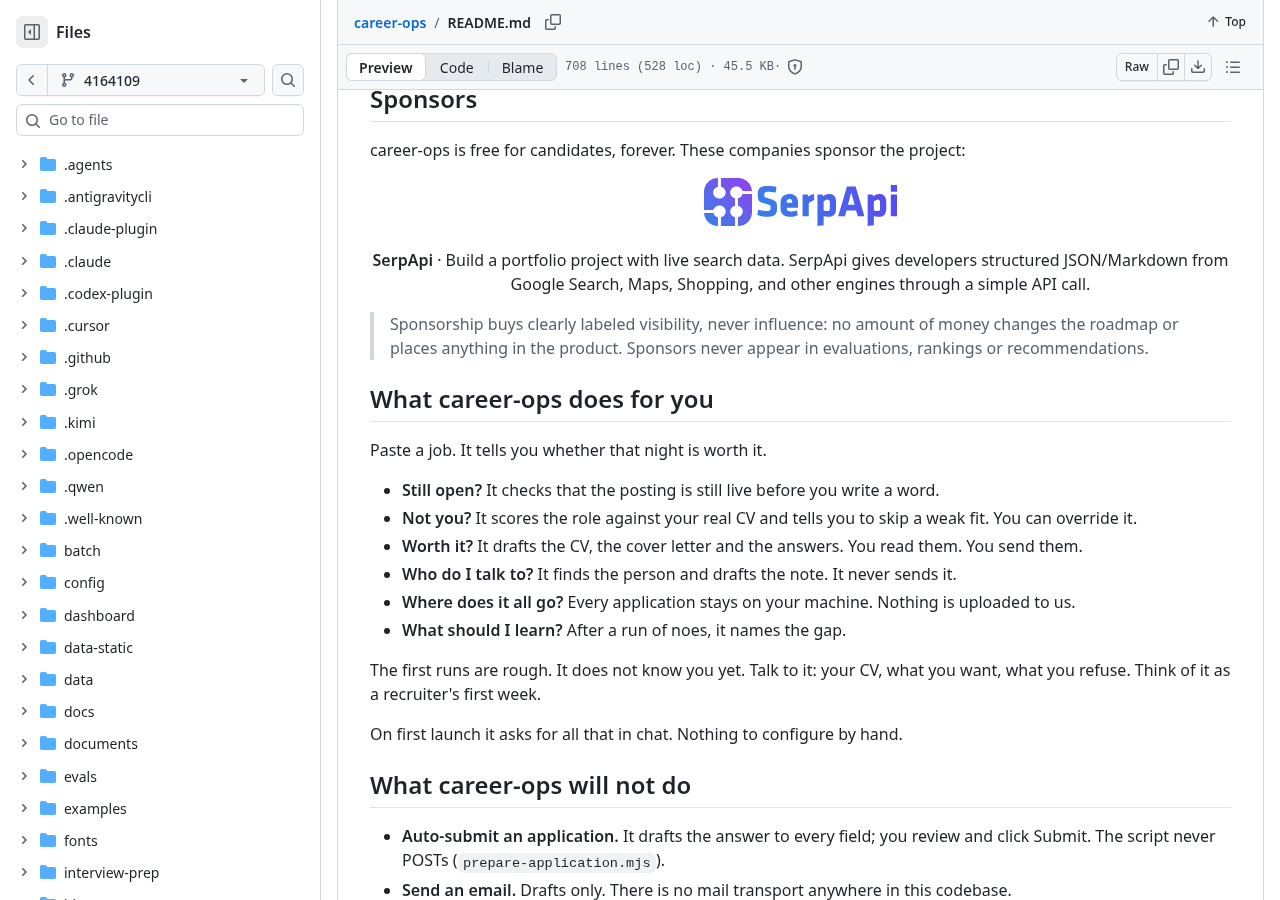
The focus of this process isn’t “more from the sea,” but first determining whether a position is worth investing in. The project will provide suggestions and allow users to override those suggestions; Scoring is just an auxiliary filter; it can’t turn recruitment results into precisely calculated answers.
It deliberately doesn’t take any step for you
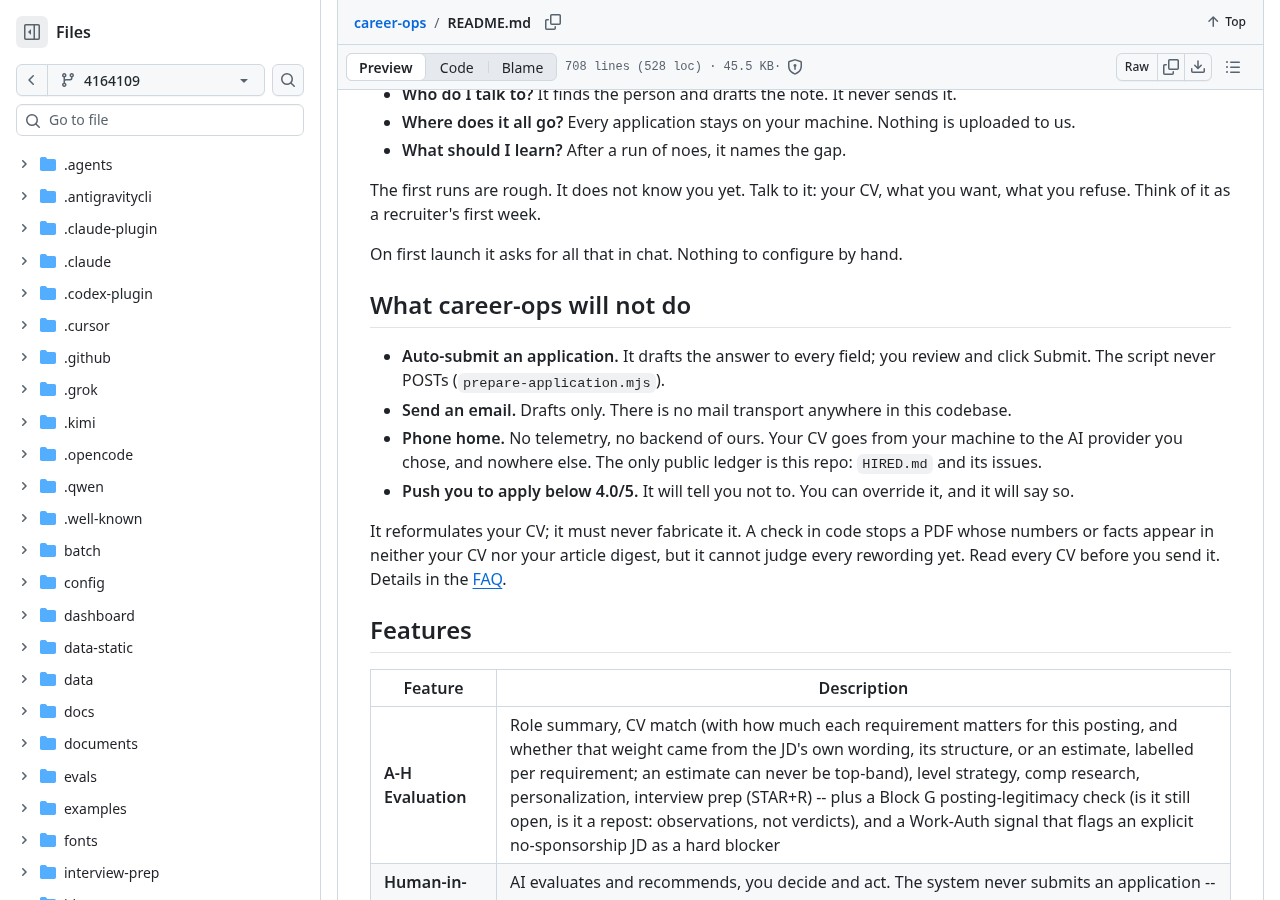
The project explicitly retains manual confirmation: it can draft application fields and contact emails, but will not automatically submit job applications or send emails. This limitation sacrifices some speed but prevents AI from sending incorrect experiences, exaggerated capabilities, or inappropriate wording directly to recruiters when unchecked.
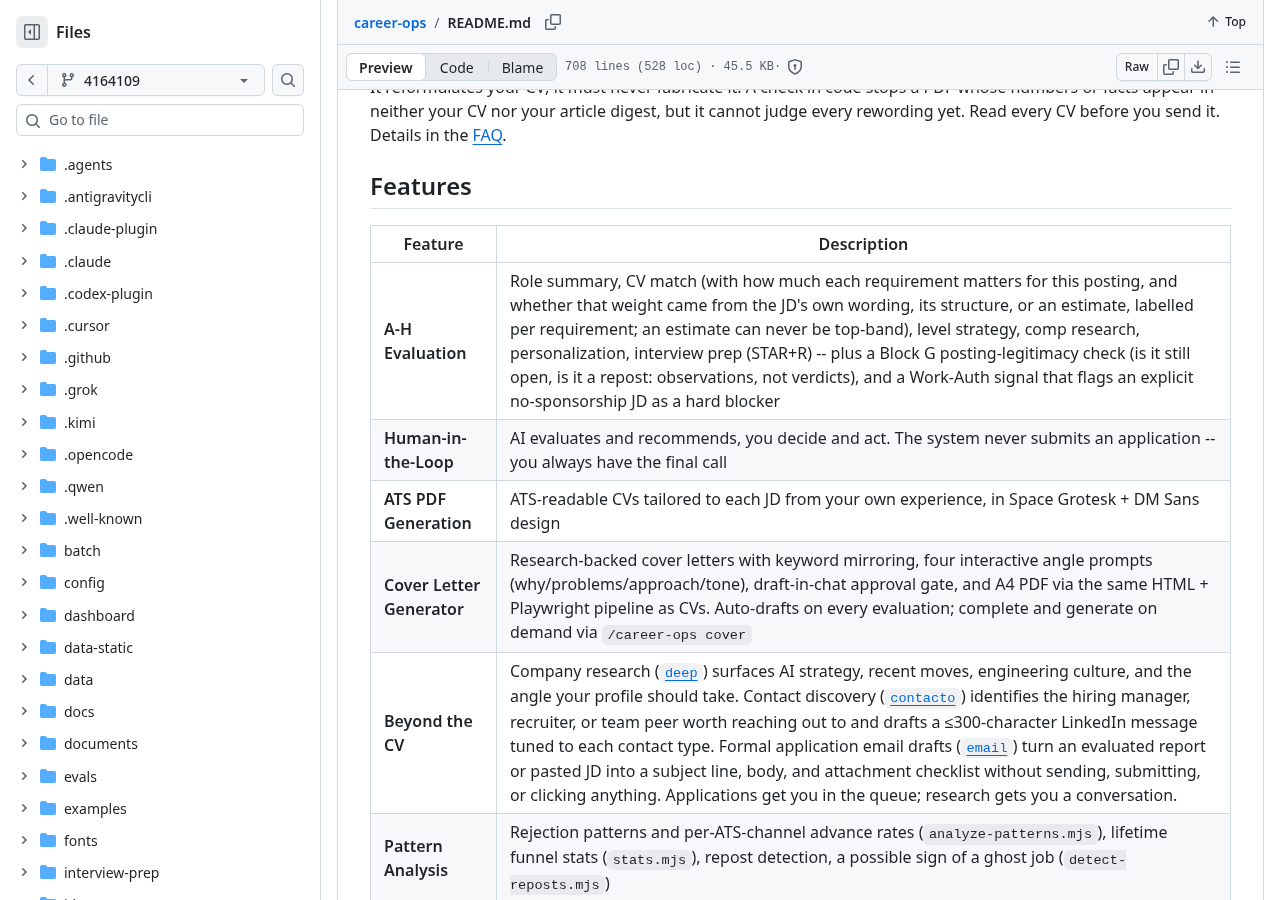
Warning The authors explain that the procedure prevents numbers or facts from some sources from being included in PDFs, but currently cannot fully judge each rewrite, nor does it cover all job title issues. Any generated resume, cover letter, and application answers should be checked item by item and cannot be treated as factual guarantees.
Which clients and environments can be used?
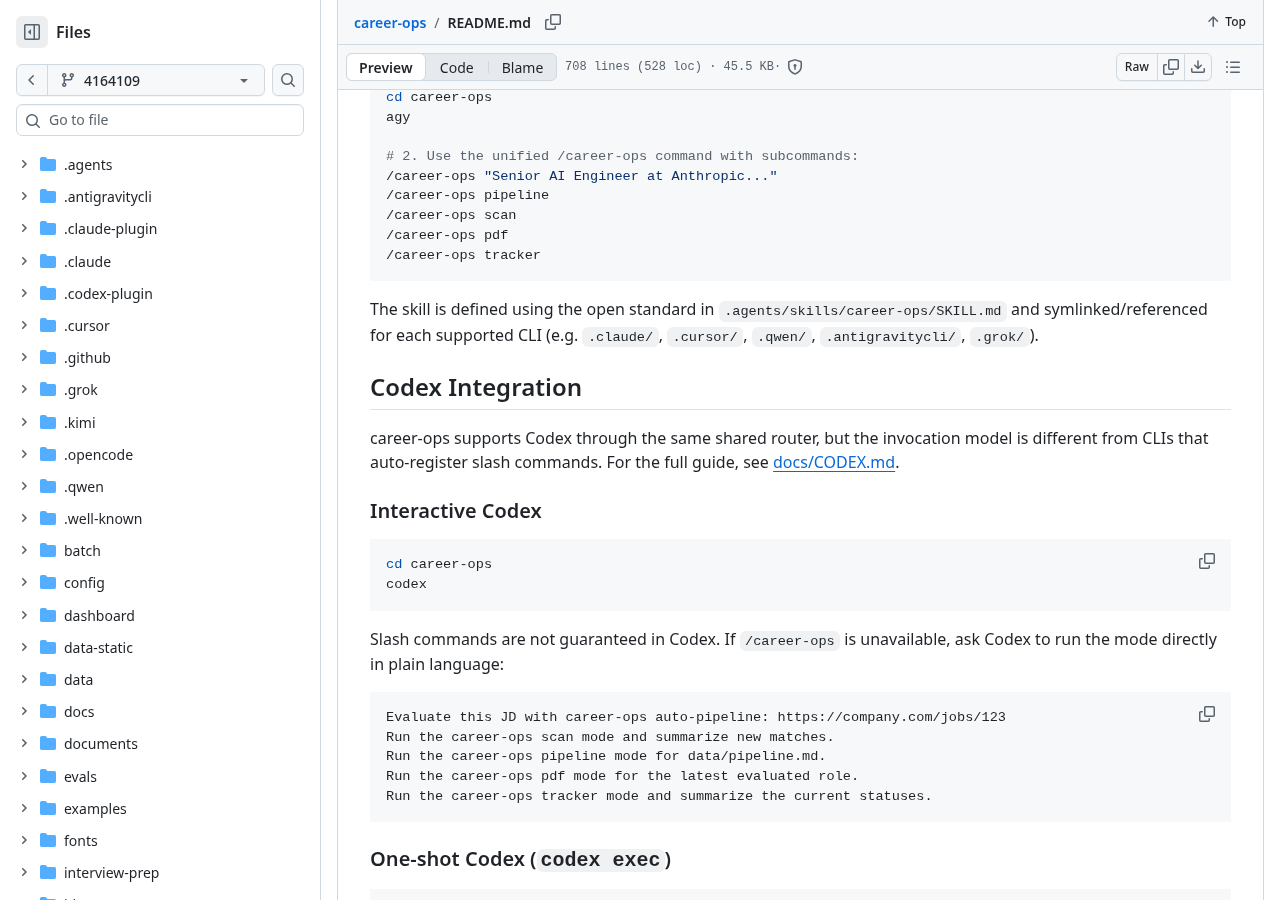
The author declares that career-ops uses a shared Agent Skill entry point, which can be used with clients such as Claude Code, Codex, OpenCode, Qwen, Grok, Pi, etc. Codex’s slash commands are not guaranteed; it is recommended to directly specify modes such as scan, pipeline, pdf, or tracker in natural language. This is the compatibility range provided by the project team and does not mean that all clients and system combinations have been independently executed.
- Basic installation and most scripts rely on Node.js.
- Generating PDFs requires Playwright and Chromium; For Linux environments not running Debian or Ubuntu, you may also need to supplement the system libraries yourself.
- The terminal dashboard uses Go, Bubble Tea, and Lipgloss, which are additional interface capabilities and not a requirement for completing a single job assessment.
- AI capabilities come from user-selected programming clients, model services, or local models; The project itself does not include an unlimited number of models.
- Plugins like Gmail, Notion, and Apify are optional integrations and are disabled by default.
How to start so you don’t get complicated right from the start
The project’s fixed submission README provides an NPX-based initialization entry and retains manual installation. The first attempt is better to start with a real position: first confirm whether the text evaluation correctly references the resume, then decide whether to enable PDF, batch scan, and external integration. Repository and installation instructions can be viewed at career-ops fixed submission README.
- Prepare an accurate resume, including your target position, refusal criteria, and work preferences.
- First, enter a job description or job link to check if the rating criteria correspond to the actual content in your resume.
- After the written report is approved, check whether the customized resume and PDF can be opened, copied, and retrieved properly.
- Confirm where and what the tracking form is written in, then consider scanning multiple job sites or batch processing.
- When it comes to personal profiles and model services, first confirm where the data will actually be sent.
The free code is not necessarily the entire job search chain
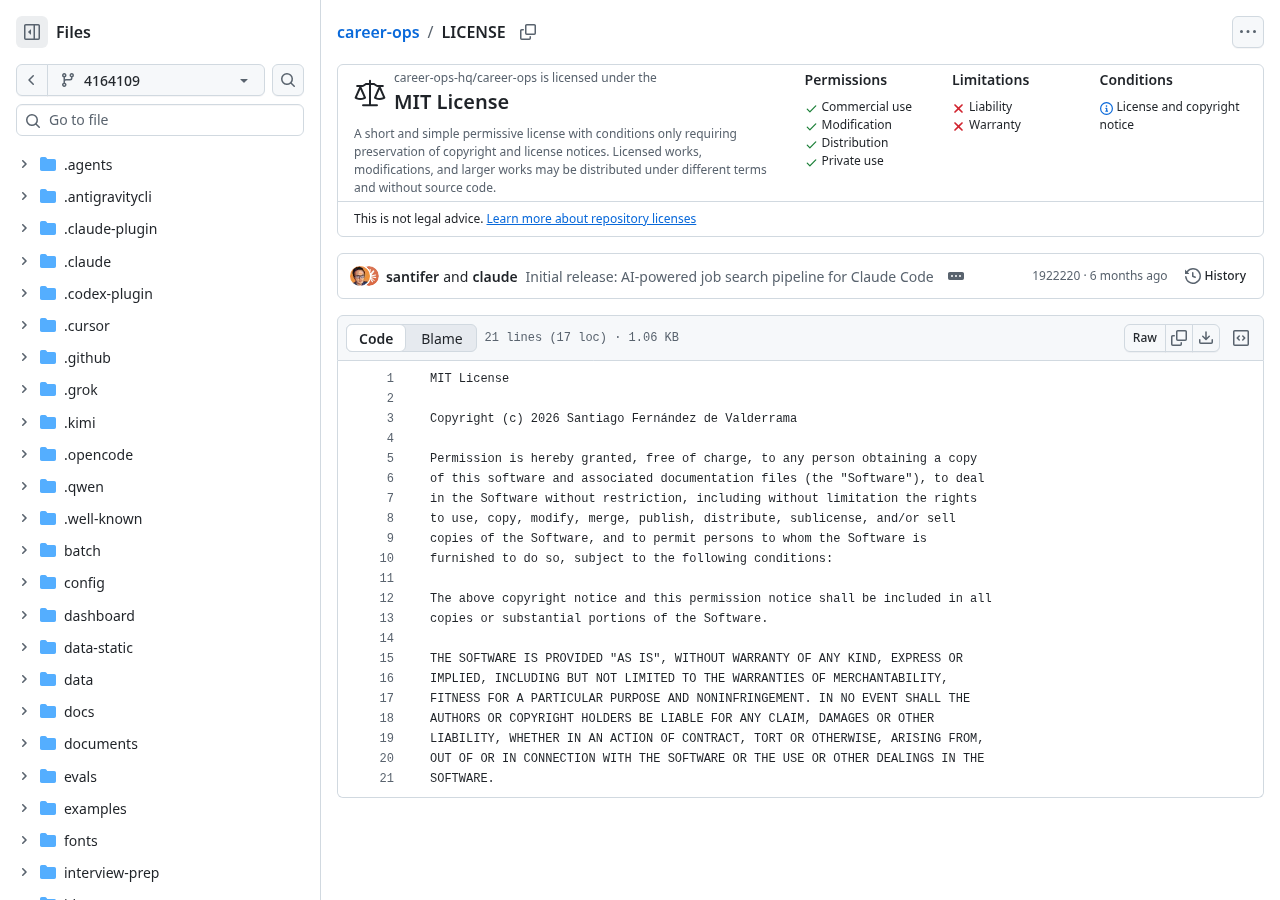
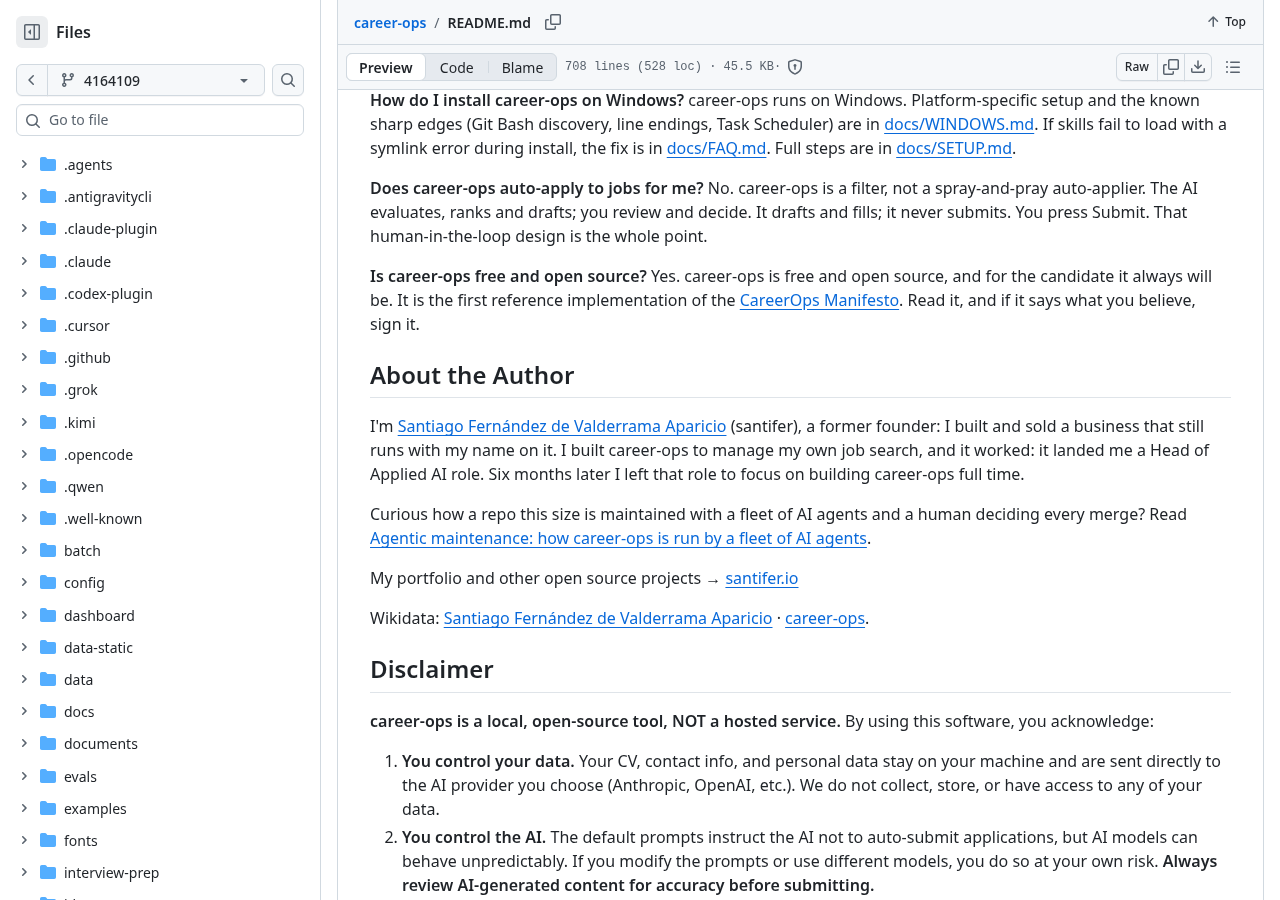
The career-ops code is licensed by the MIT License, and the project team also states that candidates can use it for free and provide instructions for both free models and local models to run. However, public code does not mean the entire process is cost-free: selected AI clients, model interfaces, search data services, and optional plugins may have quotas, subscriptions, or invocation fees. Current materials do not provide a fixed cost set applicable to all combinations, so “open source” cannot be directly translated as “all features are permanently free and unlimited.”
Running locally doesn’t mean data never leaves the computer
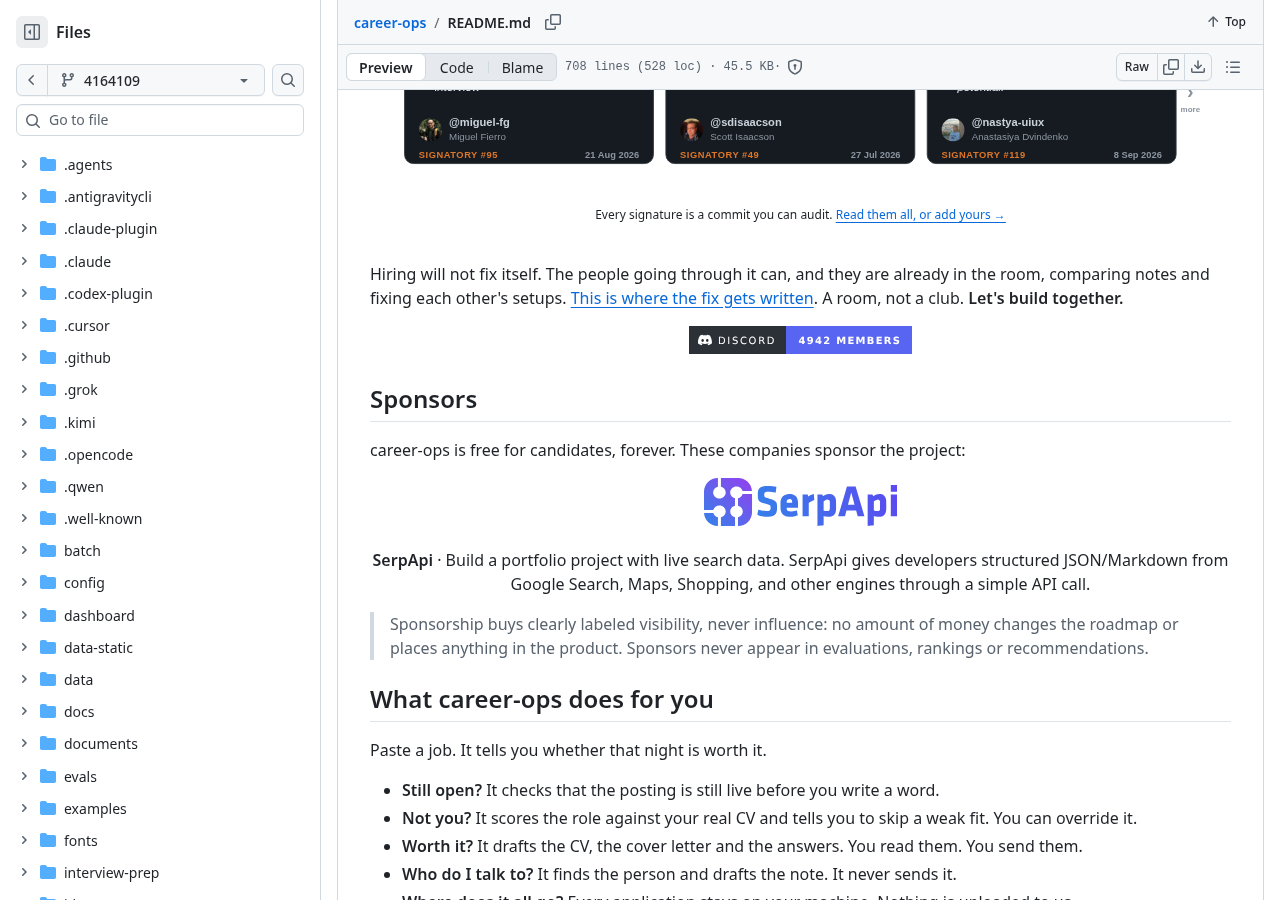
The project does not have its own telemetry or hosting backend; resumes, reports, and application tracking files are saved locally by default. However, the README also states that resume content is sent directly to AI providers chosen by users. Only by using verified local models and local processes can outsourcing be further reduced; Specific privacy boundaries still depend on the model, search service, and enabled plugins.
Beyond the MIT license, there are also names and material boundaries
The MIT license allows the use, copying, modification, merging, distribution, and redistribution of the code, but copyright and license statements must be retained, and the software must be provided “as is” without any warranty. The project also separately states the Career-Ops name and brand trademark policy: the code licensing is lenient and does not mean the project name can be used for commercial product naming or official endorsement manufacturing.
What can the author’s sample photos and warehouse popularity prove?
The author documents his job search process in README: evaluating 740 positions, applying for 68, receiving 12 interviews and 1 offer, and showing samples of the Spanish interface. This shows that the author designed the project around the real job search process but cannot prove that other industries, regions, or resume conditions would yield the same results; The samples are not independent test results.
The warehouse snapshot on October 8, 2026, recorded 73,769 stars and 13,858 forks; The baseline was 73,673 stars, an increase of 96 stars in 1.02 days, about 94.0 stars/day, with the most recent push on October 8, 2026, 07:28:51 UTC, licensed as MIT. It indicates that the project still has maintenance activity and attention, but cannot replace security audits, cross-client compatibility testing, or actual job search validation.
Who is worth using?
- Suitable for: Those already using AI programming clients, willing to maintain local files, and who need to repeatedly screen positions, rewrite materials, and track applications.
- Suitable for: Those who value low or precise submissions and want every material to be supported by real resume evidence.
- Not suitable for now: those who only want one-click automatic mass promotion, don’t want to check generated content, or don’t want to configure any local environment settings.
- Be cautious: resumes should not be sent to any external modeling services. Before choosing, verify the local model route, plugin status, and actual data flow.
The minimum acceptance method is simple: give it a real position, check whether the rating cites correct experience, whether the materials contain fabricated facts, whether the PDF is readable, whether the tracking status is accurate, and where the personal data was sent. If all five are clearly explained, then extend it into a long-term job search workbench; If any one is vague, it should not be directly applied in bulk.
Project firsthand information
🧰 Tools I build
I maintain all of these tools myself. Preview builds are clearly labeled; the release pages are the source of truth for downloads, updates and known limits.
Info: HyphenBox Status: Official releases
A radar for free LLM APIs: availability is re-tested continuously, one local interface for all of them, and keys stay on your machine
Info: LocalBrain Status: Official releases
A multimodal MCP toolbox for local models: TTS, Whisper and video generation in one place
Info: ScreenLex Status: Official releases
Learn new words while you watch shows. Free, for Mac and Windows
Info: HyphenScreen Status: Official releases
Screen recording and smart editing in one: a DaVinci-style timeline, automatic redaction and a check of the finished video before export. Free
Quote: HyphenTech Make AI your superpower Local deployment · Free resources · Self-made software https://hyphentech.top
Late nights and burned API credits went in,a cup of tea comes back out — only if you feel like it.
Scan with WeChatPress and hold to save the image, then open it from your album in WeChat Scan

Comments
Loading comments…