Info: Machine translation This post was machine-translated from the Chinese original. Wording may be rough in places — the Chinese version is authoritative.
Collecting a book, a long video, or a podcast often ends not with learning, but with a “watch later” scenario. Cangjie Skill aims to solve this gap: not just compressing content, but organizing reusable methods, processes, and judgment rules into skills that Agents can call based on scenarios.
It delivers not a summary
Cangjie Skill is designed for books, long-form video transcripts, podcast transcripts, courses, interviews, long articles, and resource collections. It first forms a capability fact source, then compiles it into installable skill products; The project explicitly excludes ordinary book excerpts, book reviews, and author role-playing.
You can think of a regular summary as a courier message: it tells you roughly what’s in the package. The Cangjie Skill is more like sorting goods onto shelves, then marking which tasks to pick up at which location, how to use them, and when they don’t apply. The focus isn’t just on “remembering the content,” but on having the Agent find and execute the methods in subsequent tasks.
- Global understanding: Generates BOOK_OVERVIEW.md that retains the main content, structure, terminology, and critical analysis.
- Capability organization: Write validated methods into the Capability Bundle and capability card, and record dependencies, comparisons, and combinations between capabilities.
- Installable products: Can be compiled into a single routing entry in single mode, or in a pack mode of “routing entry + a few independent skills.”
- Acceptance materials: Simultaneously retain coverage audits, pending items, reasons for elimination, test cases, DIGEST.md, and operational records.
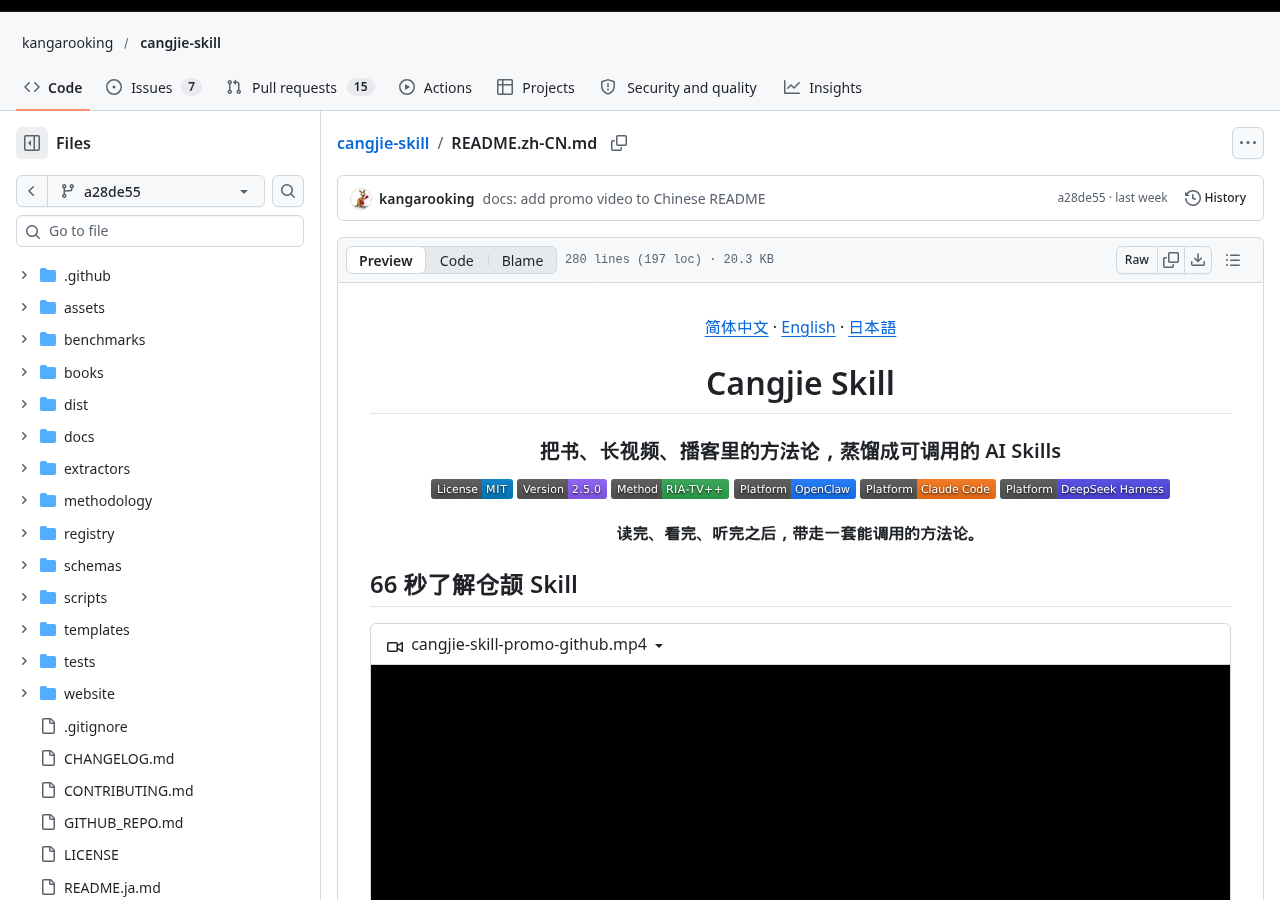
Which clients and environments are available?
The repository’s README explicitly lists OpenClaw, Claude Code, and DeepSeek Harness; Among them, DeepSeek Harness also has a plugin installation package compatible with v2.5.0. The repository does not declare that Codex has completed compatibility verification in this document, so it cannot be written as having been successfully implemented in Codex based solely on the filename or directory format.
| Project | Explanation in the materials | Use the front boundary |
|---|---|---|
| OpenClaw | README is listed as a supported platform | This is an author’s statement; no runtime verification was conducted this time |
| Claude Code | README is listed as a supported platform | This is an author’s statement; no runtime verification was conducted this time |
| DeepSeek Harness | Provides standalone plugin installation packages | You need to have the DeepSeek Harness first and verify the downloaded package |
| Definite scripts | Python 3.10+ and PyYAML are required | tiktoken and jsonschema are optional dependencies |
Warning “Author lists supported platforms” does not mean that all versions, operating systems, and clients are independently operational. Before officially starting the workflow, you should first test run a publicly available, controllable file and check whether the product can be recognized and called by the target client.
How to start so you don’t go off track right away
- Prepare the full text: it can be PDF, EPUB, TXT, subtitles, or transcription. If there is no accessible text, the project requires stopping rather than generating from memory.
- Supplement meta information: Books need the title, author, and year of publication; Videos, podcasts, or courses require titles, authors or speakers, and publication dates for traceability.
- Initial usage purpose: Prefer single for learning and browsing; Prefer pack when integrating daily workflows or needing cross-content combination.
- The first time you try only one piece of content: first confirm the extraction quality, call method, and test results, then decide whether to batch process.
The author’s RIA-TV++ process first understands the entire material, then different extractors search for frameworks, principles, cases, counterexamples, and terminology; Candidate content then goes through source adequacy, actionability, and task gain checks before deciding whether to become an independent skill or remain in a unified routing portal. Finally, representative task testing, compilation, and delivery are also performed.
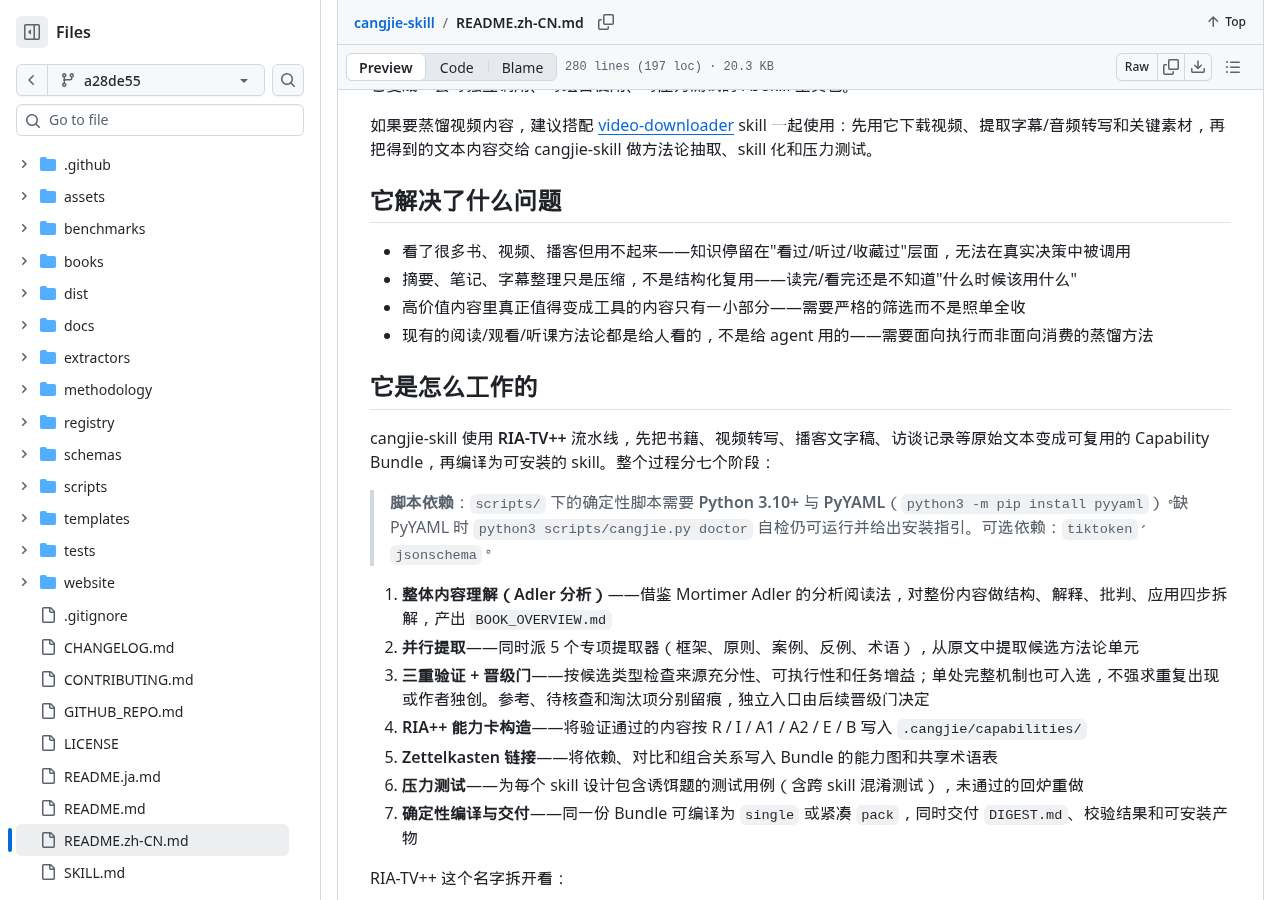
The code is free, not all upstream and running costs
The repository code uses the MIT License, which can be used, copied, modified, merged, published, distributed, sublicensed, and sold free of charge, but copyright and license statements must be retained; The software is provided “as is” without any warranty.
This does not automatically reduce the entire workflow to zero cost. Running it still requires a compatible agent environment, Python 3.10+, and PyYAML; When processing videos or podcasts, subtitles, transcription, or other usable text must be obtained first. Whether the specific model, cloud services, and content acquisition process called by the agent is charged should be checked separately, not by referencing the warehouse’s MIT license.
Warning The MIT license covers the software and documentation in this repository and does not automatically grant redistribution rights for input books, courses, videos, podcasts, and their materials. After distilling copyrighted content into skills, whether it can be publicly distributed must be separately verified for the scope of authorization of the original content.
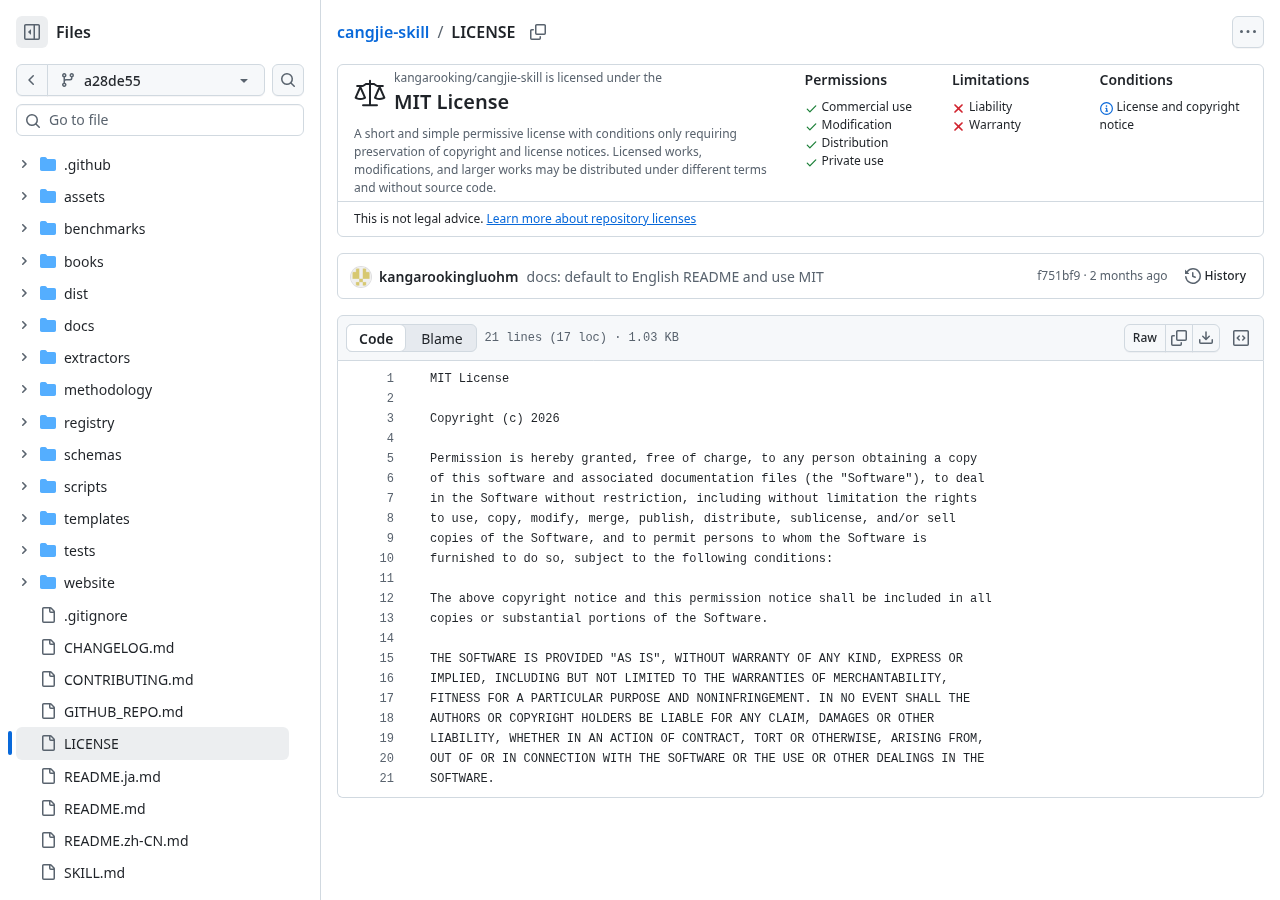
Its value lies in the process; the real results still need to be evaluated by oneself
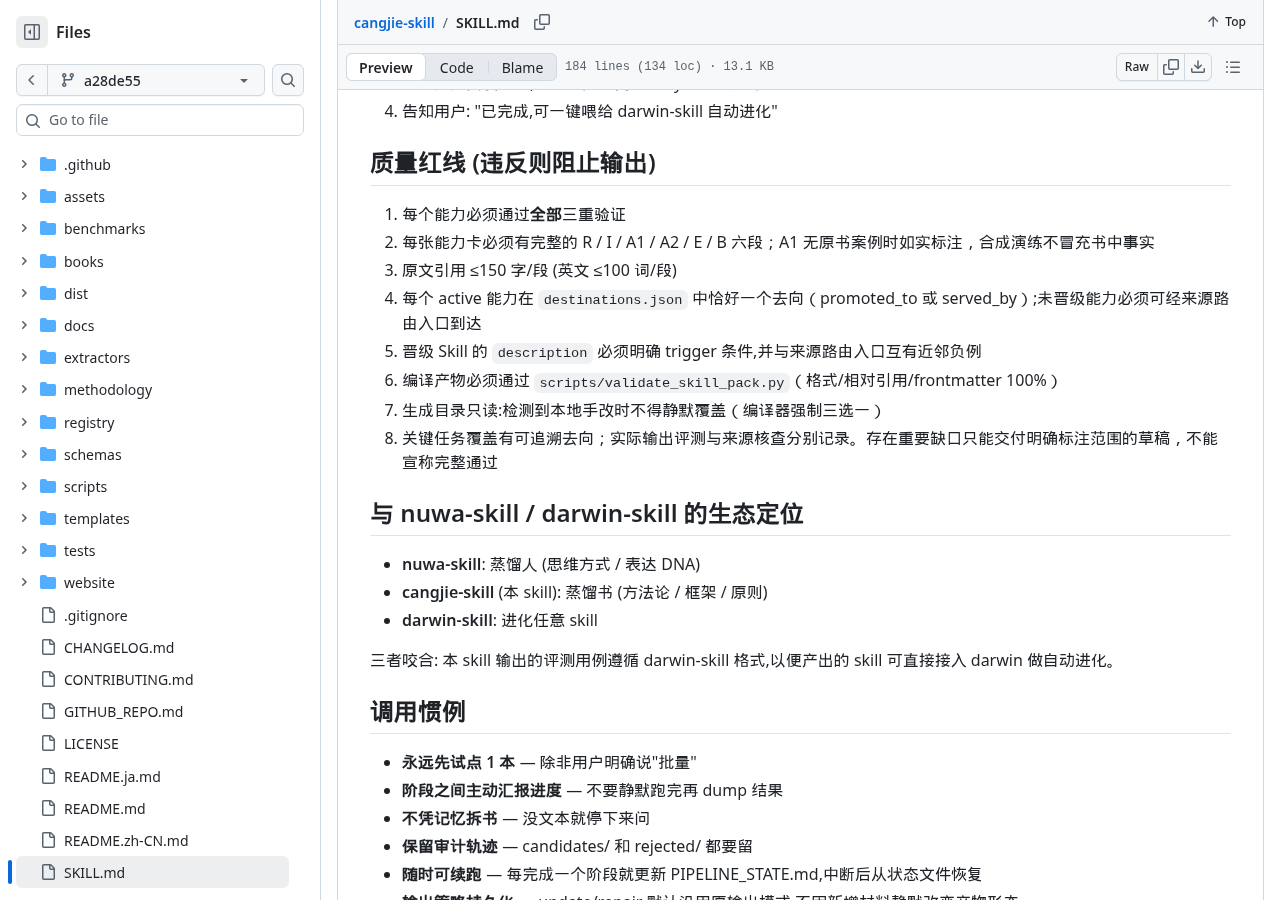
This project not only provides prompts but also describes steps such as capability cards, coverage audits, stress testing, compilation, snapshots, rollbacks, and manual modification checks. It aims to solve consistency and traceability in skill production, rather than having Agents casually summarize and then announce completion.
The snapshot records 11,055 stars and 1,285 forks, created on April 16, 2026, with the most recent push on October 2, 2026; The license is MIT, and the repository is not forked, archived, or disabled. The snapshot also records an increase from 11,007 to 11,055 in 1.1 days, but this observation window only shows changes during that period and cannot replace long-term trend judgment or feature quality verification.
Warning This time, only the README, SKILL.md, license, and repository status were verified; no scripts were executed, nor was end-to-end testing completed on any client. The sample warehouses listed by the author can illustrate the expected product form and cannot be falsely attributed to independent reproduction, security audits, or compatibility proofs.
Who is worth trying?
- Suitable for: Those who already have legally available long texts and want to integrate methodologies into Agent workflows, rather than just one summary.
- Suitable for: Those willing to check sources, boundaries, trigger conditions, and test results, and willing to pilot with a single piece of material first.
- Not suitable for now: For those who only have video links without subtitles or transcription, and want tools to restore the entire content out of thin air.
- Not suitable for now: Those who only want to imitate the author’s personality or plan to publicly distribute generated results without review.
The safest starting point is to select a piece of material with clear copyright boundaries, familiar to you, and able to verify the original text, and use a single-model for small-scale pilots. During acceptance, don’t just look at whether the file is generated; randomly select a few abilities to verify sources, trigger conditions, execution steps, failure boundaries, and actual task results. Only when these can match can Cangjie Skill transform from a “data organization project” into a truly usable workflow.
Project firsthand information
🧰 Tools I build
I maintain all of these tools myself. Preview builds are clearly labeled; the release pages are the source of truth for downloads, updates and known limits.
Info: HyphenBox Status: Official releases
A radar for free LLM APIs: availability is re-tested continuously, one local interface for all of them, and keys stay on your machine
Info: LocalBrain Status: Official releases
A multimodal MCP toolbox for local models: TTS, Whisper and video generation in one place
Info: ScreenLex Status: Official releases
Learn new words while you watch shows. Free, for Mac and Windows
Info: HyphenScreen Status: Official releases
Screen recording and smart editing in one: a DaVinci-style timeline, automatic redaction and a check of the finished video before export. Free
Quote: HyphenTech Make AI your superpower Local deployment · Free resources · Self-made software https://hyphentech.top
Late nights and burned API credits went in,a cup of tea comes back out — only if you feel like it.
Scan with WeChatPress and hold to save the image, then open it from your album in WeChat Scan

Comments
Loading comments…