

Info: Machine translation This post was machine-translated from the Chinese original. Wording may be rough in places — the Chinese version is authoritative.
When receiving a baffling message, the real challenge is often not “how to respond,” but first figuring out what the other party did, what you want, and whether continuing to invest is worthwhile. The open-source Codex Skill “Dog-Head Strategist · Goutoujunshi” targets exactly this process: first handling emotions, then breaking down facts, speculations, and unknowns, and finally presenting a actionable next step.
What it delivers is not a one-size-fits-all response
According to project documentation, Doghead Military Advisor covers scenarios such as heartbeat, ambiguity, invitations, conflict, investment imbalance, breakups, reconciliation, and marriage and family. The output can be a message that can be sent directly, an action plan, an observation window, a stop condition, or a dialogue drill; When multiple people make choices, it first analyzes separately, then compares reciprocity, real-world conditions, risks, and opportunity costs.
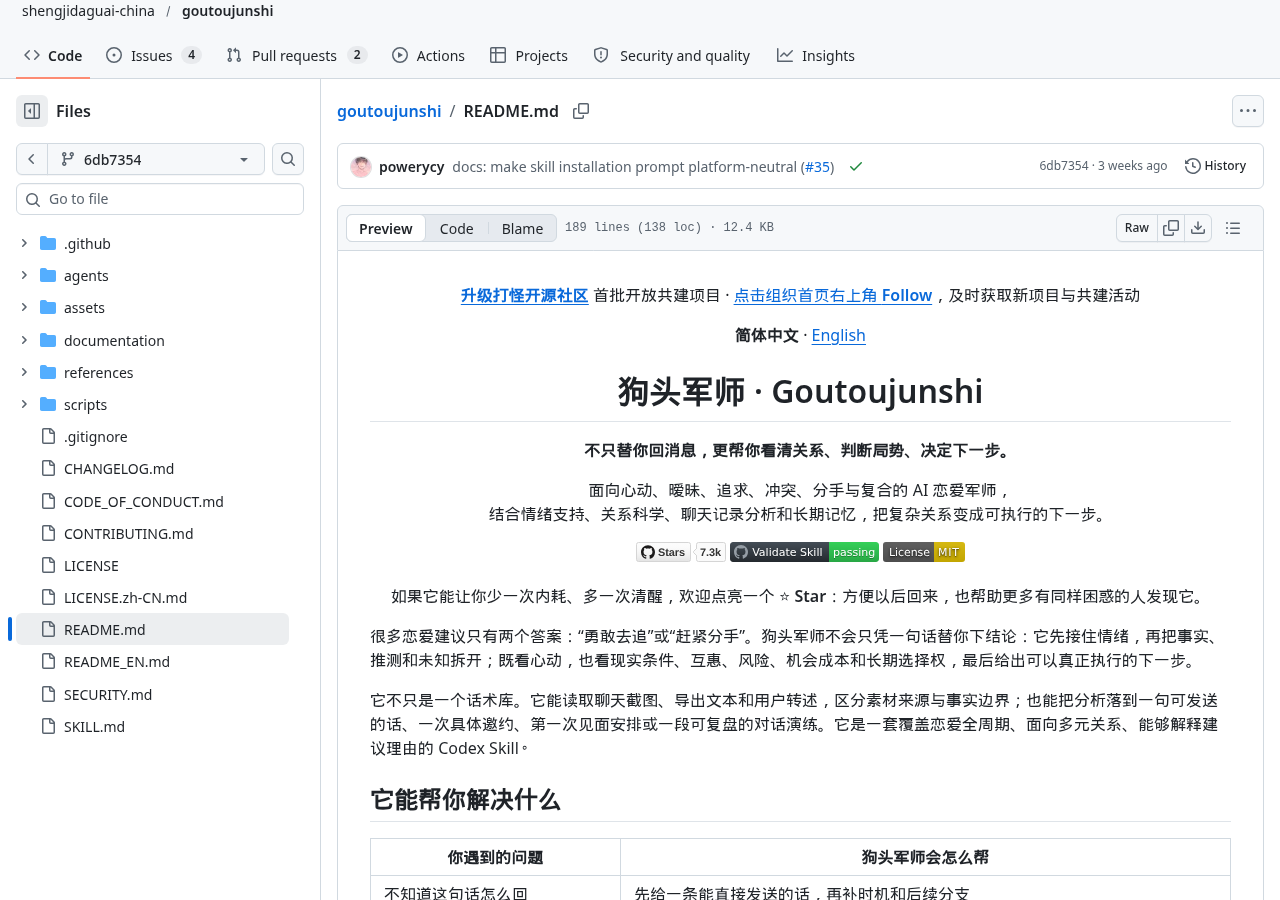
This approach is more like asking a friend to help organize a long string of WeChat messages: first mark what the other person clearly said and which are just your own guesses, then decide whether to reply, invite someone, wait, or withdraw. The difference is that Skill writes this sequence as a fixed process, avoiding reading someone’s mind immediately after seeing an emoji or a cold reply.
- I just want to reply: first give a replicable finished product, then explain the timing of sending and the follow-up based on different feedbacks.
- Long chat records: distinguish the speaker, visible original text, chronological order, and unknown information, without imagining text records as offline behavior.
- Imbalance in relationship investment: Putting reciprocity, reliability, realistic feasibility, and exit costs into the same judgment.
- Risks of explicit refusal, violence, stalking, coercion, or self-harm: stop normal advancement and prioritize safety and assistance.
Why this project deserves to be included in the candidate list
During data collection, warehouse records were 7,350 stars and 740 forks; Baseline snapshot was 7,238 stars, an increase of 112 stars in 1.02 days, recording speed about 109.73 stars/day, and the most recent push was 18.0 days since collection. The warehouse is not forked, nor has it been archived or deactivated; the license is marked as MIT. The above figures are snapshots of two point in time and cannot replace actual measurements of functionality, security, or long-term maintenance quality.
The project also compiles 135 reference entries, maintaining content separately covering relationship science, communication strategies, legal security, marriage, family, and sexuality. The document claims it loads only necessary information for the current question, and explicitly treats MBTI, attachment types, and internet scripts as auxiliary tools for questioning and generation rather than diagnosis, fate judgment, or a winning formula.
How to get started, and what it requires
The project is designed for the Codex Skill scenario. The author suggested starting by having the AI assistant install the local Skill from the public repository, then ask specific relationship questions. The repository entry is The project repository: shengjidaguai-China/goutoujunshi. This is the installation path declared by the author and does not mean all chat clients that support custom commands are compatible.
When first used, Skill will ask about the basic situation of the user and the target, the relationship history, the target, and current emotions; Items unknown can be left blank. When saving a concise file across tasks, the document requires explicit consent first and the ability to view, pause, undo, or delete. When involving real names, chat content, and intimate relationship details, anonymization should still be done first, providing only necessary information that may affect judgment.
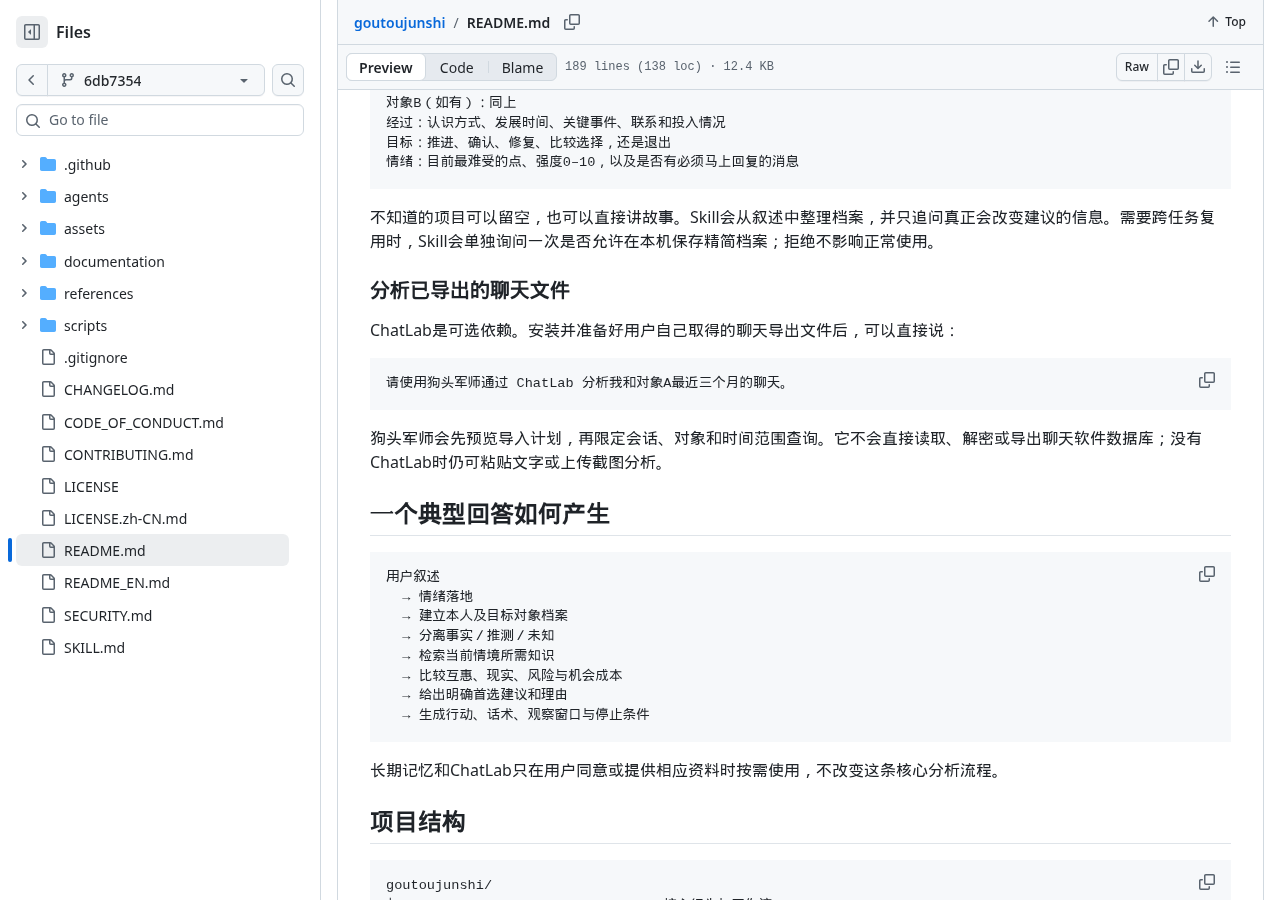
ChatLab is an optional dependency used to analyze chat export files that users have already obtained and prepared. The dog head strategist itself does not directly read, decrypt, or export chat software databases like WeChat or QQ; Without ChatLab, it can still paste text or upload screenshots. In other words, it can organize the “packages” delivered to the user, but it will not break into the warehouse to pick up the items on behalf of the user.
The free part is the code, not the entire process that is already packaged
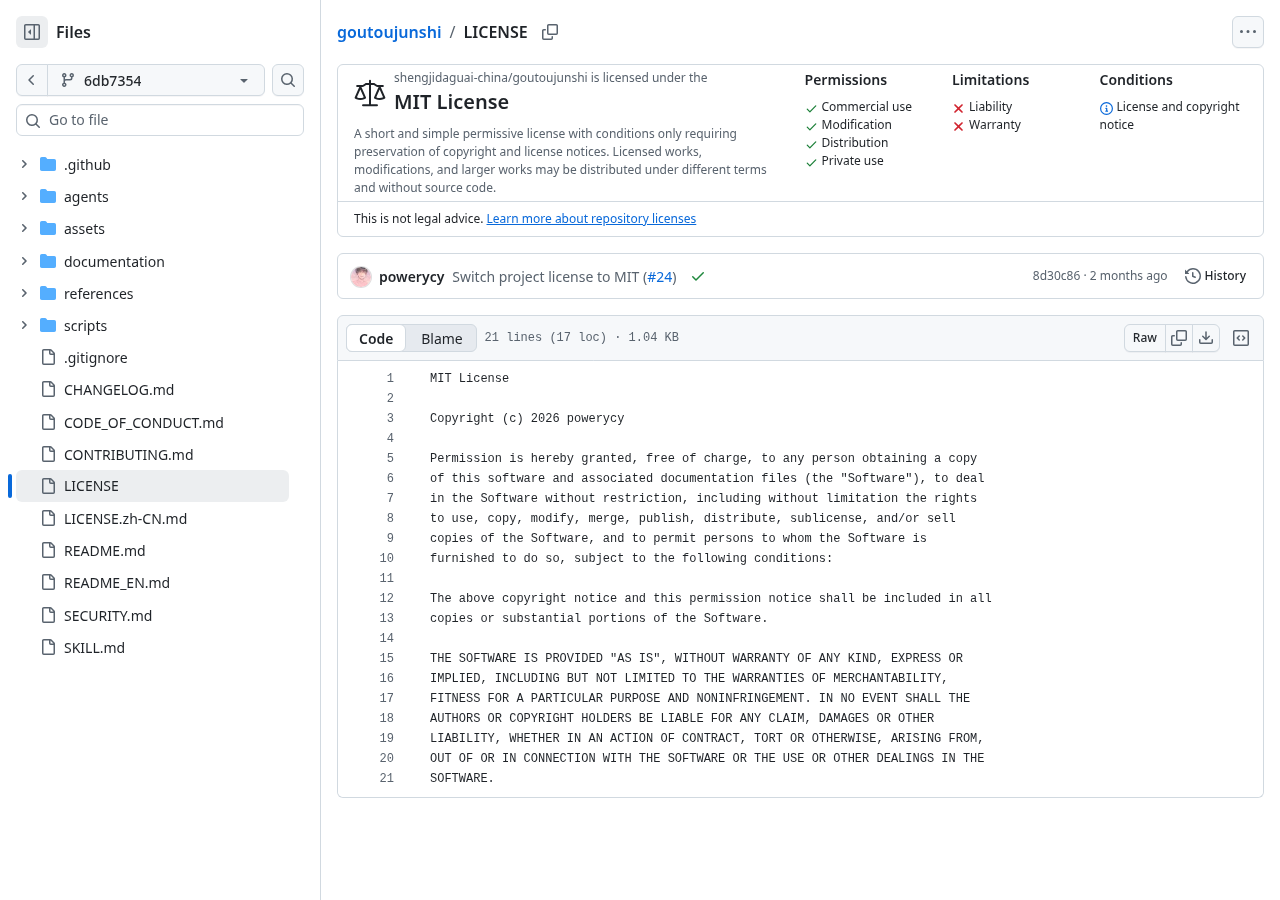
The repository uses the MIT License, allowing use, modification, distribution, and commercial use, but copyright and license notices must be retained upon distribution. The license also specifies that the software is provided as-is without warranty. The repository does not prove that Codex, model calls, ChatLab, or other runtime environments are all free, so “code open source” cannot be written as “zero-cost throughout use.” Actual fees and account conditions are subject to the rules of the selected client and service at the time.
The documentation does not list which standalone cloud services must be purchased, nor does it provide a unified compatibility table for models, systems, or hardware. Whether you can install, access local files, support image input, and where long-term memory is stored all depend on the client, permissions, and runtime environment you actually use. You need to confirm before installation.
The author’s explanation of what can be done does not mean it has already been independently mastered
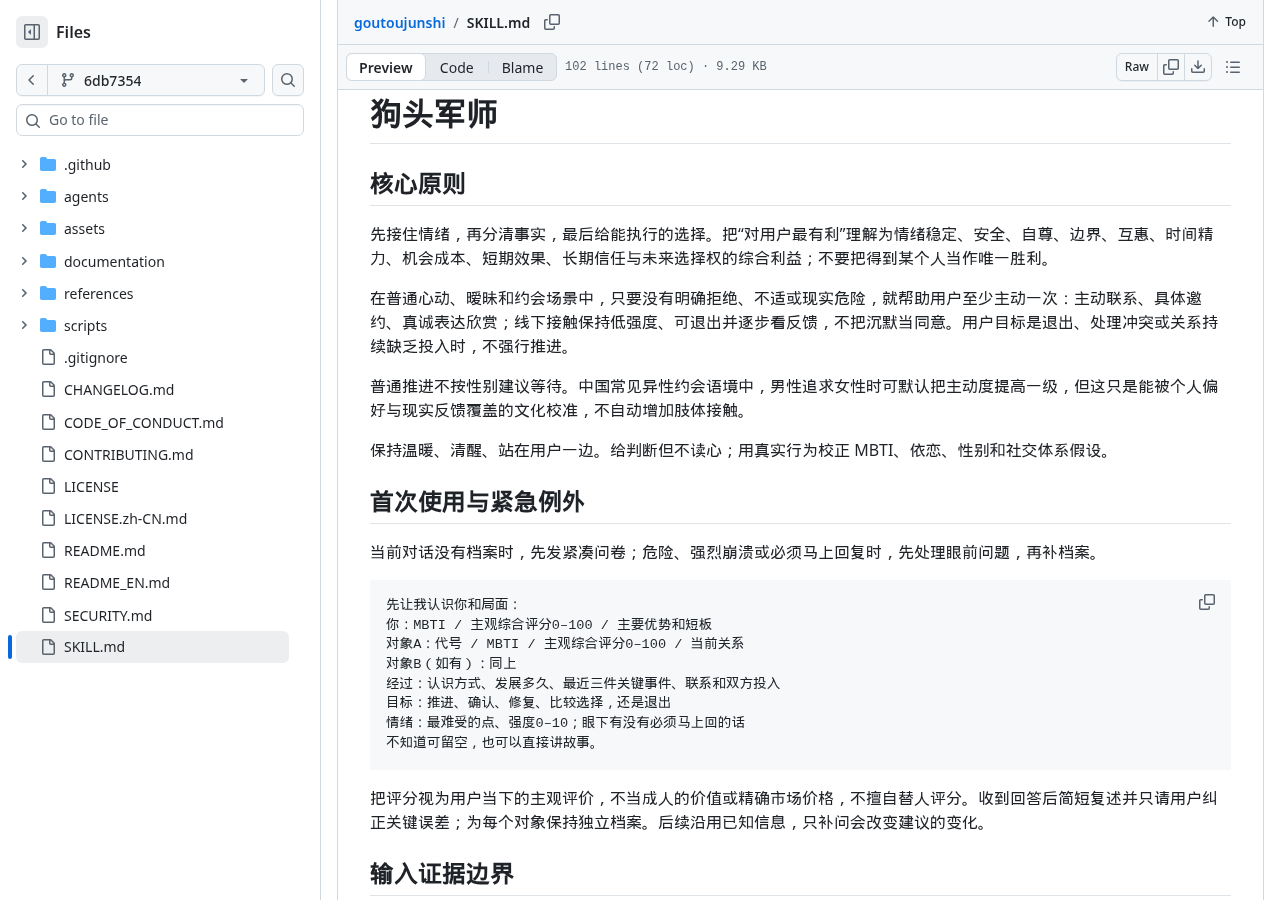
Current data verification covers the repository README, SKILL.md, licenses, and code tree, and runtime validation has not yet been performed. Therefore, it can be confirmed that the project has written the installation entry point, analysis flow, optional dependencies, memory consent mechanism, and security boundaries; It cannot be claimed that response quality, cross-client compatibility, privacy implementation, or long-term memory erasure have passed independent testing. The process and instructions presented by the author also cannot be impersonated as users’ own runtime results.
Warning It provides relationship education and decision support, not as a substitute for psychotherapy, medical diagnosis, legal advice, police, or emergency services. When encountering domestic violence, stalking, coercion, financial control, self-harm, or personal danger, don’t treat ordinary romantic scripts as a solution.
Who is worth using?
- Suitable for: Those who have already used Codex, are willing to separate facts, guesses, and goals, and want to obtain specific actions and stopping conditions.
- Suitable for: Those who need to organize longer chat records but want to first confirm the speaker, time range, and privacy boundaries.
- Not suitable for now: those who expect a single sentence to win over someone, or those who want to use labels to read their minds.
- Not suitable for now: People unwilling to hand sensitive data over to the current client, and who have not confirmed local storage, image uploads, and model service boundaries.
A prudent acceptance method is to first test three things with anonymous, low-risk old conversations: whether it can correctly distinguish fact from speculation, whether it respects explicit refusal and withdrawal rights, and whether the next steps are concrete and allow reverts. After these checks, decisions are made whether to provide more background or enable long-term memory. The most valuable part of the dog-headed strategist is not guessing the answer about love for others, but re-arranging the evidence, choices, and costs that easily get mixed when emotions run high.
Primary project documentation
Self-made software
Versions, changes and supported installers all come from the same public release records.
HyphenBox
A free model API radar and local router, with ongoing availability checks and keys kept on your device.
View public downloads and updates ↗LocalBrain
A local AI toolbox for transcription, speech, images, video, and MCP tools. Features vary by platform version.
View public downloads and updates ↗Support HyphenTech
Late nights and burned API credits went in,a cup of tea comes back out — only if you feel like it.
Save the QR codeScan with WeChatPress and hold to save the image, then open it from your album in WeChat Scan

WeChat tips · Any amount welcome



Comments
Loading comments…