
Info: Machine translation This post was machine-translated from the Chinese original. Wording may be rough in places — the Chinese version is authoritative.
When asking a programming assistant to modify a webpage, the hardest thing to explain is often not “where the buttons are placed,” but “it already works, so why is it still not good?” Font size, spacing, color, and feedback — problems can be crowded on the same page. A sentence like “be more refined” doesn’t explain what to change first or what must be retained.
Impeccable aims to solve this kind of communication problem: giving the programming assistant a set of interface design and inspection processes, breaking down general modification requests into targeted actions. The author clearly states that it is better at iterating around existing interfaces and can also create new pages. For those who already have product pages but lack design review, this is more worth paying attention to than just looking at beautiful samples.
It delivers a process modification, not an automatic guarantee of becoming beautiful
You can think of these skills as briefings for renovation workers. Just say “make the living room look good,” and the other person guesses aesthetics; Explain, “Keep the furniture, clear the hallway, then check the lighting,” and the actions become more specific. The skills in Impeccable are responsible for organizing requirements, reading project backgrounds, and selecting handling methods; the real code changes are still the programming assistant that supports them. It’s not a design model that does all the work for you independently.
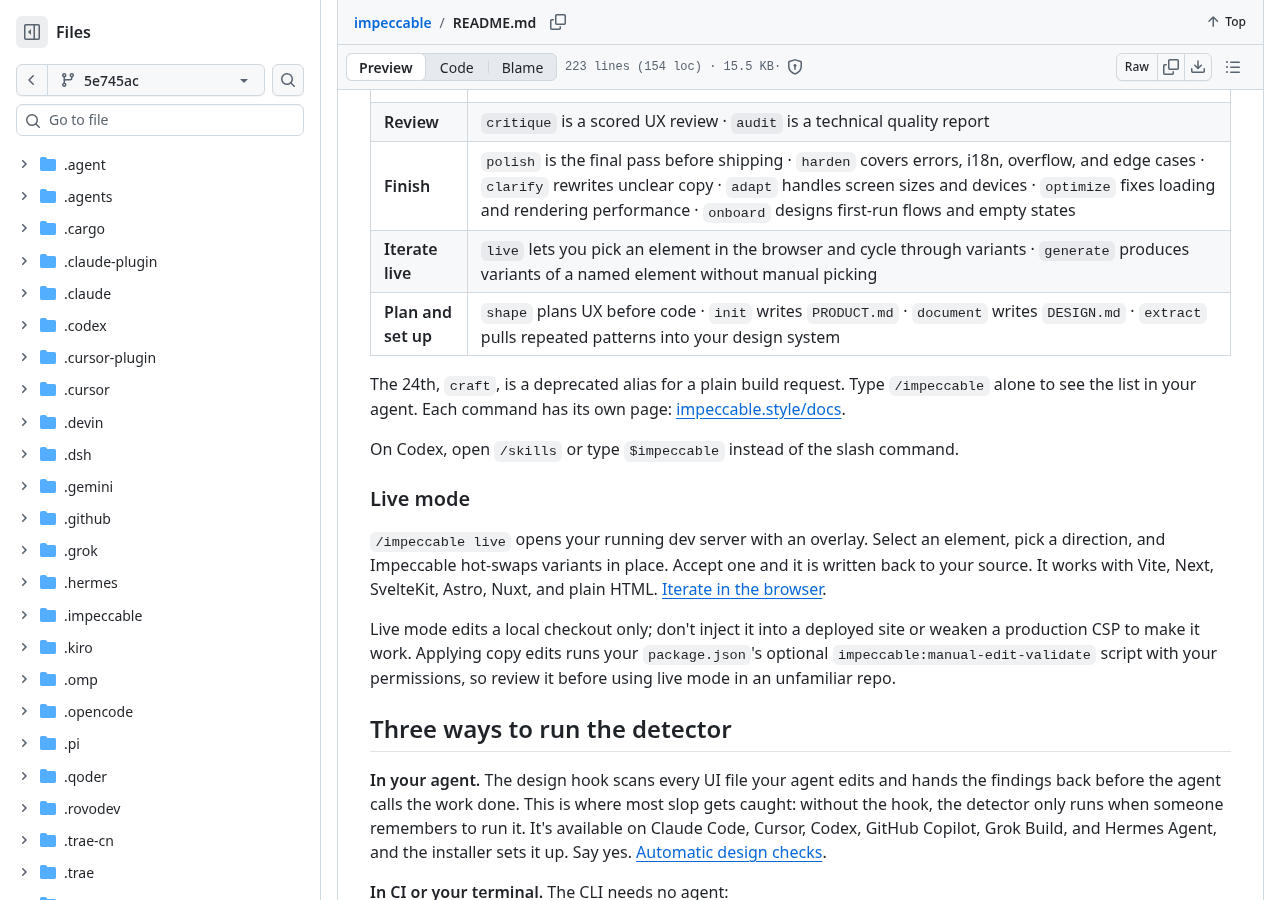
The entry points provided by authors each have their own roles: critique evaluates interfaces based on usability principles and prioritizes modifications; audit checks accessibility, performance, themes, and responsiveness; polish is used for polishing before delivery; harden focuses on error states, internationalization, content overflow, and boundaries. Here, “responsive” means that even when switching to different sizes like phones, the content and actions can still be reasonably arranged.
Therefore, the deliverables to look forward to are not just modified pages, but also prioritized check results and project descriptions for future modifications. The scope of application also has boundaries: skill files target the frontend interface, explicitly excluding pure backend and non-interface tasks. Database issues will not be automatically resolved just because design skills are installed.
First, the product is presented, then narrowed down to a single component
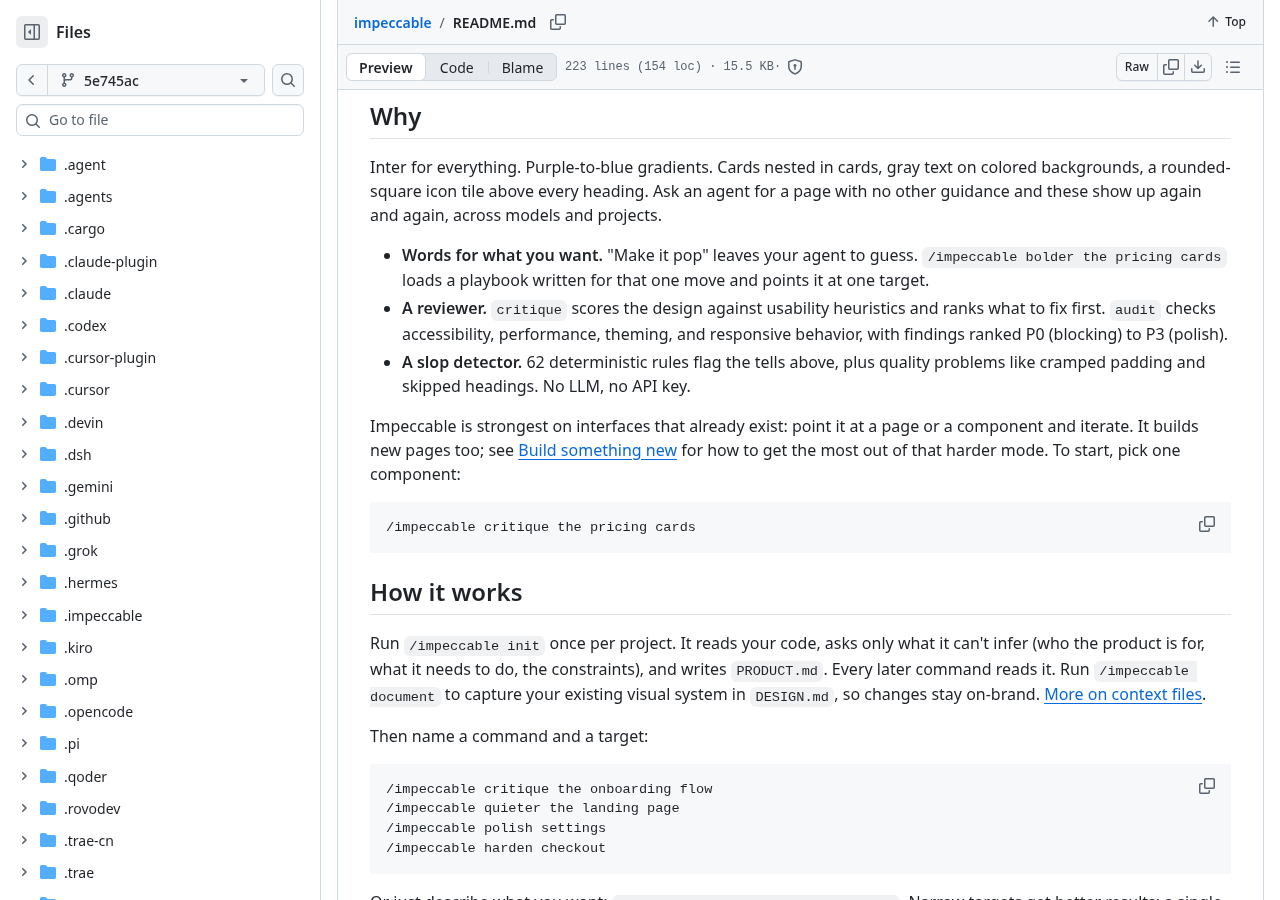
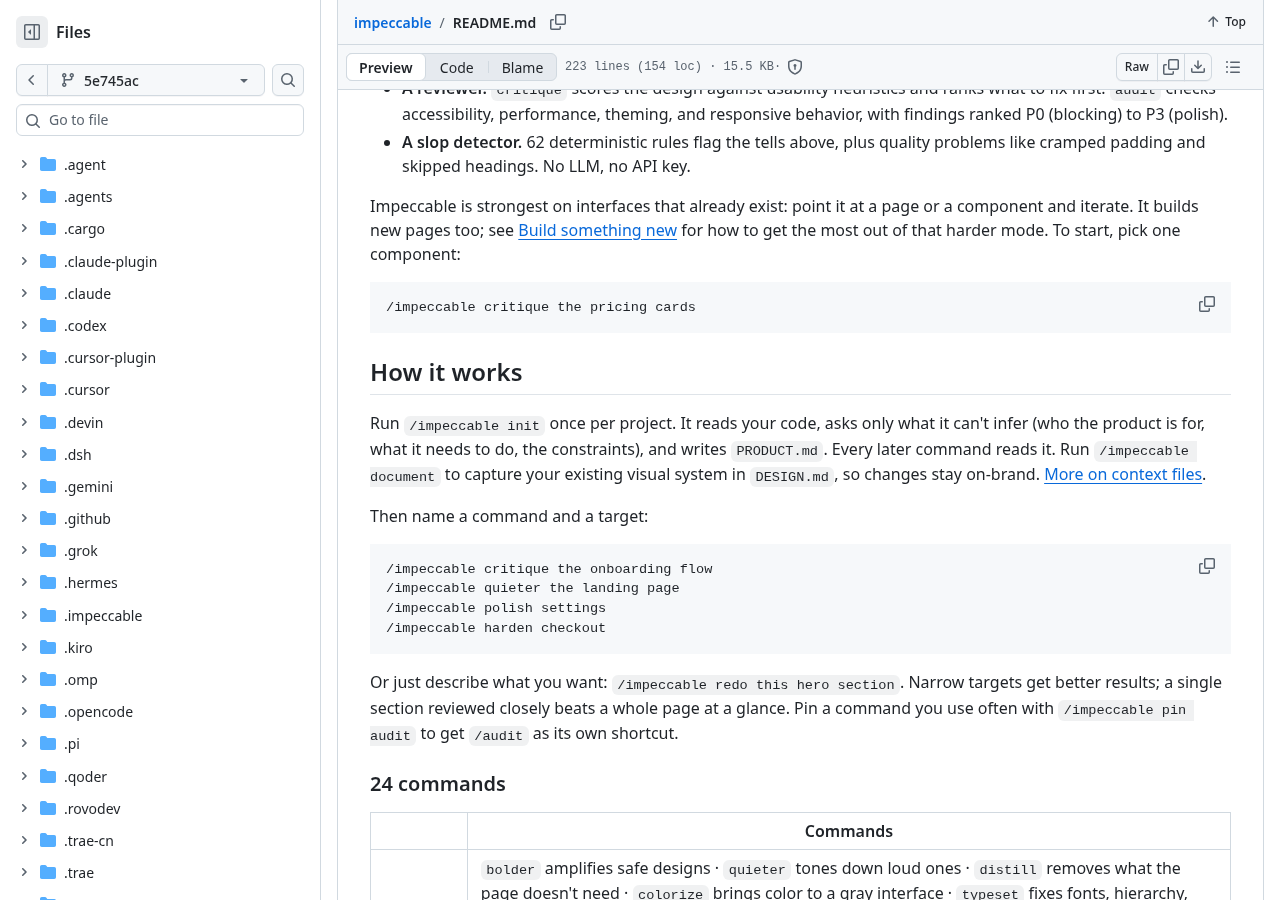
According to the author, initialization reads the code, only asking questions about unpredictable content, such as who the product is for, what needs to be accomplished, and what limitations exist, before writing it into the PRODUCT.md. Subsequent commands will read this explanation. Another document entry point is used to record existing visual systems into the DESIGN.md, allowing modifications to retain the original design as much as possible.
This is like clarifying how to live in the house before renovation: some spaces need to showcase effects, while others need ease of passage first. Back in the software, the promotional page needs to attract people to take action, while the backend and settings page focus more on being easy to find, understand, and easy to operate. Skill files also distinguish these usage goals, rather than requiring all pages to be changed to be eye-catching or complex.
You don’t have to hand over the entire site at the start. The README recommends first selecting a component and pointing out that the narrower the goal, the easier it is to achieve targeted results. A safer trial method is: select a section of an existing page that explains the actions the user needs to complete, what must be retained, and the current issue, let the assistant evaluate first, and then decide on the scope of modifications.
Acceptance should also return to this action: whether the previously hard-to-find entry is clearer, whether the text becomes longer and blocks the buttons, and whether the operation can still be completed on the phone. Only changes in appearance do not prove that usage issues have been resolved; The inspection report listing problems does not mean that after modifications, you no longer need to look at the actual page. The skill file itself requires viewing the final rendering result.
The free ones are open-source projects, not the full cost of the programming assistant
The repository uses the Apache 2.0 license and is an open-source resource. The author also emphasizes separately that deterministic detectors do not use large models and do not require API keys. This commitment has a clear scope: it refers to detectors, and not all processes of design, code modification, and image generation are free.
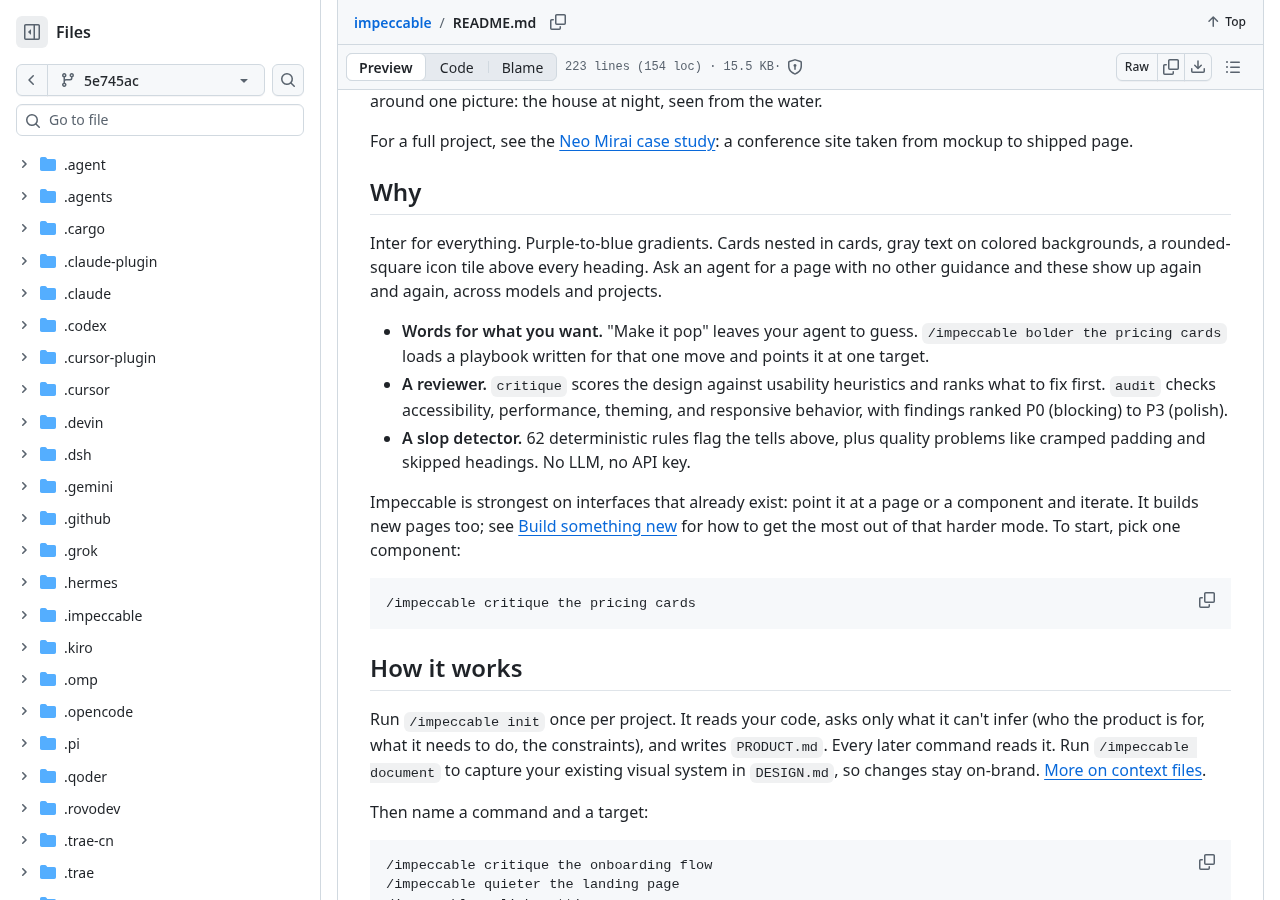
Deterministic checking can be understood as checking the waybill according to a fixed list: identifying which fields are missing or formatting incorrectly, and identifying each item according to the rules. The README lists 62 rules to detect duplicate design patterns and quality issues. But a fixed checklist cannot judge whether the entire page is suitable for the business, just as filling out the waybill does not mean the contents of the package meet the requirements.
The detection range also depends on the input. According to the author’s instructions, when scanning source files like JSX or TSX, only mode rules are run; For issues like low contrast or text that require seeing the actual page, the page address must be scanned. For example, when inspecting clothes, you can see the stitching during tiling and only know if it fits when worn. Just scanning the code and reporting “Comprehensive interface check” goes beyond the conclusions these rules can support.
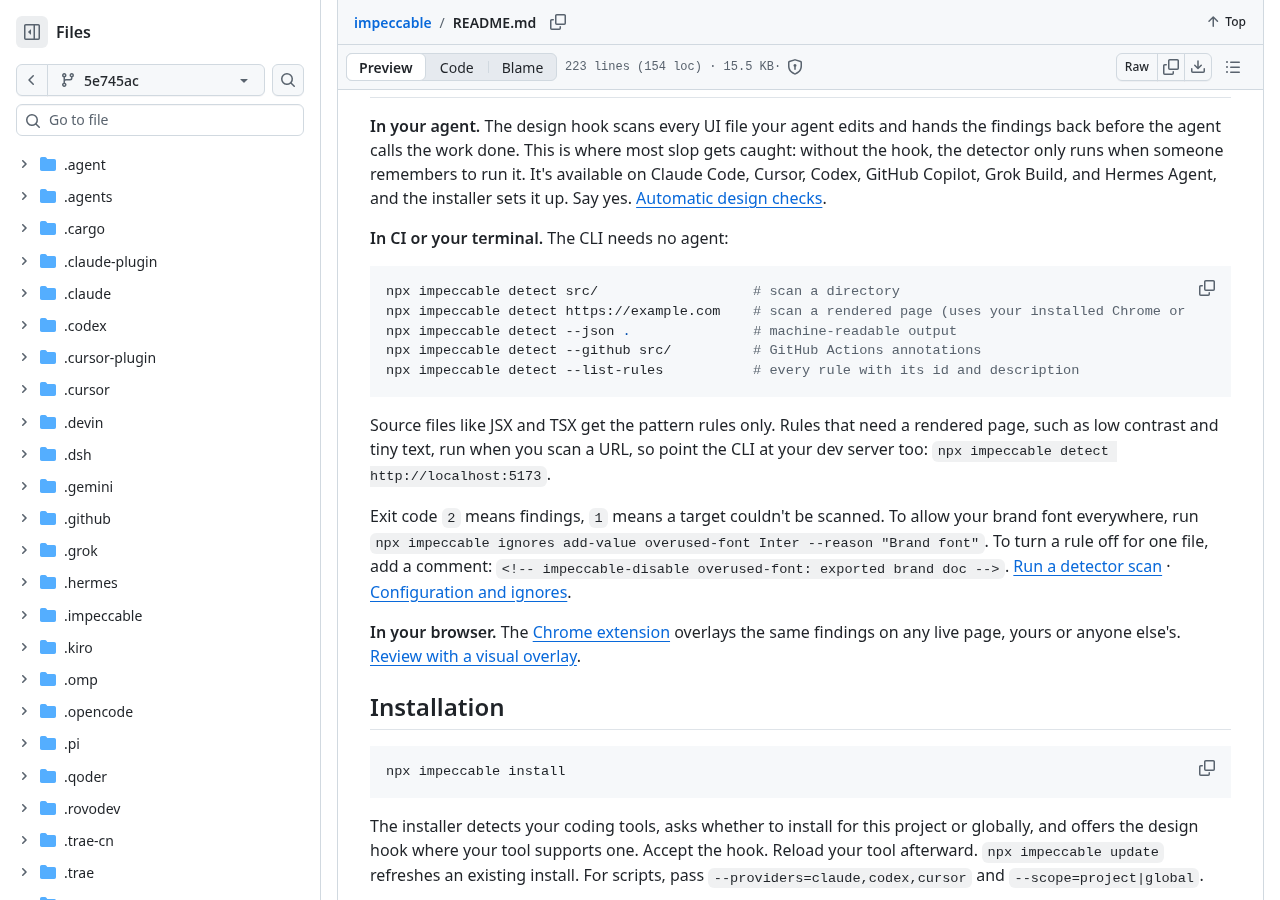
Design and code modifications still depend on the programming assistant and its model, with costs to be confirmed separately for the corresponding service. The author also describes a complete visual draft and then a route to implementation, but this option only appears when the client has image generation capabilities. Existing materials do not provide a unified free quota, nor do they prove that purchasing a cloud service is mandatory; Therefore, zero-cost completion of the entire process cannot be guaranteed.
Client support and auto-execute permissions should be viewed separately
The author states support for clients such as Claude Code, Cursor, Codex CLI, GitHub Copilot, Gemini CLI, and provides their respective skill directories and installation instructions. Codex’s call entry point differs from other clients; the README states it can be accessed from the skills menu or using $impeccable. These are compatibility instructions provided by the author and are not yet validated across clients.
Environmental dependencies are not simply “just install a skill.” The README explains that Node is used for the npx installation portal; The skill itself calls a standalone engine provided with the package or first download. Manually copying skills skips the auto-check hook and sub-agent, so “skill appears” and “automatically checks after every modification” are different states.
An automatic check hook is a checklist pre-attached after an action, similar to how waybill verification is triggered after a package is shipped out, so you don’t have to manually click it again each time. The convenience lies in automation, but so does the risk: the author reminds that command hooks installed in Claude Code may continue to run even if the model’s own commands are rejected, and the first edit may trigger engine downloads. Codex’s project hooks require separate approval and may need to be approved again after related updates.
Warning Review the installation content and hook permissions first, then decide whether to enable auto-execution. Authors restrict Live mode to only edit local code copies; it should not be injected into deployed sites nor relax production environment content security policies for its use. Optional validation scripts in unfamiliar projects also need to be checked first.
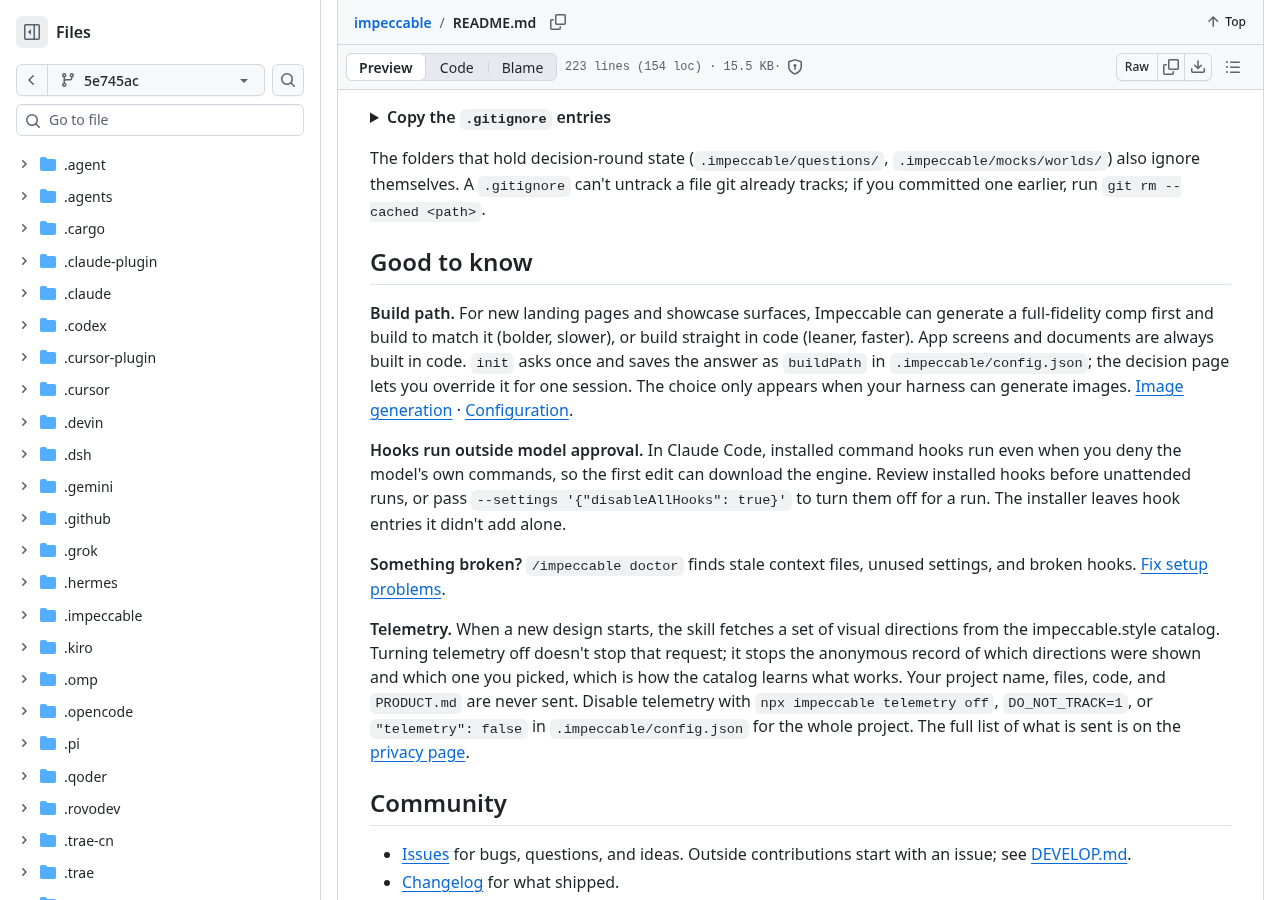
If you need to browse the page while selecting a solution, the author offers a Live mode: open the running development service, select the element, switch variants, accept it, and write back to the source code. The README lists adaptation objects including Vite, Next, SvelteKit, Astro, Nuxt, and regular HTML. What kind of project it suits and whether it can reliably write back in specific environments still needs to be verified with your own code.
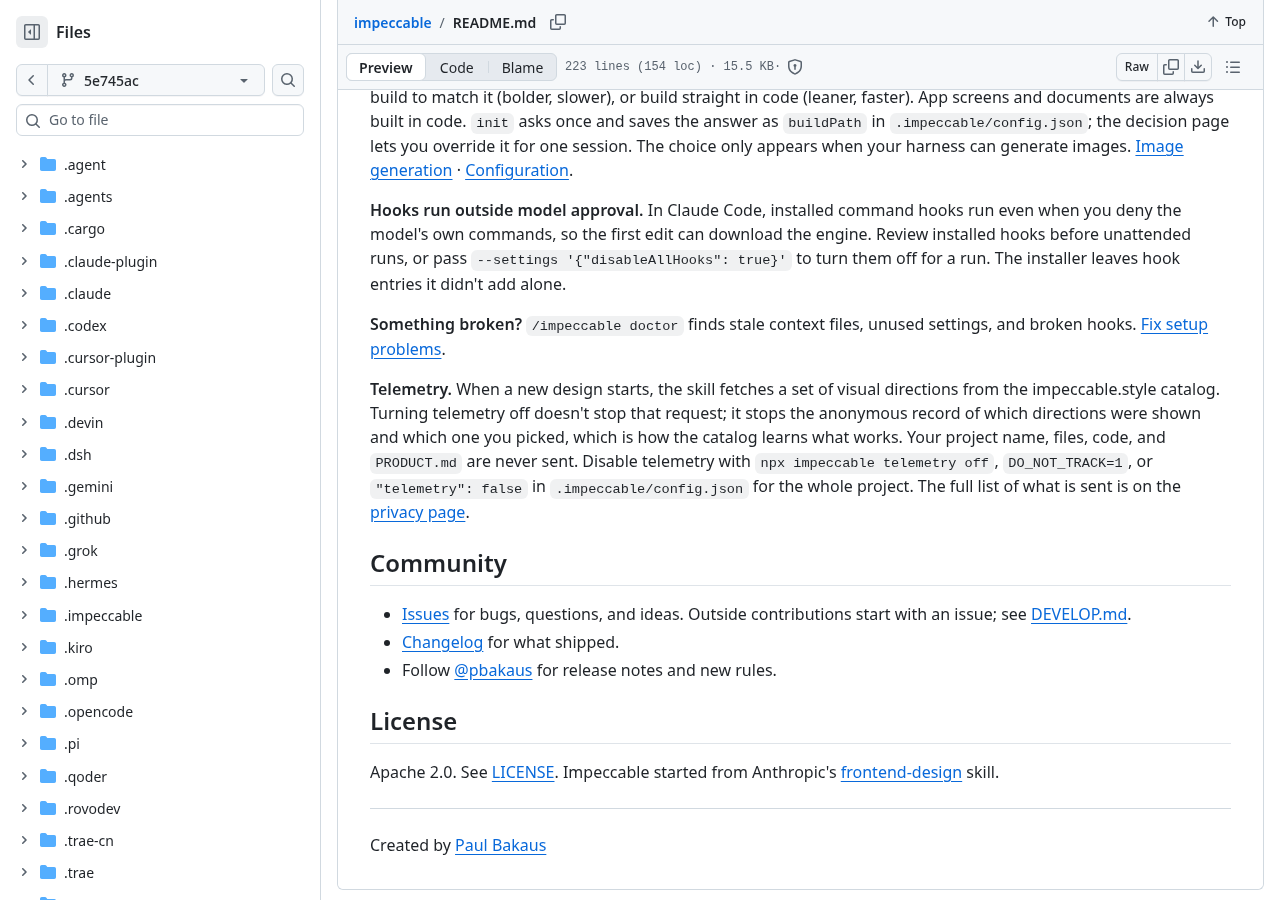
It is also important to distinguish between turning off telemetry and completely disconnecting the network. According to the README, the new design will start by obtaining visual directions from the online directory; Disabling telemetry will not stop this directory request. The author states that project names, files, code, and PRODUCT.md will not be sent, but this remains a privacy statement for the project team and cannot be considered fully offline based on this.
Author samples can indicate direction but cannot replace effect acceptance
The README shows a skill comparison for the same model Fable 5.1 and the same hotel website requirements. The author describes the difference as: when not in use, the page leans toward the common light-colored page and capsule buttons, and after use, the image is organized around the hotel’s night scene. This helps understand the visual direction the author pursues, but it is still a case study provided by the author, not an independent evaluation, nor can it prove that different tasks achieve the same improvement.
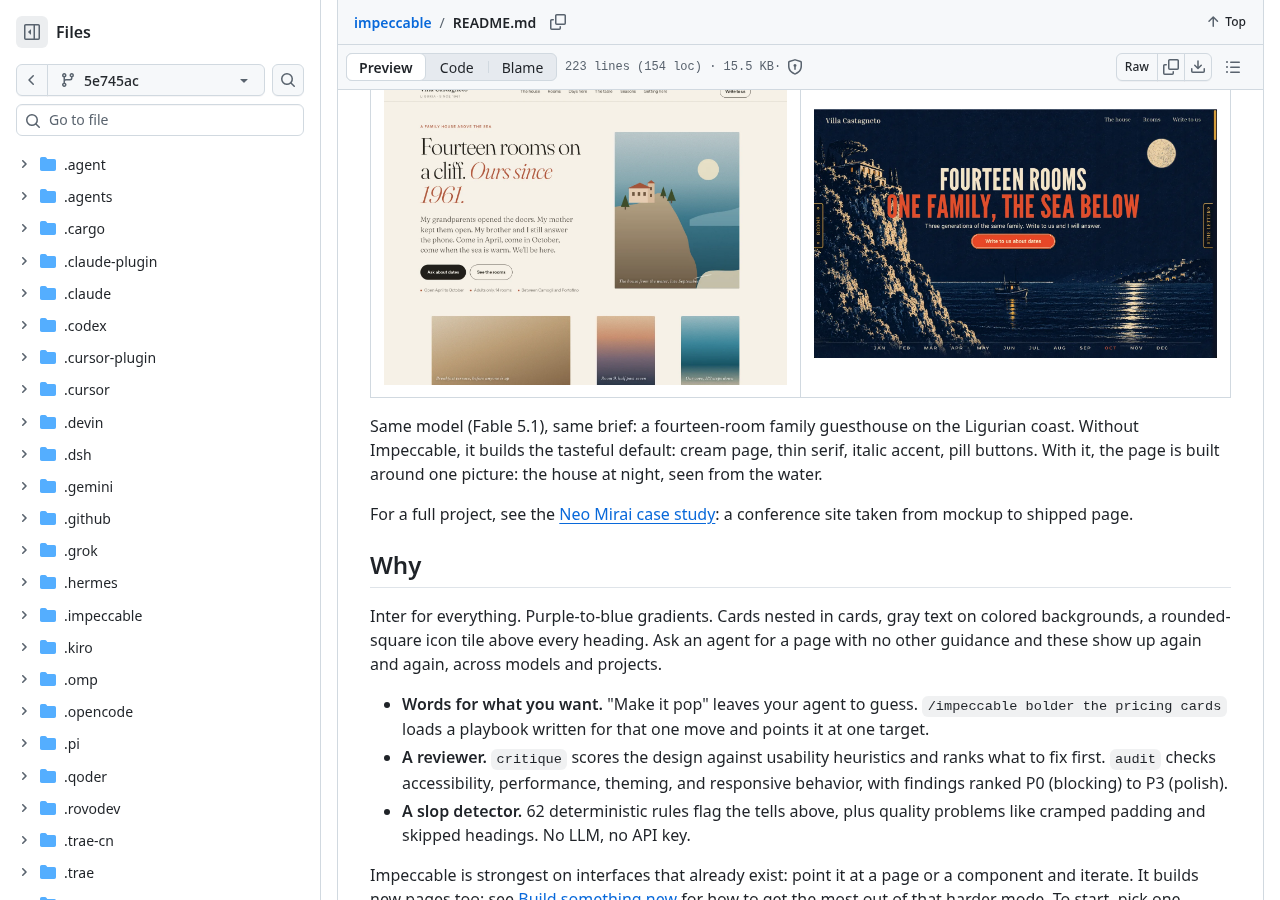
Samples especially cannot answer all usage questions: whether the page is easier to operate, whether maintenance costs have decreased, or whether complex states are complete—all require results corresponding to the tasks. Currently, there are no functional operation records or independent comparison results, so Impeccable is suitable as a design workflow worth trialing, rather than a proven universal quality improvement guarantee.
Licenses also need to clearly identify the applicable parties. The repository declares Apache 2.0 and provides a LICENSE; This does not mean that images, fonts, or other external content in the case can be freely used item by item. Existing materials do not provide a complete list of licenses for this content. Borrowing work methods and directly copying and displaying content should be handled separately.
Those with ready-made pages are better off starting small
If you are already using a programming assistant to create web pages, have a running page but often get stuck on “unclear where it doesn’t work,” Impeccable is worth considering. It connects background records, local modifications, design evaluations, and technical checks, potentially making the modification goals clearer. If you expect automatic design capability after installation, complete offline access, or free model fees, the existing data is insufficient to support these expectations.
The next step is to start reading Fixed version installation and usage instructions , select the entry point according to your client, and start from a component that does have a problem in the revertable local code copy. First, confirm that the assistant can read the project background, then check if the results are specific and whether the modifications resolve the original issue, and finally verify the actual page and additional service overhead.
To understand the scope of the task, you can see Impeccable Skill File; To confirm usage and distribution conditions, you can check Project License. Deciding whether to keep it should look at whether the issues on the specific page have been resolved, not whether the sample is impressive enough.
Primary project documentation
Self-made software
Versions, changes and supported installers all come from the same public release records.
HyphenAssistant
Continue your computer’s DeepSeek Harness session from a phone browser. The service, computer and network must stay online; model costs follow your existing setup.
View public downloads and updates ↗LocalBrain
A local AI toolbox for transcription, speech, images, video, and MCP tools. Features vary by platform version.
View public downloads and updates ↗HyphenBox
A free model API radar and local router, with ongoing availability checks and keys kept on your device.
View public downloads and updates ↗ScreenLex
Turn subtitles from your own films and shows into an English vocabulary library, entirely offline.
View public downloads and updates ↗HyphenScreen
Screen recording and editing with a Resolve-style timeline, automatic redaction and pre-export checks.
View public downloads and updates ↗Support HyphenTech
Late nights and burned API credits went in,a cup of tea comes back out — only if you feel like it.
Save the QR codeScan with WeChatPress and hold to save the image, then open it from your album in WeChat Scan

WeChat tips · Any amount welcome




Comments
Loading comments…