Info: Machine translation This post was machine-translated from the Chinese original. Wording may be rough in places — the Chinese version is authoritative.
If you don’t want to open Figma or AE and just want to hand over your requirements to the agent and finally get clickable prototypes, editable slides, or animation files, Huashu Design offers a route using HTML as an intermediary. It’s not a production-grade website generator; it’s more like a set of design processes handed over to the agent.
It delivers not just a rendering
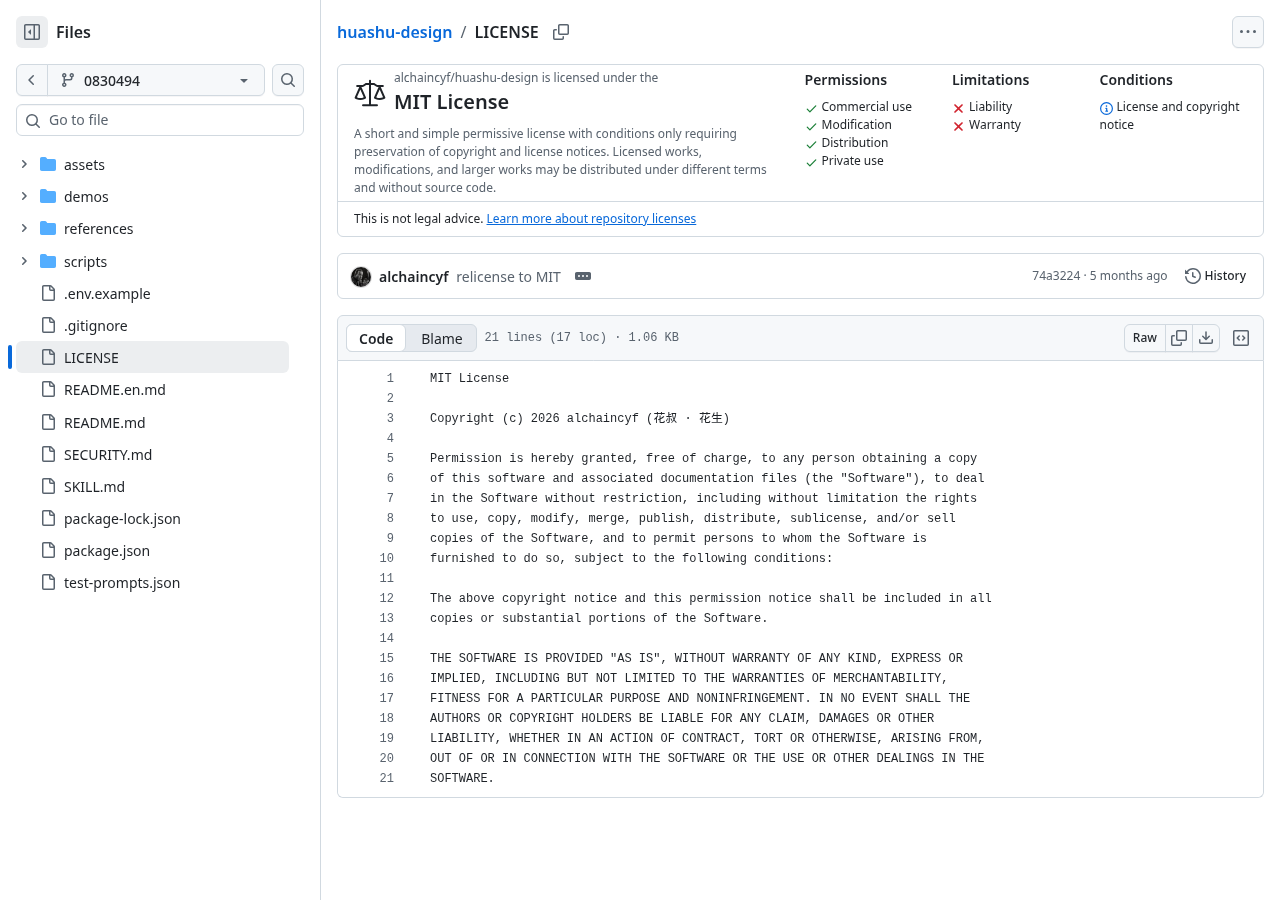
According to project documentation, Huashu Design can generate single-file HTML interactive prototypes, browser slides, editable PPTX, MP4, GIF, PDF, PNG, and SVG. The author also provides design direction exploration, five-dimensional review, and script export, aiming for continued demonstration, modification, or delivery of the results, rather than just viewing screenshots and ending the process.
| Mission | Main deliverables | The author lists typical time consumption |
|---|---|---|
| Interactive prototypes | Single file HTML, clickable interface | 10–15 minutes |
| Presentation slides | HTML deck, editable PPTX | 15–25 minutes |
| Timeline animation | MP4, GIF, BGM finished video | 8–12 minutes |
| Infographic | PDF, PNG, SVG | 10 minutes |
Time spent is based on the project README, a typical value given by the author, not an independent test result.
Its working method can be understood as giving the agent a renovation construction order: it’s not just about saying “make it look nicer” and handing over the house directly, but first presenting three real design directions for users to choose from; After making choices, they add brand assets, produce finished products, and check browser results. This process requires several steps compared to single generation, but it helps detect direction shifts earlier.
Before starting, look at the environment first, not just the installation entrance
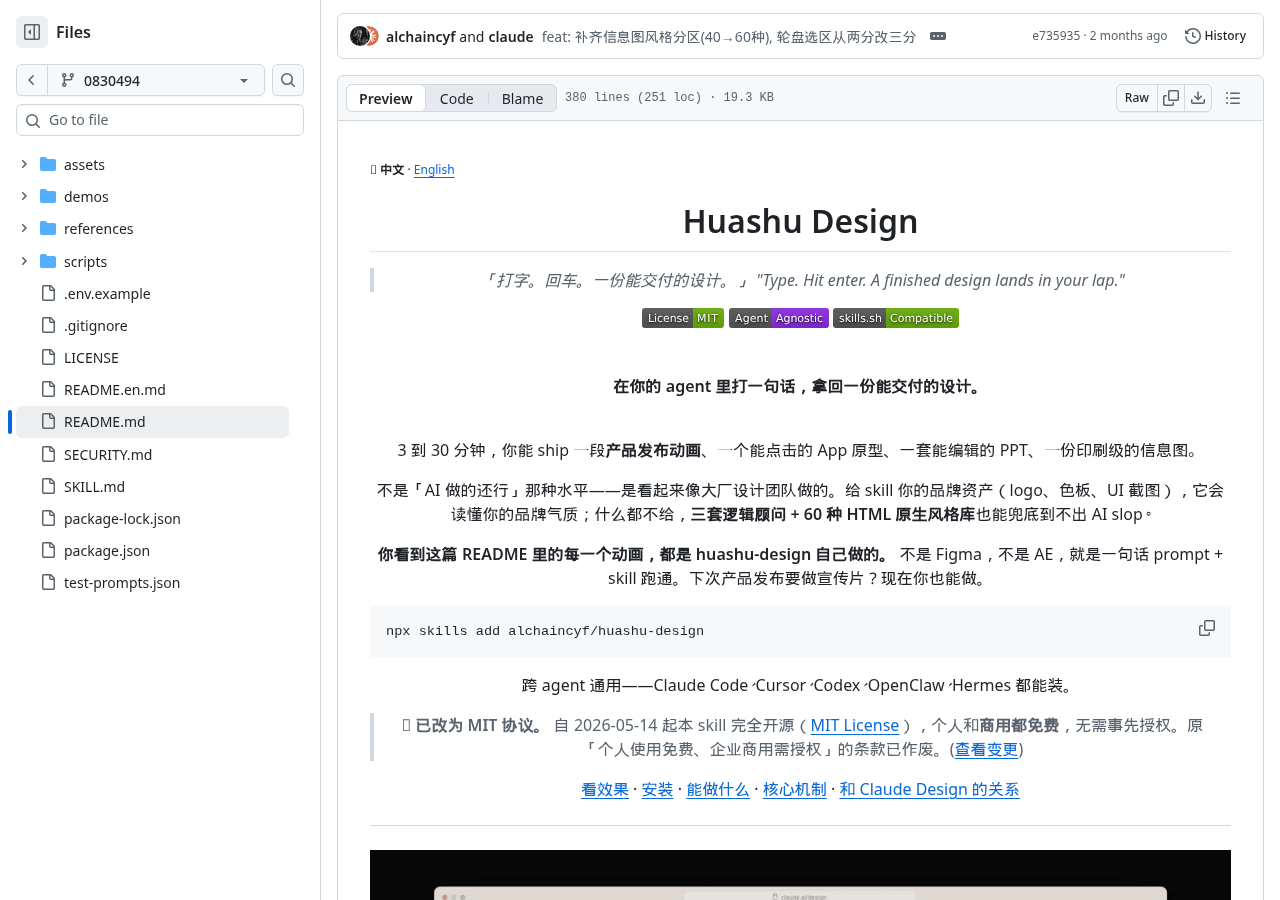
The author provides the skills CLI installation method and allows cloning the repository to the client’s skills directory. Documentation Declaration Agents supporting Markdown skills such as Claude Code, Cursor, Codex, OpenClaw, and Hermes can be used, but this is the author’s compatibility declaration; This document verification was not run on each client individually.

- The minimum requirement is an agent environment capable of reading Markdown skills, accessing project files, and executing the required tools.
- The creation and verification chain calls browser, Node.js, Playwright, Python, as well as video or document export tools according to the task; The specific dependencies vary depending on the delivery type.
- After installation, don’t just see the SKILL.md; make sure the references, assets, scripts, and demos directories are complete.
- The first time you use it, it’s best to start with a well-defined task, such as prototyping four clickable pages or arranging a ready-made piece of content into a presentation.
Warning Don’t assume that the “standard skill format” has been validated by all clients. Being able to read documentation, call scripts, install dependencies, and reliably export the finished product are four different things.
Free code doesn’t mean the entire generation chain is free
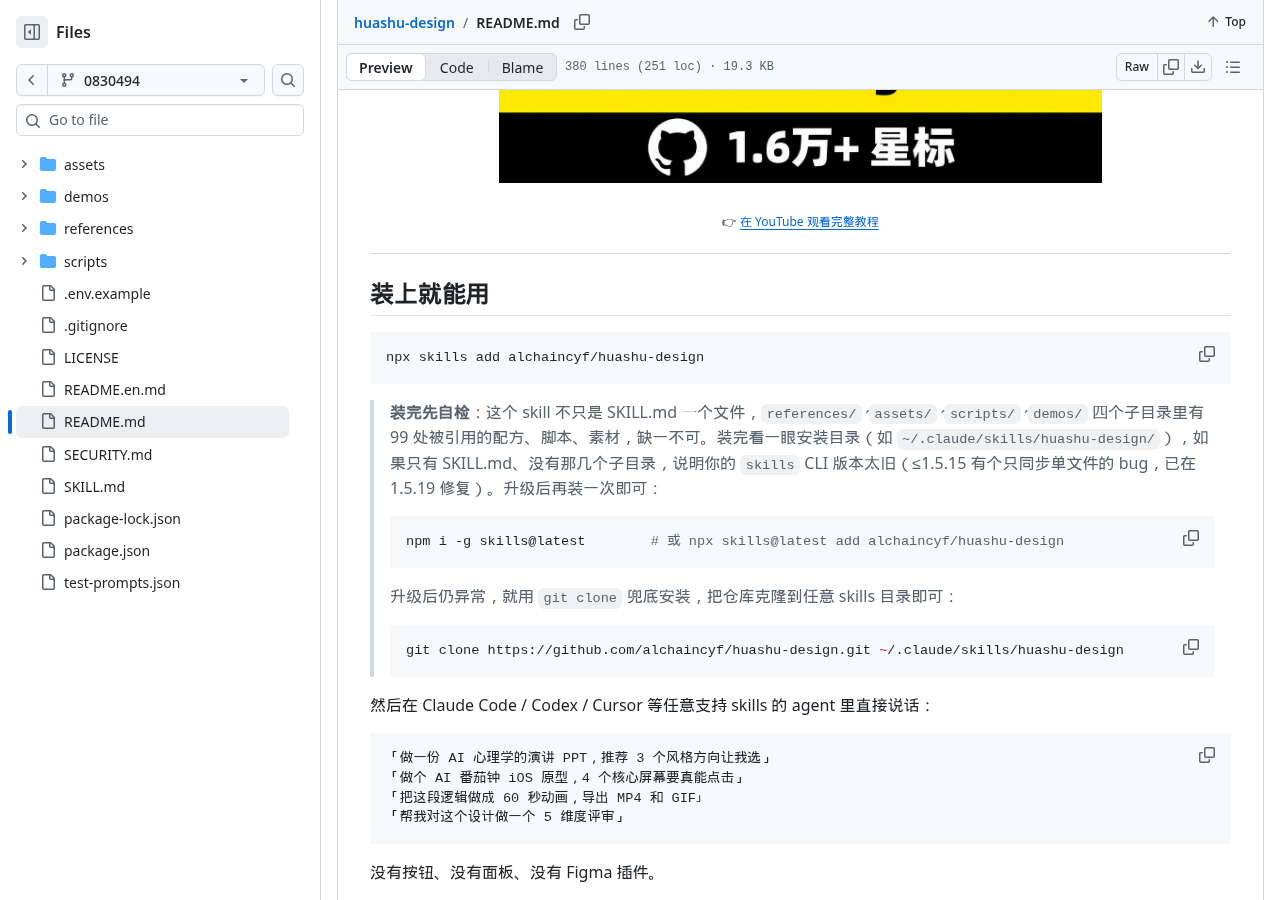
The repository currently uses the MIT License. The license allows for use, modification, distribution, and commercial use, and requires copyright and license statements to be reserved in software copies or significant parts. The README also states that personal usage licenses prior to May 14, 2026, have been replaced by the MIT License.
The author states that the core link for design, rendering, and exporting MP4, PDF, and PPTX can run locally without the need for network or keys; Doubao TTS and AI video review are placed in the optional cloud directory, requiring the user’s own key and confirmation to call them. On the other hand, whether running agents like Claude Code or Codex incurs subscription fees or API consumption depends on the chosen client and model and cannot be counted as “free in the repository.”
| Link | Free borders |
|---|---|
| Repository code and documentation | MIT, free to use and commercially available |
| HTML, PDF, PPTX, and video export toolchains | The author states that the core link can run locally, but still requires preparing the software environment themselves |
| agent reasoning | Whether charging is required depends on the client, subscription, or API |
| Doubao TTS and AI video review | Optional cloud capabilities require you to prepare the corresponding service keys yourself |
| External brands and image materials | Warehouses do not automatically obtain the same license just because MIT is adopted |
Free licenses are open source code; Machines, models, third-party services, and external materials still need to be checked separately.
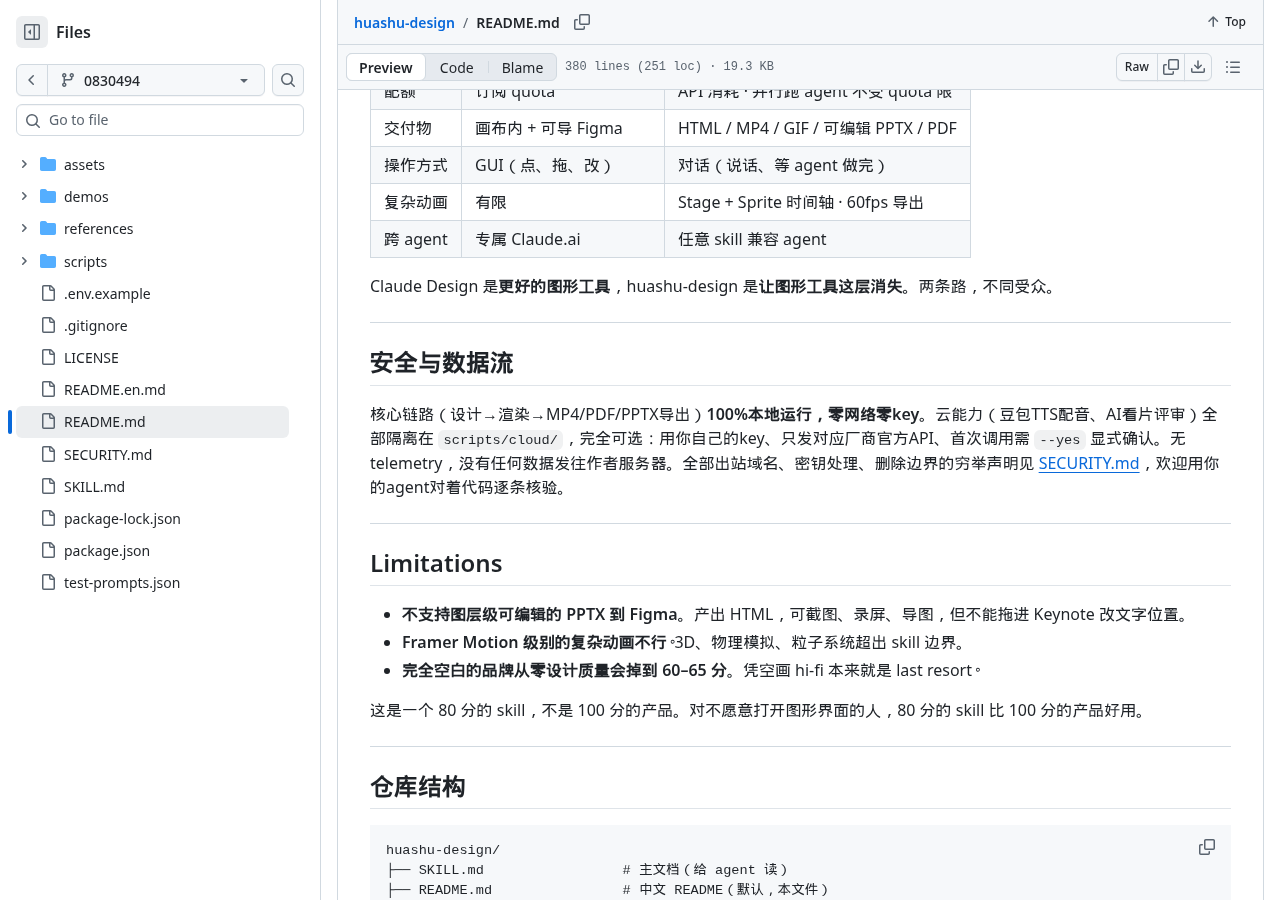
MIT files overwrite the software and related documents in this repository, but brand logos, product images, gallery images, and other third-party materials obtained by the workflow should continue to be authorized according to their respective sources. Just like getting a free set of editing software does not automatically mean the music and photos used in the video are automatically free.
Which people are worth using, and which tasks shouldn’t be forcefully assigned to it
- Suitable for those already using agents like Claude Code, Codex, Cursor, and who want to complete prototypes, PPTs, infographics, or animations through conversation.
- Suitable for those who want to compare design directions first, then undergo browser review and export verification.
- Suitable for teams that already have logos, color swatches, product screenshots, or reference pages, and want to design based on real brand assets.
- Not suitable for production-grade Web apps, SEO websites, or business systems that require continuous backend operation.
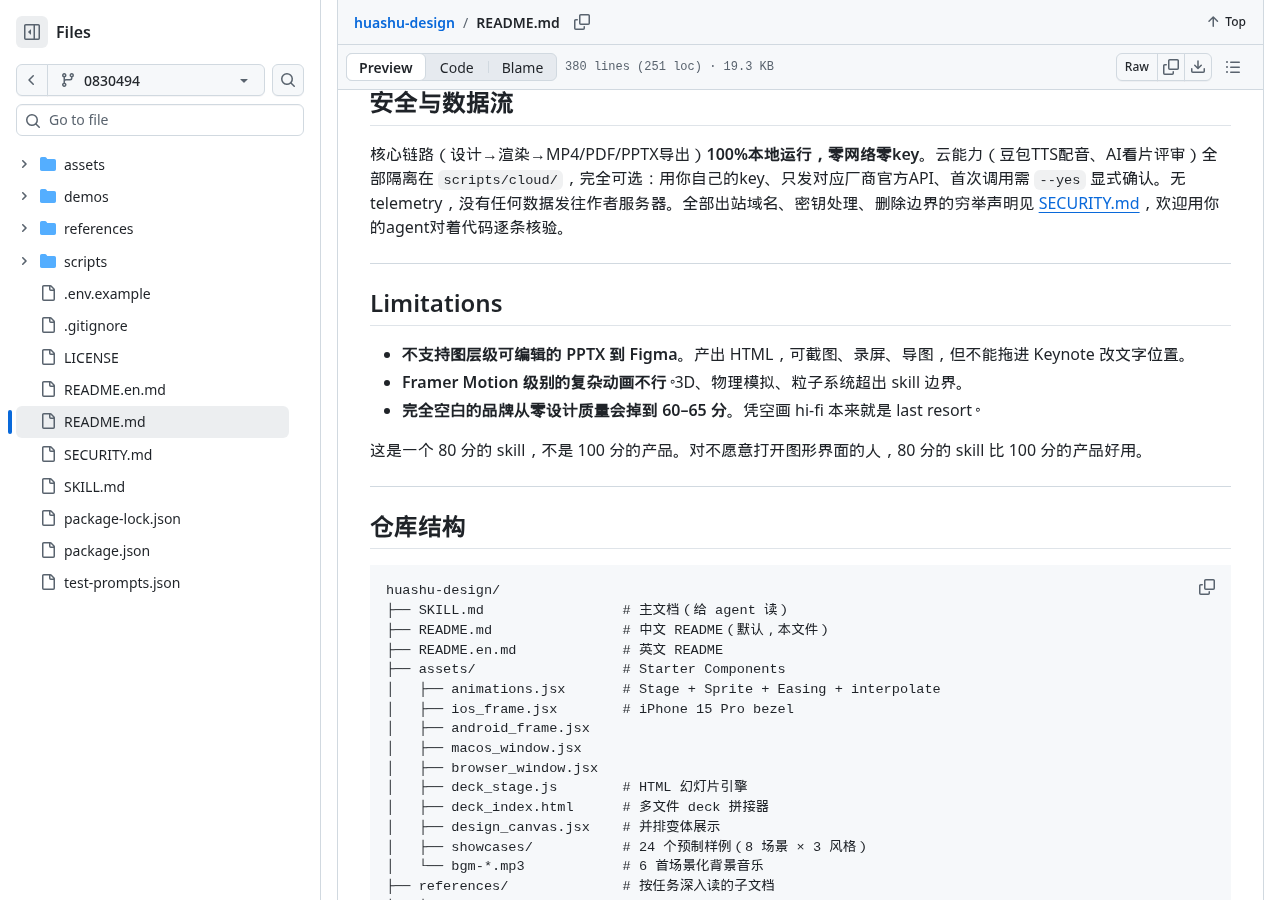
The project also proactively set the boundaries of capability: you can’t send the entire PPTX layer into Figma, and complex 3D, physical simulations, and particle systems are out of reach; With no brand equity at all, the author believes the quality of the finished product will also decline. Therefore, it’s better suited to shorten the ‘idea to showcase’ gap, rather than replacing the complete design, development, and copyright review process.
The author’s sample is very complete, but it can’t be considered your acceptance result yet
As of October 8, 2026, the warehouse snapshot shows 24,693 stars and 2,794 forks, with the warehouse built about 172.2 days ago, and the most recent push about 16.1 days after the snapshot. The two snapshots, spaced 1.0 days apart, recorded 44 new stars; This short window can show daily changes and cannot represent the long-term growth trend alone.
README showcases prototypes, slides, animations, infographics, and review samples created by the author, as well as Playwright verification and export scripts. These materials demonstrate that the repository provides a relatively complete example and implementation roadmap, but this time there is no code run, nor independent verification of security, cross-client compatibility, export success rate, or the time required by the author.
Treat it as a design workflow and decide whether to invest in it
The most valuable aspect of Huashu Design isn’t how many styles you can generate at once, but that it writes the process of “first find assets, then look at three directions, select and produce, and finally accept” into a process that agents can execute. If you’re already using agents in terminals and often need prototypes, demos, or short animations, it’s worth a small task to validate first. If you just want to reliably get the final commercial product with one sentence, or need production-grade applications, you shouldn’t treat it as plug-and-play ready-made software for now.
Tip The first acceptance only considers four things: whether the supporting directory is complete, whether the agent truly follows the three-way selection, whether browser interaction is usable, and whether the target format can be successfully exported. After passing these four, the brand assets or optional cloud services can be integrated.
Project materials: Huashu Design repository, fixed submission version README, MIT License.
Project firsthand information
🧰 Tools I build
I maintain all of these tools myself. Preview builds are clearly labeled; the release pages are the source of truth for downloads, updates and known limits.
Info: HyphenBox Status: Official releases
A radar for free LLM APIs: availability is re-tested continuously, one local interface for all of them, and keys stay on your machine
Info: LocalBrain Status: Official releases
A multimodal MCP toolbox for local models: TTS, Whisper and video generation in one place
Info: ScreenLex Status: Official releases
Learn new words while you watch shows. Free, for Mac and Windows
Info: HyphenScreen Status: Official releases
Screen recording and smart editing in one: a DaVinci-style timeline, automatic redaction and a check of the finished video before export. Free
Quote: HyphenTech Make AI your superpower Local deployment · Free resources · Self-made software https://hyphentech.top
Late nights and burned API credits went in,a cup of tea comes back out — only if you feel like it.
Scan with WeChatPress and hold to save the image, then open it from your album in WeChat Scan

Comments
Loading comments…