
Summary Model Deep Dive · Evidence-Backed Pros, Cons & Real Task Bills Priced at
$3/$15with #1 finishes on Zapier and CursorBench, why does Neon drop 3x in generic harnesses and burn$6.44per task at Xhigh? Understanding the two paid knobs behind Google’s new workhorse HyphenTech · 2026-11-19
On November 18, 2026, Google officially released Gemini 4 Neon, its new mid-tier frontier reasoning model. At first glance on the Google DeepMind launch post, the pitch looks almost unbeatable: 61 on the Artificial Analysis Intelligence Index (#3 globally, trailing only far larger models) while cutting list prices by a quarter compared to flagship Gemini 4 Carbon.
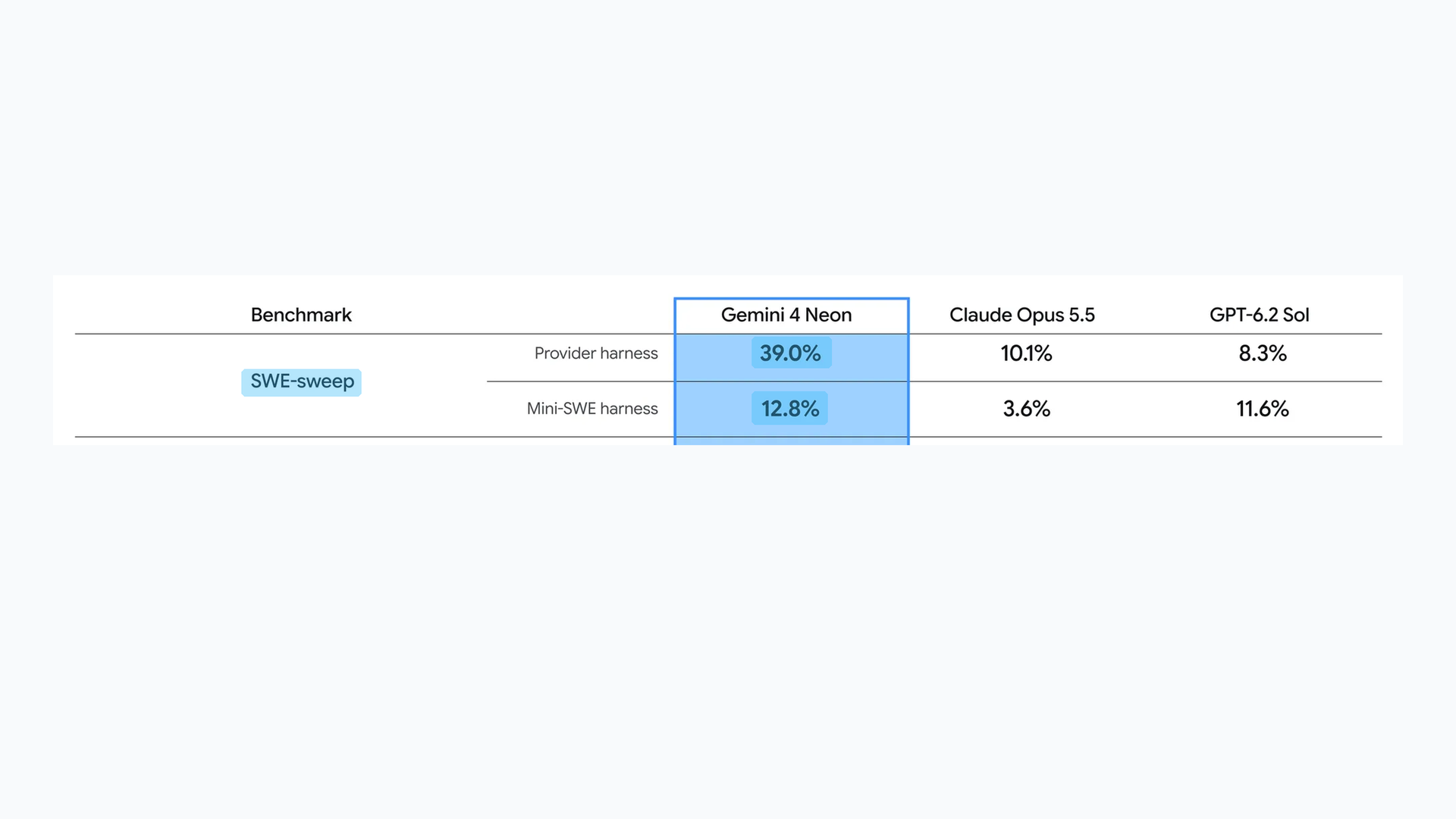
Yet two rows further down the exact same official benchmark table sits a jarring contrast: inside a shared open-source mini-SWE harness, Gemini 4 Neon resolves just 12.8% of tasks; move that exact same model into Google’s proprietary Antigravity environment, and the score leaps to 39.0%—a 3x swing from switching the tool harness alone.
An even sharper surprise hides in the invoice: Neon lists at $3 input / $15 output per million tokens—less than 40% of GPT-6.2 Astra ($8 / $40). Yet across the full Artificial Analysis run, cranking Neon to xhigh pushed its average bill to $6.44 per task, making it more expensive per task than GPT-6.2 Astra Max ($4.00 per task). Instead of running cherry-picked toy prompts, let’s lay out the 10-page Model Card PDF, the 6-page Evals Methodology PDF, and raw leaderboards from Artificial Analysis, Zapier, and Cursor side by side.
1. Family Positioning & Three Verified Strengths: Undercutting Rivals in the 60+ Bracket
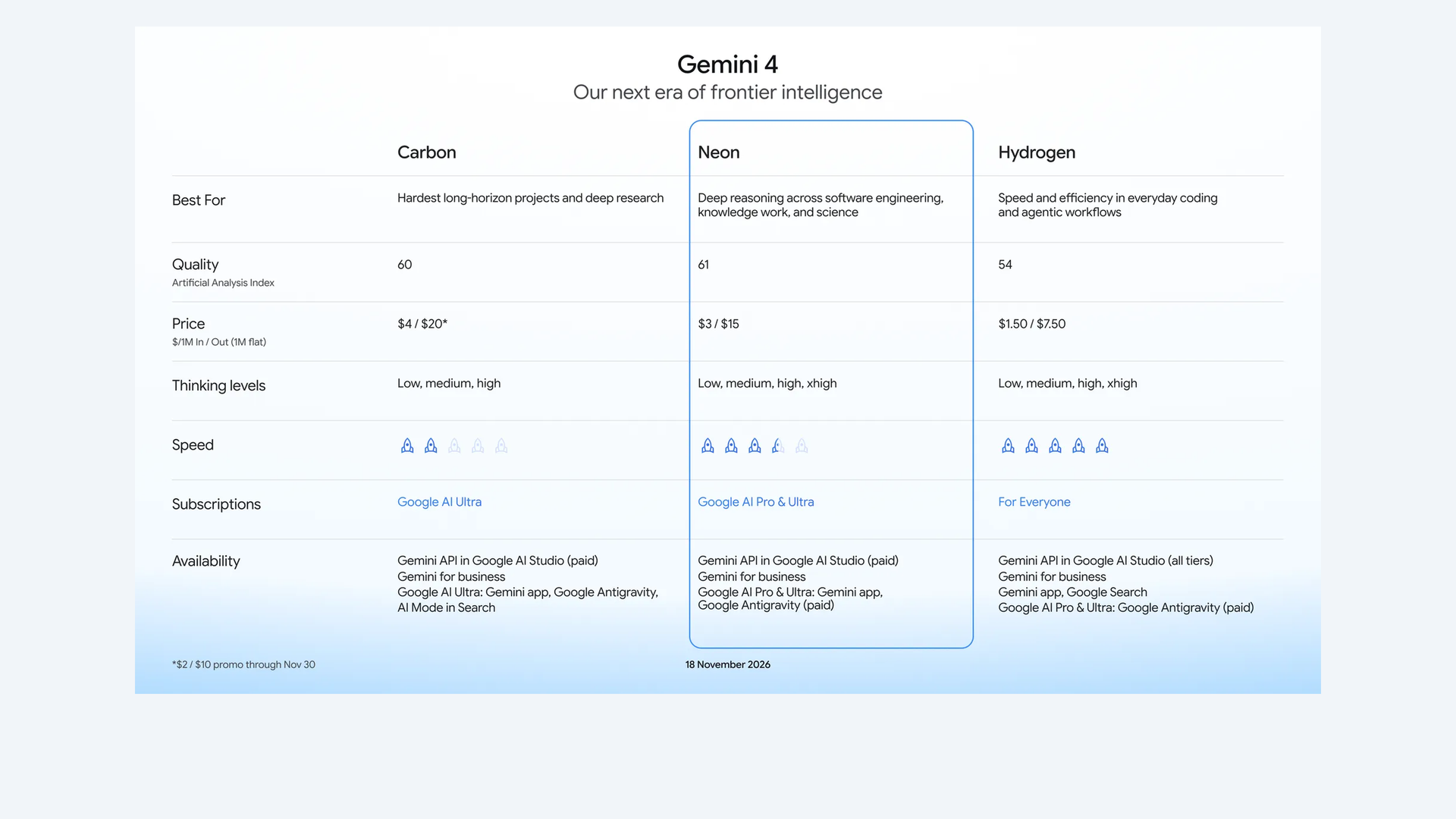
First, place Neon inside the Gemini 4 lineup. Google now splits the family into three clear tiers: Carbon tackles the hardest long-horizon research, Hydrogen handles ultra-fast low-cost execution, and Neon sits squarely in the middle. As the Gemini 4 Neon Model Card page states plainly, Neon is adapted directly from Carbon and exposes 4 thinking levels: low, medium, high (default), and xhigh.
On Google’s comparison graphic, AA Quality stands at 60 for Carbon, 61 for Neon, and 54 for Hydrogen. Per million tokens, Carbon lists at $4 / $20 (with a $2 / $10 promotional rate through November 30), Neon lists at $3 / $15 with $0.15 implicit cached input, and Hydrogen sits at $1.50 / $7.50. Speed bars rate Carbon at 2, Neon around 3.5–4, and Hydrogen at 5/5—delivering a 25% lower list price and 32% lower per-task cost at default high effort than Carbon.
Where Neon genuinely shines comes down to three concrete pillars:
- Broad leads over similarly priced peers on official suites: Against Claude Opus 5.5 and GPT-6.2 Sol, Neon leads on the AA Intelligence Index (61 vs. 59 vs. 57), Vals Index (70.9% #2 vs. 70.1% and 66.1%), HLE-Diamond (71.3% vs. 67.9% and 64.0%), and long-context GraphWalks (95.2% vs. Opus’s 66.8%), while taking #1 on the AA Coding Agent Index (58.6) alongside 90.5% on SEC-bench Pro, 84.0% on RiemannBench, and $16,843 on Vending-Bench 2.
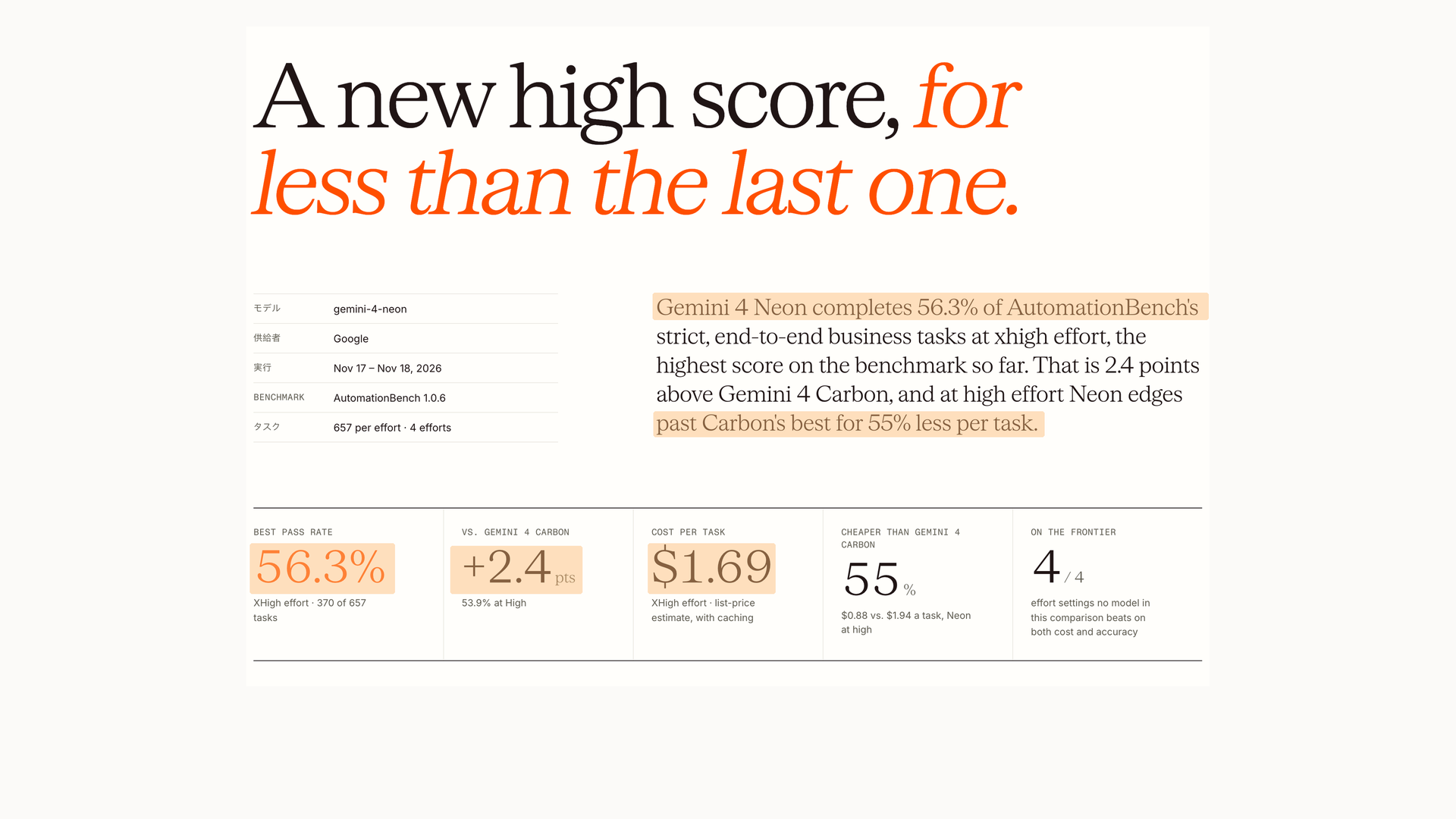
- Record #1 on Zapier AutomationBench—and 55% cheaper than Carbon at High: In the independent Zapier AutomationBench report spanning 657 end-to-end enterprise tasks, Neon
xhighsolved 370 (56.3%) to set a new benchmark record—beating Carbon (53.9%) by 2.4 points and GPT-6.2 Astra Max (52.4%) by 3.9 points. Better yet, dropping to defaulthighretains 54.3% accuracy at $0.88/task (55% cheaper than Carbon’s $1.94), whilemediumhits 53.3% at $0.58/task (30% cheaper than Astra). - 1-2 finish on CursorBench 4.1 at a fraction of rival task bills: On the CursorBench 4.1 leaderboard (see also Cursor’s launch post), Neon Extra High takes #1 at 65.4% ($10.67/task, 73 steps), and default High takes #2 at 63.7% for $6.54/task (56 steps)—dramatically undercutting Carbon High (61.5%, $8.52), Claude Opus 5.5 Max (58.1%, $11.88), and Claude Fable 5.2 Max (61.3%, a whopping $48.11/task across 295 steps).
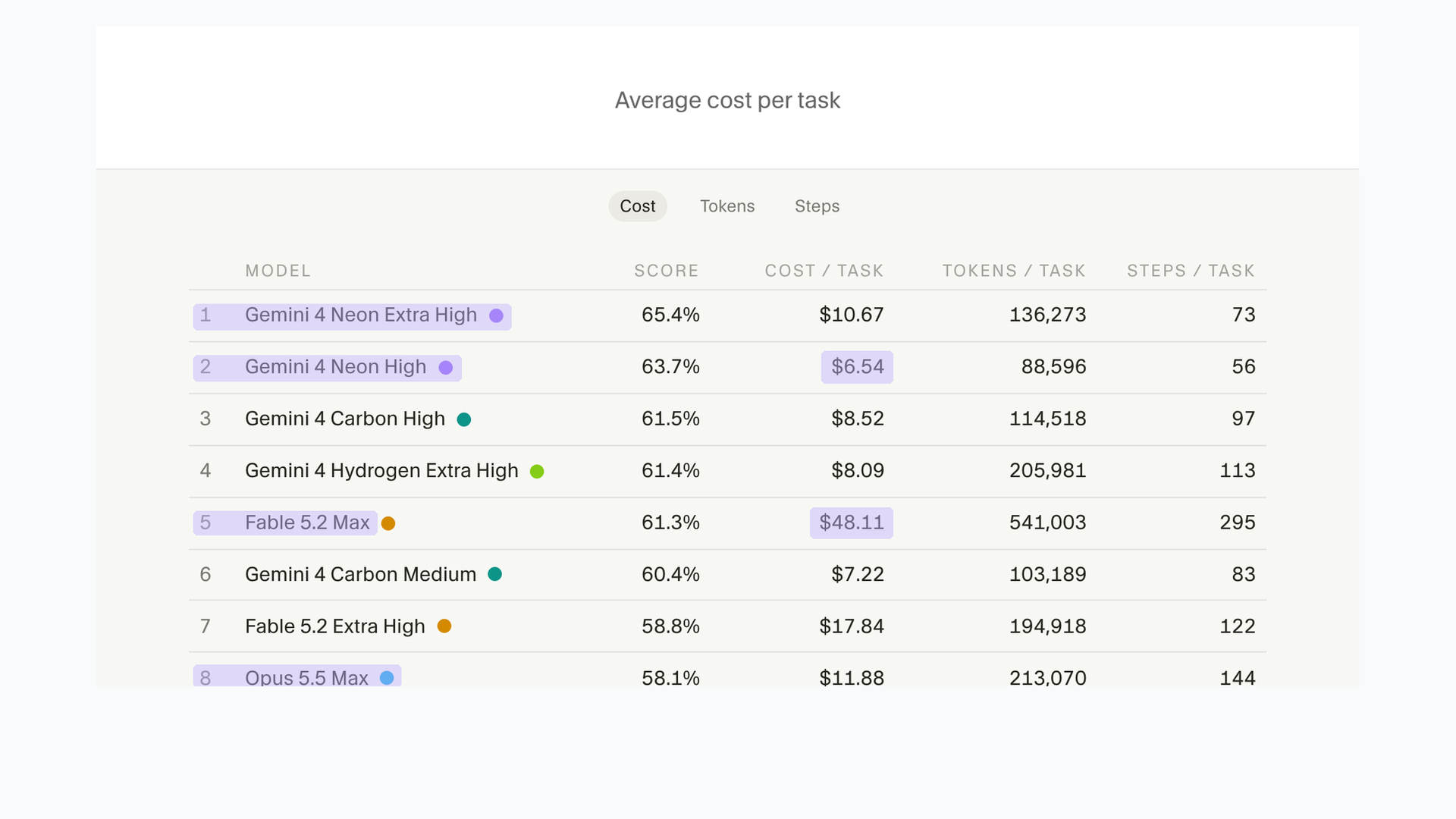
Behavioral discipline improved as well: DeepMind reports its lowest internal fabrication rate to date and a 2.45% reward-hacking shortcut rate on coding evals (lowest in Gemini 4), while the GitHub Copilot changelog notes fewer unsolicited edits compared to Carbon. Inside Google Antigravity, Orchestrator mode pairs Neon as planner with 8 parallel Hydrogen workers—building the 3D synthwave mini-golf game NEONPUTT '84 with automated browser verification from a single prompt, before handing Player 2 to Hydrogen in real time.
2. Four Real Trade-Offs: Why $3/$15 Ended Up Costing More Per Task Than $8/$40 Astra
Now flip the coin over. Treating $3/$15 as an invitation to leave xhigh pinned on every call is the fastest way to blow your monthly API budget.
1. Runaway Reasoning Verbosity: 283M Output Tokens Push Xhigh to $6.44/Task
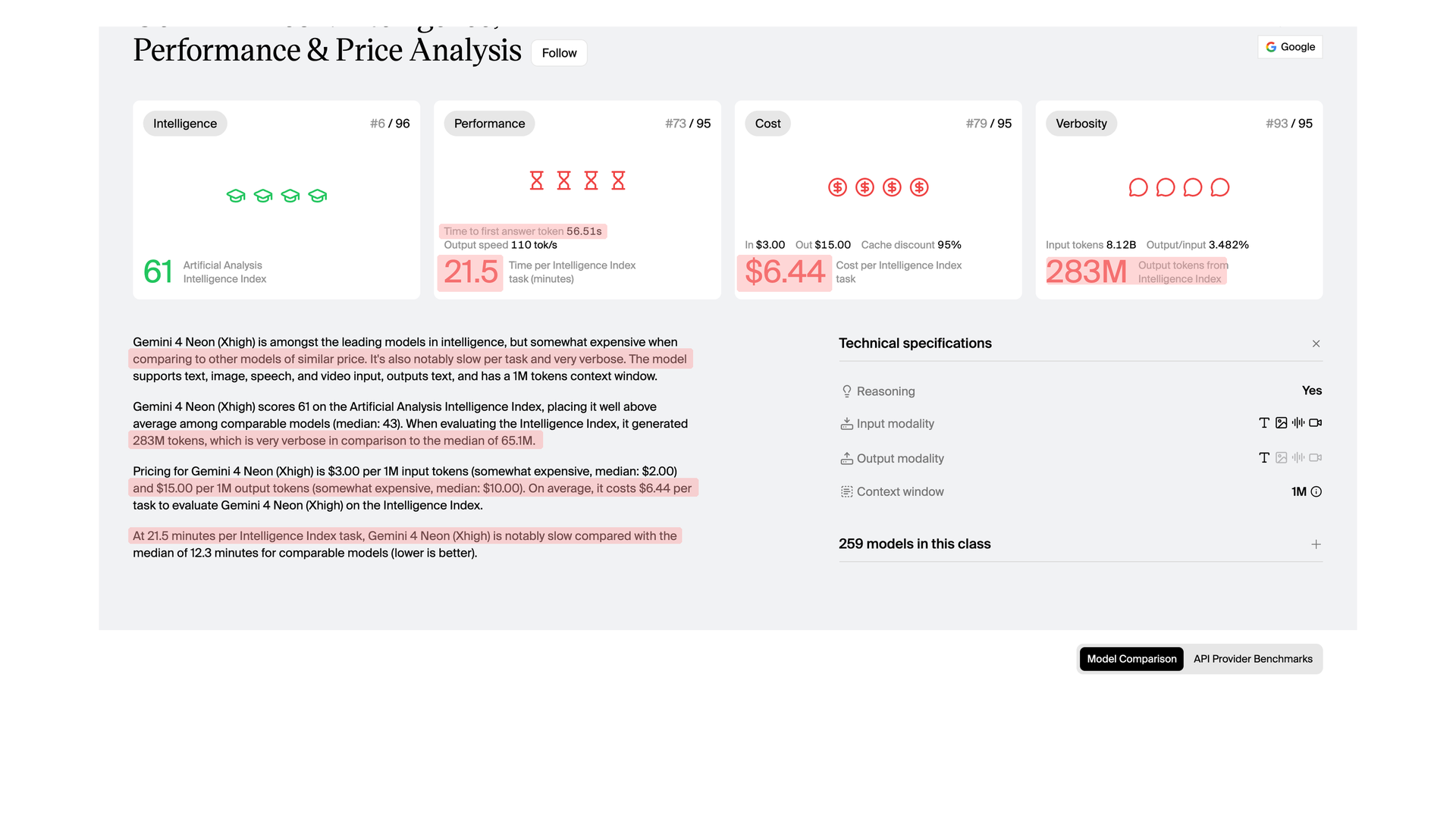
Artificial Analysis (full standings on the AA Models Leaderboard) bluntly characterizes Neon (xhigh) as notably slow, very verbose, and somewhat expensive. Each Index task averaged 21.5 minutes (versus a 12.3-minute peer median) with a 56.51-second wait for the first answer token. Across the evaluation suite, Neon emitted 283M output tokens—over 4.3x the 65.1M peer median—driving its average cost to $6.44 per task.
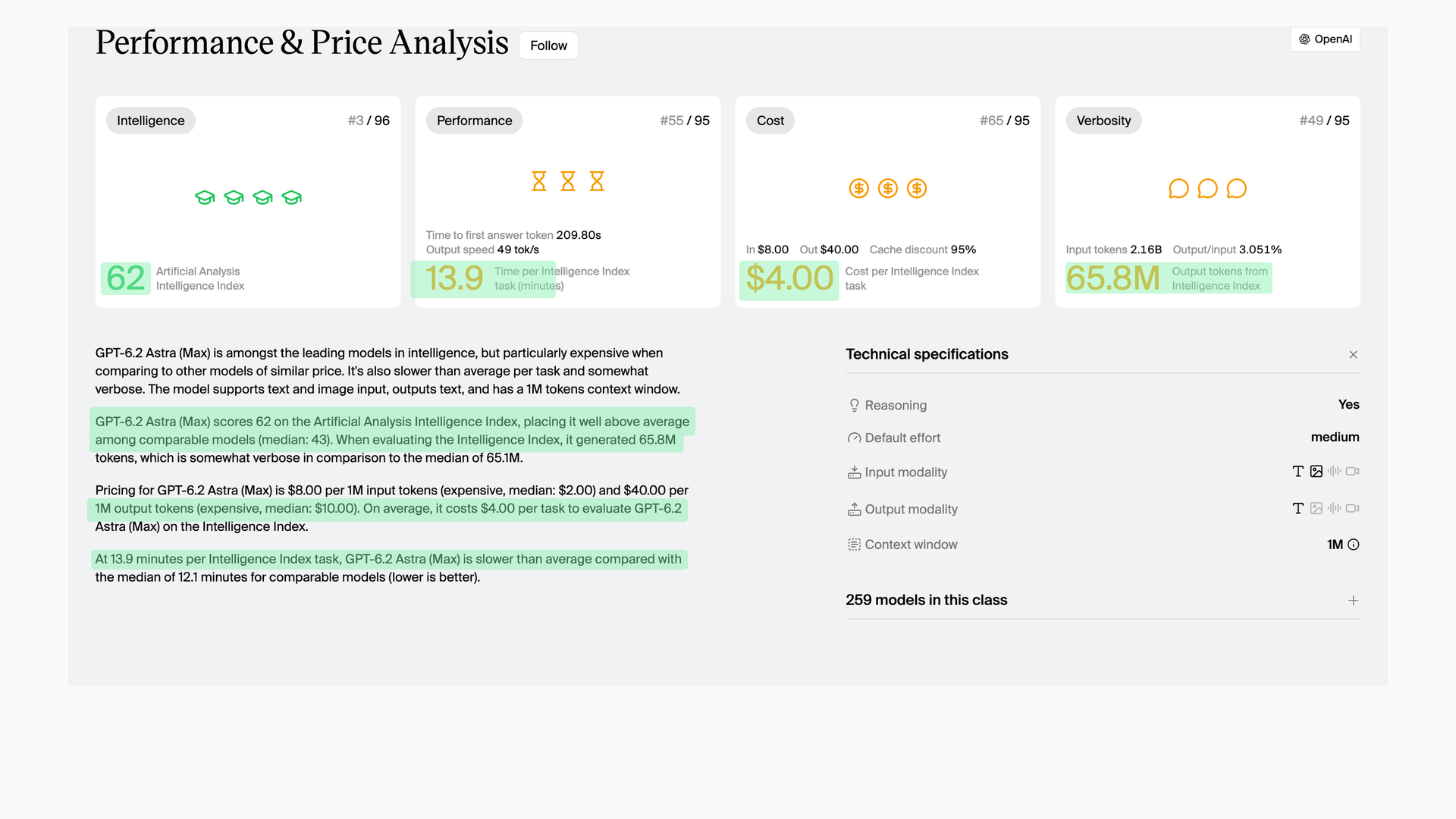
Compare GPT-6.2 Astra (Max) side by side: despite a 2.67x higher list price ($8 / $40), Astra generated just 65.8M tokens, finished in 13.9 minutes, scored 62, and averaged $4.00 per task. Token price means nothing without token volume.
2. Steep Diminishing Returns Across Effort Tiers—and Failed Runs Cost the Most
Across AA’s four effort settings, Neon scores 61 at xhigh (21.5 min), 60 at high (14.8 min, 123M tokens), 55 at medium (8.3 min, 62.9M), and 44 at low (3.7 min, 28.3M). On Zapier, cranking from low to xhigh raised solved tasks by just 13% (326 to 370) while per-task cost jumped 320% ($0.40 to $1.69) and reasoning tokens expanded 8.8x to consume 82% of all output. Worse still, failed xhigh runs averaged $2.21 versus $1.29 for successful runs—meaning stuck tasks spin in reasoning loops and pad your bill. Conversely, dropping to low on CursorBench sinks accuracy to 45.5%, trailing cheaper Hydrogen High (57.3%).
3. Harness Lock-In, 512K Client Caps, and Missing Modalities
- Heavy reliance on Google’s own harness: Dropping from Antigravity (39.0%) to generic
mini-SWE(12.8%) shrinks Neon’s lead over GPT-6.2 Sol (11.6%) from 30.7 points down to 1.2 points. - 512K context cap inside Antigravity: While the Google AI Studio model docs (and release notes) provide 1M context via API, the Google AI Forum rollout post confirms Antigravity caps Neon at 512K and Enterprise plans omit Orchestrator.
- Category & modality gaps: Neon trails Opus 5.5 slightly on Terminal-Bench 4.1 (65.2% vs. 65.8%) and FrontierCode 2.0 (46.2% vs. 47.3%), trails Sol on Chartography (73.5% vs. 75.1%), and tops out at 37.5% on Zapier HR tasks (5.8 points behind Astra). It supports no image generation, no audio generation, no Live API, no explicit caching, and no free API tier, with a March 2026 knowledge cutoff and its full safety report still marked
coming soon(inheriting Argon’s CCL assessment).
3. Underlying Mechanism & Six-Model Buying Guide: Lock In Default High
Every paradox in Neon’s launch comes down to two paid knobs: the thinking-depth knob (buying 1–2 extra points with 82% internal reasoning tokens and wait time) and the harness knob (buying a 3x repo-repair boost by locking into Antigravity’s subagent swarm).
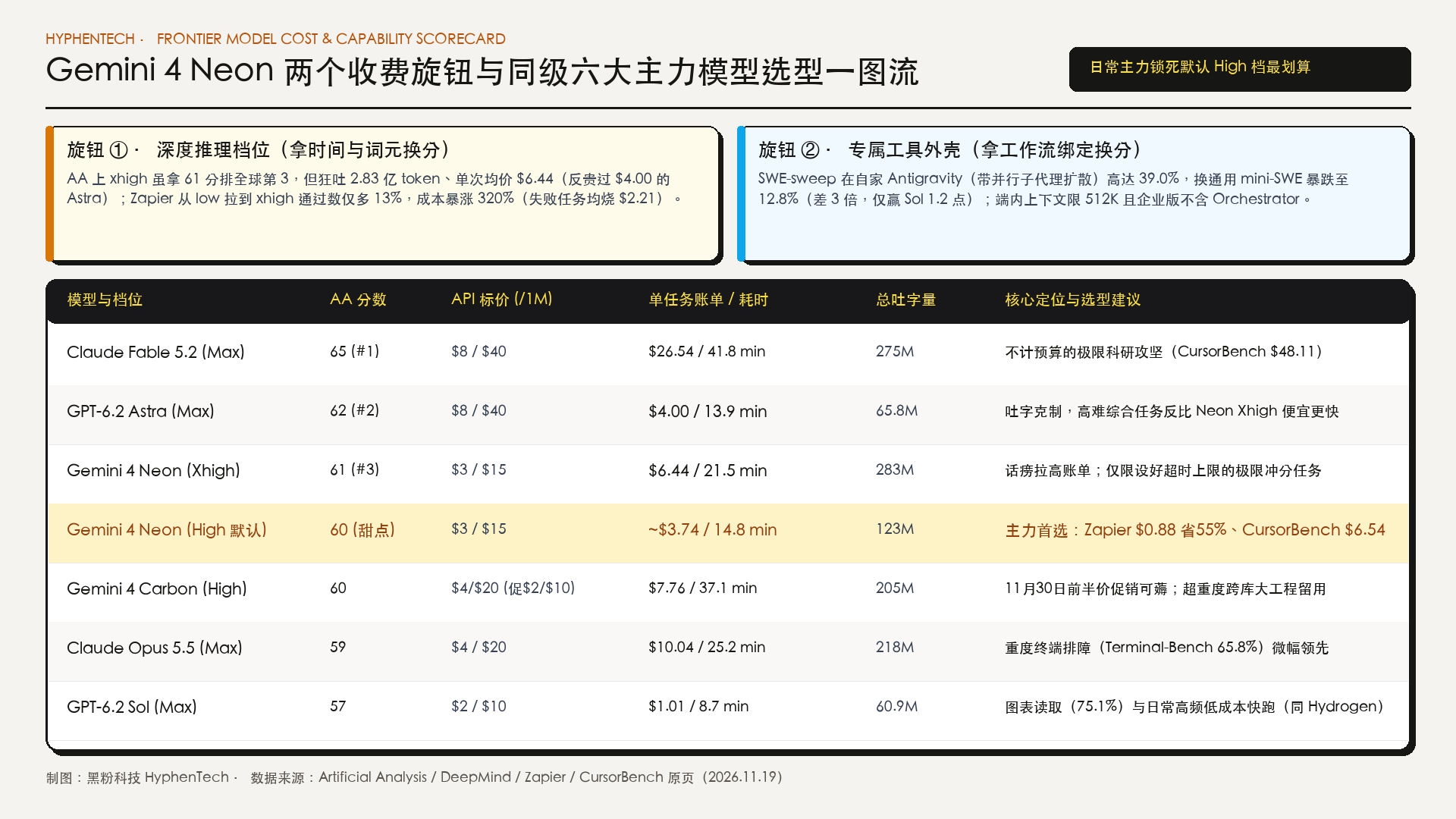
| Model & Effort | AA Score | List Price (In/Out) | Avg. AA Task Bill / Time | Best Practical Fit |
|---|---|---|---|---|
| Claude Fable 5.2 (Max) | 65 (#1) |
$8 / $40 |
$26.54 / 41.8 min |
Budget-unconstrained frontier science & hardest proofs |
| GPT-6.2 Astra (Max) | 62 (#2) |
$8 / $40 |
$4.00 / 13.9 min |
Concise output (65.8M); faster & cheaper per task than Neon Xhigh |
| Gemini 4 Neon (Xhigh) | 61 (#3) |
$3 / $15 |
$6.44 / 21.5 min |
Hard edge cases only—always pair with strict token/timeout caps |
| Gemini 4 Neon (High, Default) | 60 |
$3 / $15 |
~$3.74 / 14.8 min |
Daily sweet spot: $6.54 on CursorBench, $0.88 on Zapier |
| Gemini 4 Carbon (High) | 60 |
$4 / $20 ($2/$10 promo) |
$7.76 / 37.1 min |
Worth grabbing before Nov 30 half-price promo ends; heavy projects |
| Claude Opus 5.5 (Max) | 59 |
$4 / $20 |
$10.04 / 25.2 min |
Slight edge in pure CLI repair (Terminal-Bench 4.1 65.8%) |
| GPT-6.2 Sol (Max) | 57 |
$2 / $10 |
$1.01 / 8.7 min |
Chart reading (75.1%) & fast low-cost execution (alongside Hydrogen) |
For day-to-day software engineering, long-context analysis, and multi-step business workflows on your own machine, lock Gemini 4 Neon to its default high effort—it captures Carbon-class 60-point reasoning while keeping bills squarely in the sweet spot. Pair it with GPT-6.2 Sol or Hydrogen for high-frequency lightweight runs, and reserve GPT-6.2 Astra (or Carbon during its pre-November 30 promo) for massive architectural refactors. If you mix multiple cloud endpoints and local models on your desktop, you can route keys cleanly through HyphenBox, wire local TTS/Whisper/video MCP tools in LocalBrain, and edit full-resolution technical breakdowns on the DaVinci-style timeline in HyphenScreen (which produced our companion video for this episode).
Limits and Applicable Boundaries
- All benchmark scores, latencies, and per-task dollar figures reflect public Model Cards and independent leaderboard snapshots verified as of November 19, 2026; real production bills vary with repository size, implicit cache hit rates, and agent retry loops.
- Gemini 4 Carbon’s
$2 / $10half-price promotion expires on November 30, 2026, reverting to$4 / $20thereafter.
Primary Verified Sources
- Google DeepMind Blog: Introducing Gemini 4 Neon & Official Benchmarks
- Google DeepMind: Gemini 4 Neon Model Card (10-page PDF)
- Google DeepMind: Gemini 4 Neon Evaluation Methodology PDF
- Artificial Analysis: Gemini 4 Neon Performance, Verbosity & Cost
- Zapier AutomationBench Report: Gemini 4 Neon Across 657 Tasks
- Cursor Official Leaderboard: CursorBench 4.1
- Google Antigravity Blog: Orchestrator & NEONPUTT '84 Demo
- Google AI Forum: Antigravity 512K Context Cap & Rollout Details
- Google AI Studio Docs: Gemini 4 Neon Capabilities & Caching
- GitHub Changelog: Gemini 4 Neon in GitHub Copilot
Self-made software
Versions, changes and supported installers all come from the same public release records.
HyphenBox
A free model API radar and local router, with ongoing availability checks and keys kept on your device.
View public downloads and updates ↗LocalBrain
A local AI toolbox for transcription, speech, images, video, and MCP tools. Features vary by platform version.
View public downloads and updates ↗Support HyphenTech
Late nights and burned API credits went in,a cup of tea comes back out — only if you feel like it.
Save the QR codeScan with WeChatPress and hold to save the image, then open it from your album in WeChat Scan

WeChat tips · Any amount welcome




Comments
Loading comments…