Info: Machine translation This post was machine-translated from the Chinese original. Wording may be rough in places — the Chinese version is authoritative.
Note This article was first published on the HyphenTech official WeChat account
Old Huang came to flip the table again
Taiwan 2026 Full Teardown: The Agent Era Truly Arrives, Three Tables Flipped All at Once
2026-06-01 · HyphenTech · AI hotspot tracking
First, the “useful AI” has truly arrived
On June 1, 2026, Jensen Huang stood on the GTC stage in Taipei, Taiwan, and with his very first sentence, set the tone for the entire industry: after two years of effort, Agentic AI (agent AI) has officially “arrived” today. Note, the term he used was “useful AI”—not toys that can chat, but productivity that can work and earn money.
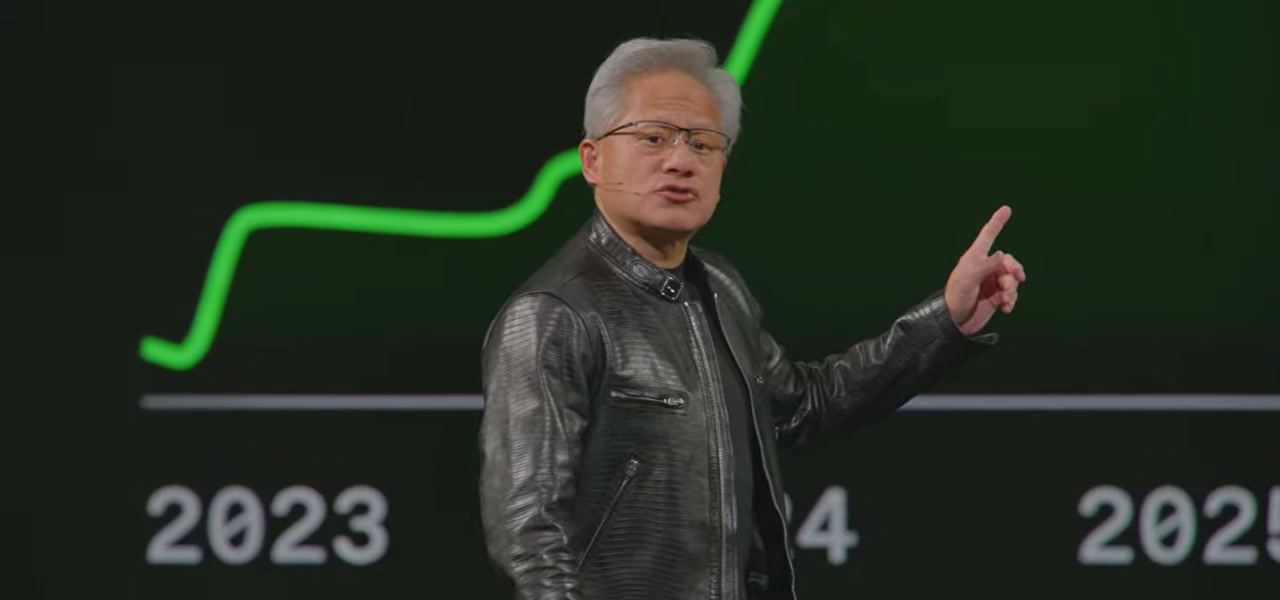
The first piece of evidence he presented was GitHub. Code commits were 300 million in 2023, 400 million in 2024, 500 million in 2025, and in just the first few months of 2026, they nearly tripled. Old Huang did the math: globally, there are 30 to 40 million professional programmers, earning about 3 trillion USD in annual wages, now producing productivity equivalent to 9 trillion USD, and extending outward, affecting industries worth about 100 trillion USD globally.
So he immediately retorted that old saying “AI is taking the job”: not only have programmers not decreased, but recruitment is increasing. The logic is simple—if an engineer can leverage 9 trillion in output, do you think the boss wants to hire more or fewer? This is what he repeatedly emphasized: tokens are now “profit units”; if they can make money, everyone is desperately building AI factories and buying computing power. This is also why Taiwan’s demand for computing power has taken off, with GDP expected to grow by nearly 10% this year.
2. What exactly is an Agent? Lao Huang drew a picture for you
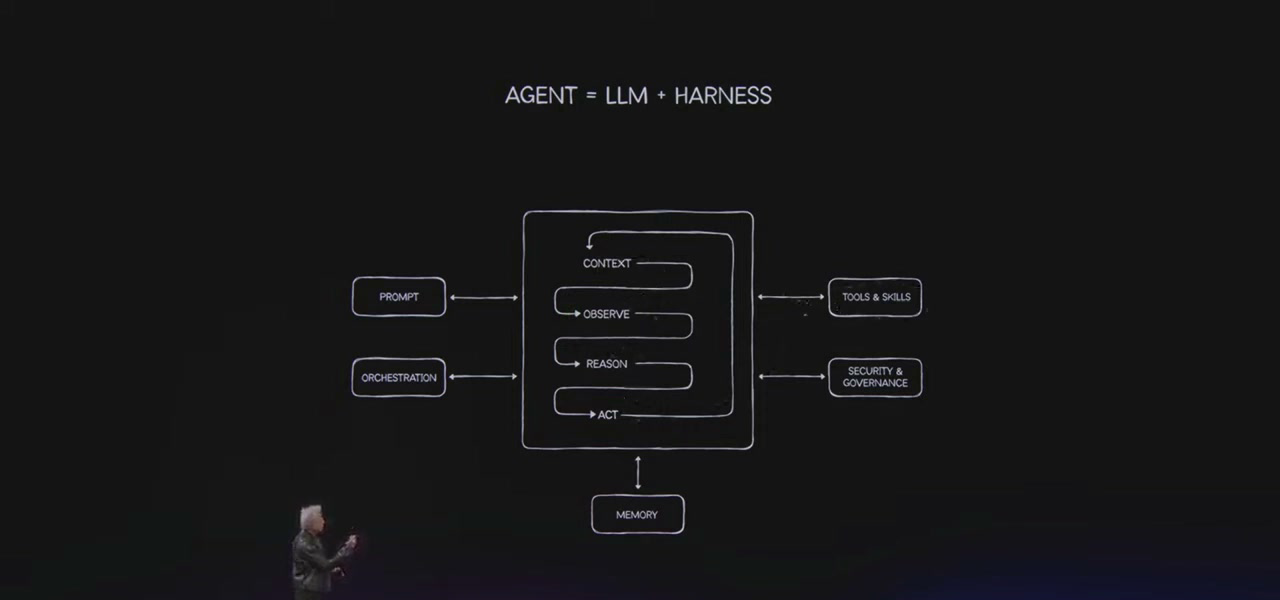
Many people talk about Agent, but they don’t really understand the difference between it and a “chatbot.” Nvidia simply drew a diagram: the past application was “application + code + operating system,” but now it’s “large model + harness (scheduling framework).” Large models handle thinking, while harness connects everything like an operating system.
What does an Agent do? Observe, reason, plan, act, and call tools, and it also has to manage two types of memory: short-term “working memory” (KV cache) and long-term memory—just like the human brain. It can split tasks, open sub-agents, adjust databases, and run browsers on its own. Lao Huang demonstrated live by directly pulling out Claude Code and Codex, generating GIFs and 3D printable CAD files with a single prompt, and it fine-tunes the tools all by itself.
Even more brilliant is Huang’s “counterintuitive” judgment: people say software companies are doomed, but he says completely the opposite — because there are far more Agents than humans and will use more tools than humans, so this is the best era for software companies. The premise is: your software must be “translated” into something the Agent can call. NVIDIA has packaged all over a thousand CUDA-X libraries into tools with “user manuals” so AI can use them after a glance. This move is well hidden.
3. The first table: Vera Rubin, not just a chip, but a factory
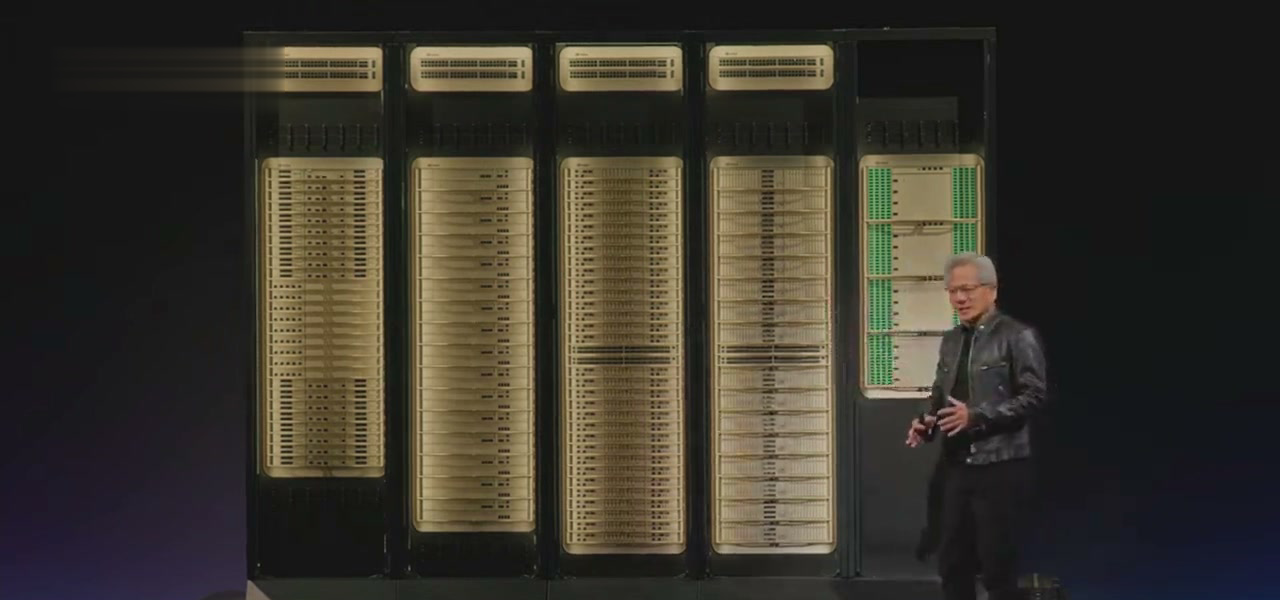
Here comes the main event—the new generation of Vera Rubin is officially mass-produced**. Lao Huang repeatedly emphasized: it’s not a single GPU**, but a ‘five-cabinet integrated Pod-class supercomputer,’ with the GPU, Vera CPU, storage, and networking all packaged. 7 new chips, TSMC 3nm, HBM4 memory; A single compute board packed 6 trillion transistors and over 18,000 components; The whole cabinet has 1.3 million components, and the liquid-cooled busbar supports 5,000 amperes—equivalent to 20 electric vehicles accelerating at full speed.
To build it, NVIDIA mobilized 40,000 engineers and brought together 150 Taiwanese supply chain partners. The supply chain scale is twice that of the previous generation Grace Blackwell, and the time required to assemble a single cabinet has been reduced from 2 hours to 5 minutes. Microsoft, Dell, and CoreWeave are all already building engineering prototypes. Nvidia’s line, “NVIDIA is no longer just a GPU or systems company, but an AI infrastructure company,” sounds like a slogan but actually represents an overall upward shift in the business model.
He even flipped the CPU desk: old CPUs were built for “people,” rented out by cores and billed by the second; But Agents lacked patience, living in the nanosecond world, feeling slow even after waiting. So there was the Vera CPU—the brand-new Olympus core, 88-core monolithic mesh, capable of running 10 instructions per clock; Compared to x86, memory latency was 40% lower, inter-core communication was 50% faster**, and on-chip bandwidth 3.6TB/s. Actual tests were even more aggressive: SQL was 3 times faster, NYSE real-time streaming processing 6 times faster**, Agent sandbox performance was 1.8 times that of x86. The supporting model also includes open-source NemoTron 3 Ultra (SSM+MoE hybrid architecture, 5x faster**, 30% cheaper**), and a chip design agent in collaboration with Cadence, which offers 40 times faster verification, allowing weeks to work and just hours to complete.
4. The Second Table: For the first time in 40 years, the PC has been reinvented
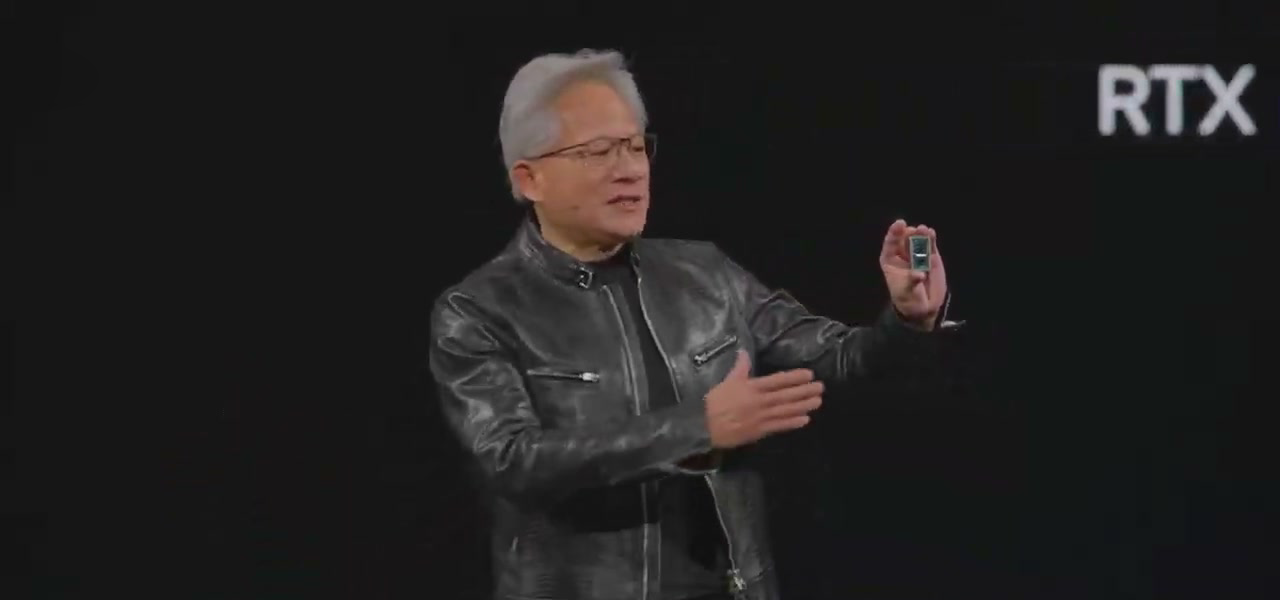
This part is the most explosive. Nvidia and Microsoft have teamed up to reinvent the personal computer for the first time in 40 years. Leading the way is the RTX Spark chip: Blackwell RTX GPU with 6,144 CUDA cores, 1 petaflop of AI computing power, paired with a 20-core** Grace CPU in collaboration with MediaTek, 128GB of unified memory, TSMC 3nm, and 70 billion transistors. He also raised an N1X chip, saying it “would take 33 years to build”—because 100% of NVIDIA’s software stack can run on it.
Above that is the desktop-level DGX Station: 768GB of RAM, capable of running trillion-parameter models directly on the desk, 20 petaflops of computing power, and 8TB/s memory bandwidth. Nvidia gave a very “sci-fi” prediction: future PCs will completely transform like the evolution from feature phones to smartphones back then. Your home will have an AI supercomputer running Agents 24×7 hours, getting smarter the more you use it, “more like R2-D2 than a PC.” Even Adobe has redone Photoshop and Premiere for RTX Spark, nearly doubling the speed, and can be directly called by Agents via MCP.
Why is this important? Because it lays out the “Agent” computing model from the cloud and enterprise all the way to your desktop. The same “model + harness + tool + runtime” can run in the cloud, the company can run, and even at home. Old Huang has basically planted a stake right at your doorstep.
5. The third table: Physics, AI, and robotics, the entry point for the next decade
Finally, Lao Huang turned his attention to “physical AI.” He said that data in language models is “we write, we read” first-person, but robots need data from their own perspective, while almost all videos worldwide are third-person—data is the hardest hurdle for physical AI. NVIDIA’s solution is a complete ladder: from remote manipulation (roughly equivalent to RLHF), to simulation (Omniverse, roughly reinforcement learning with verifiable rewards), and finally training a “world foundation model” capable of understanding the physical world from any perspective.
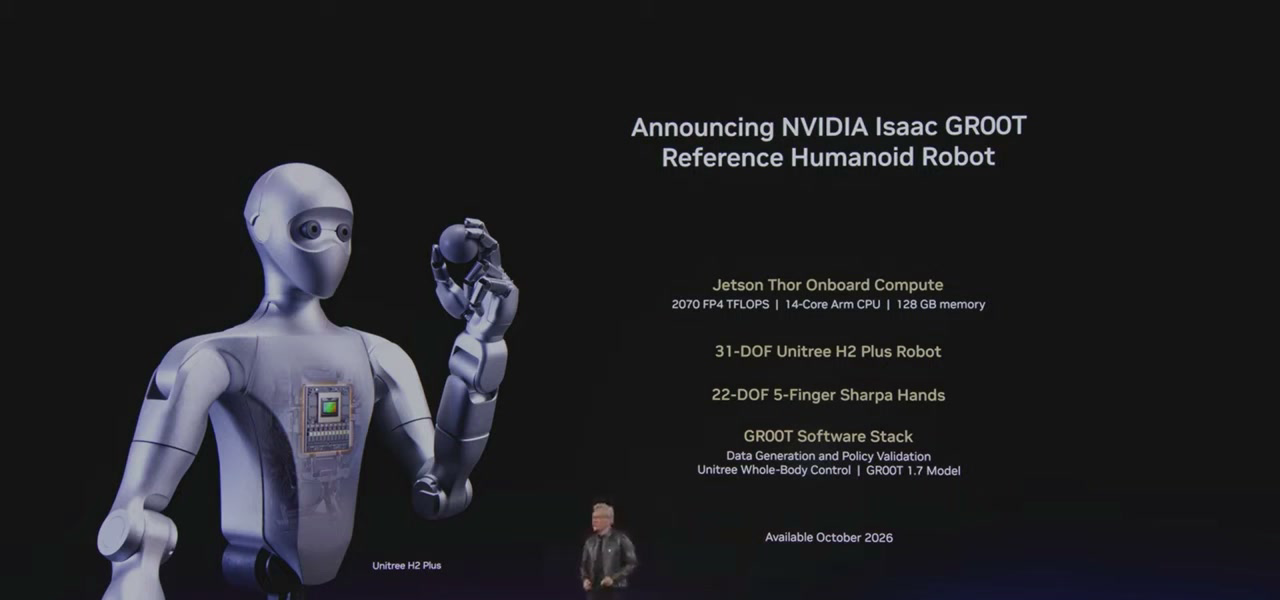
Thus, there were three consecutive launches: the open-source world model Cosmos 3, the open-source autonomous driving model Alpamayo 2 (claiming to be the world’s first autonomous driving capable of “reasoning,” with the NVIDIA Hyperion platform covering about 80% of automakers and approximately 97% of mobility services worldwide), and the humanoid robot reference platform Isaac Groot—each hand 25 degrees of freedom, 31 degrees of freedom as a whole machine, 6 feet tall, 150 pounds weight (Huang joked that “about the same as me, just a bit shorter and fatter”), and running the brand-new Thor chip.
In the past six months, everything has changed. Because Agents have landed and hit cutting-edge models, AI can do real work for the first time.
6. Some of my judgments and predictions
**Judgment 1: This is a “overall upswing” in the business model. ** NVIDIA has shifted from selling chips and systems to selling “AI factories.” When Huang repeatedly repeats “computing power equals revenue, performance-to-power ratio equals profit,” he is actually rewriting the customer’s purchasing logic: don’t just look at chip unit price; calculate how many tokens per watt can be produced and how many years assets can last. Once this marketing logic is accepted, the price war will no longer be effective.
**Judgment 2: The new front line of CPUs is underestimated in terms of lethality. ** “Building CPUs for Agents” sounds like a supplement, but in reality, it’s shooting directly into the heart of x86. If Vera can really achieve 3 to 6 times the real load and be “pre-certified” by the industry alongside Vera Rubin, it will become NVIDIA’s fastest-growing new engine—Nvidia himself says the order has made it one of the most successful product launches in company history.
**Judgment 3: Home AI supercomputers are closer than you imagined. ** “Having an AI supercomputer at home” sounds like science fiction now, but think back ten years ago, you wouldn’t believe phones could replace cameras, wallets, and TVs. When the DGX Station can run trillion-parameter models on the desk, and Microsoft rebuilds the PC base, once this track is validated, the pace of follow-up will be very fast. The real suspense isn’t “will it happen,” but “who will define the operating system of that home AI desktop.”
Note In short
Huang’s two-hour speech essentially sealed the computing paradigm for the next decade into one word—Agent. Vera Rubin handles computing, Vera CPU handles scheduling, RTX Spark puts everyone on their desktops, and robots step into the physical world. When “computing power equals revenue” becomes a consensus, the tone of this game is basically set. The only remaining suspense is: how many years will it take to “set up an AI supercomputer at home”? Share your judgment in the comments.
🧰 Tools I build
I maintain all of these tools myself. Preview builds are clearly labeled; the release pages are the source of truth for downloads, updates and known limits.
Info: HyphenBox Status: Official releases
A radar for free LLM APIs: availability is re-tested continuously, one local interface for all of them, and keys stay on your machine
Info: LocalBrain Status: Official releases
A multimodal MCP toolbox for local models: TTS, Whisper and video generation in one place
Info: ScreenLex Status: Official releases
Learn new words while you watch shows. Free, for Mac and Windows
Info: HyphenScreen Status: Official releases
Screen recording and smart editing in one: a DaVinci-style timeline, automatic redaction and a check of the finished video before export. Free
Quote: HyphenTech Make AI your superpower Local deployment · Free resources · Self-made software https://hyphentech.top
Late nights and burned API credits went in,a cup of tea comes back out — only if you feel like it.
Scan with WeChatPress and hold to save the image, then open it from your album in WeChat Scan

Comments
Loading comments…