
Info: Machine translation This post was machine-translated from the Chinese original. Wording may be rough in places — the Chinese version is authoritative.
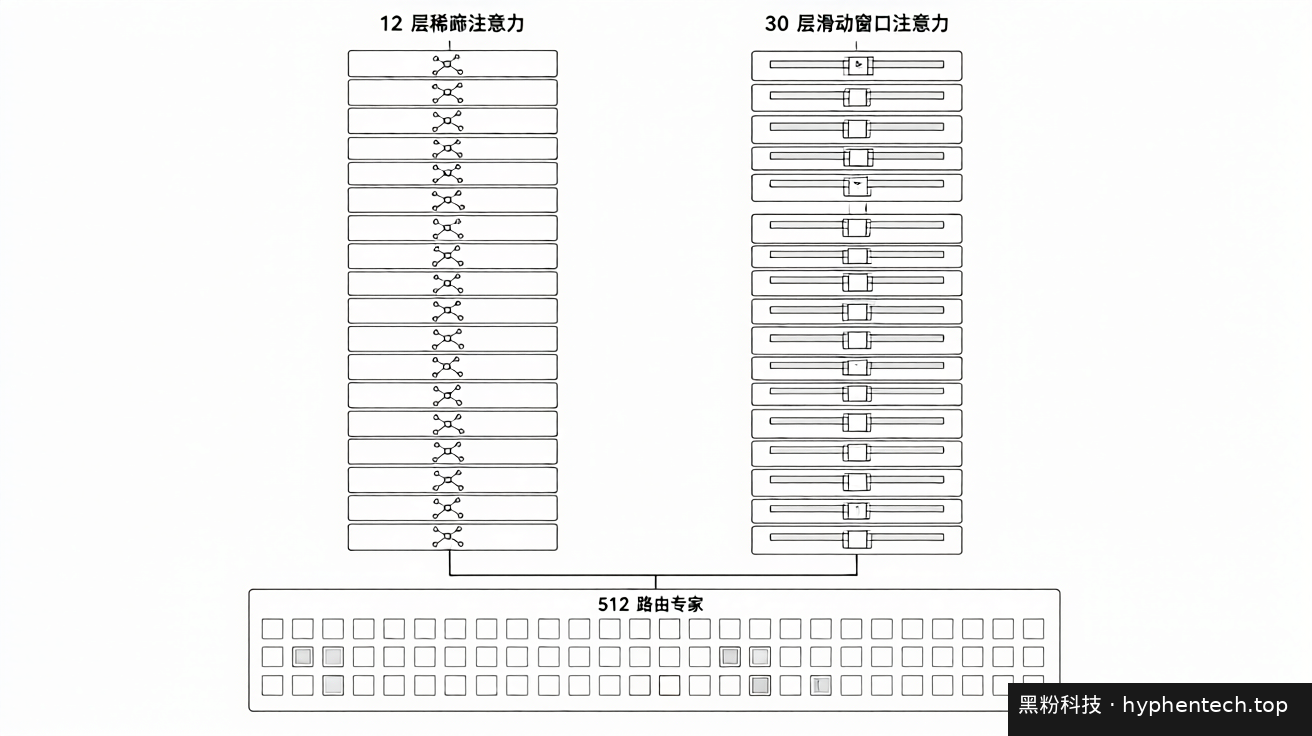
- Total parameters 220B (including 64B Engram parameters), each token only activates 12B parameters; The official parameter table is subdivided into text 11.3B + visual 0.43B
- Context length: 1M (1,048,576 tokens)
- Natively accepts text and image inputs to generate text
- At the same time, it opens up three weights: Hy4 flash, Hy4 flash-FP8, and Hy4 flash-base, hosted on Hugging Face, ModelScope, and GitCode
- The license is Tencent Hy License; Official documentation shows that no Inference Provider has deployed this model yet
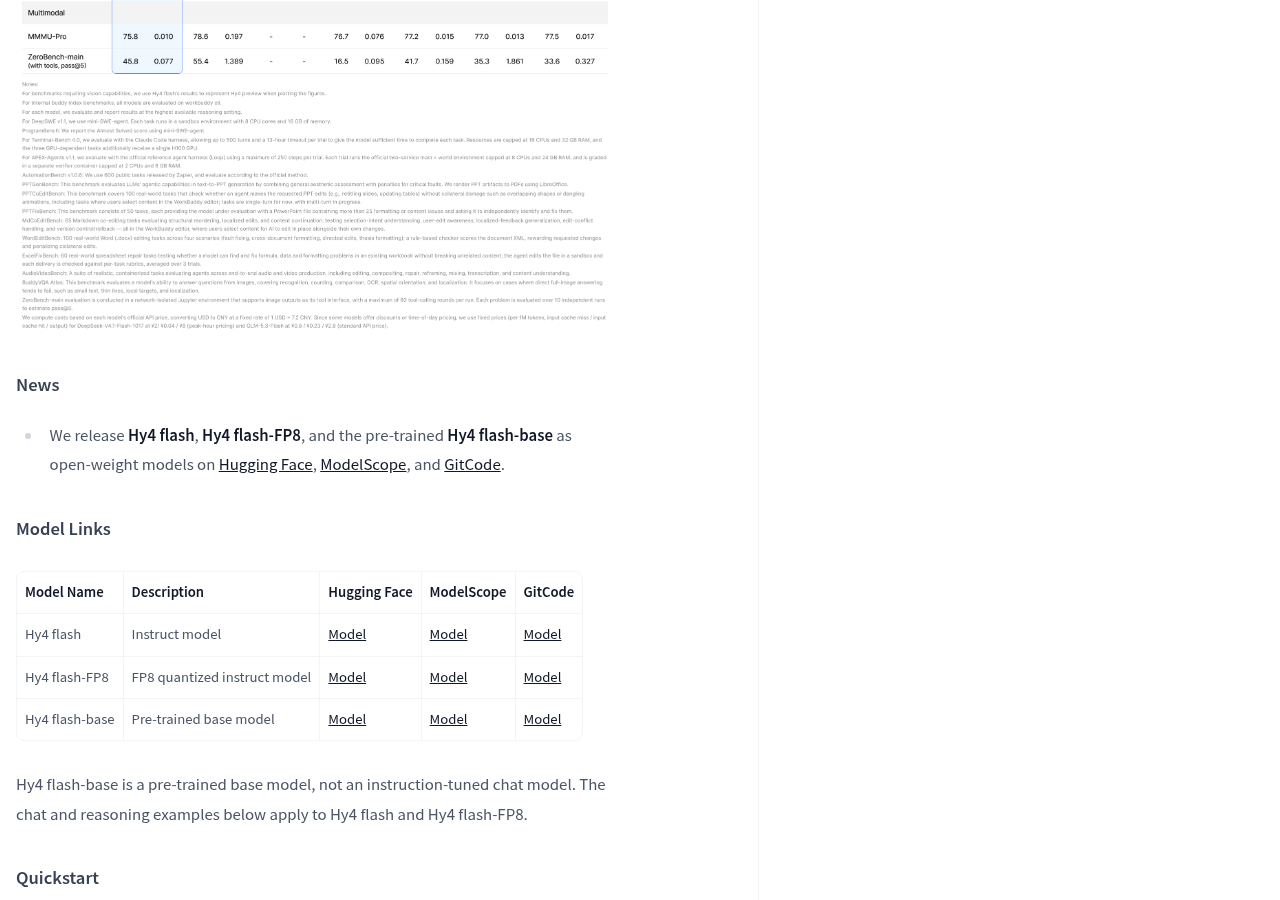
Tencent Hunyuan released the Hy4 flash in its official model warehouse, which is claimed to be the most cost-effective among the Hy series so far. The key numbers are 220B total parameters, only 12B parameters activated per token, 1MB context, and native image consumption. For those who want to run models on their own machines, the most important thing to look at is not the total parameters column, but the “activation parameters” and the official deployment configuration — the latter stating 8 cards of tensor parallelism.
Three words that must be distinguished: open authority, activation parameters, and license
The issue of “opening up authority” is best described by the WeChat group file sharing analogy: the file itself can be freely downloaded and forwarded, but if a notice in the group says “Please use according to the rules on this paper,” those rules still bind you. The weight files for Hy4 flash are public, and the license is the Tencent Hy License. The official requires you to check the LICENSE details yourself. In other words, opening the file does not mean there are no usage conditions; rules and files must be verified separately.
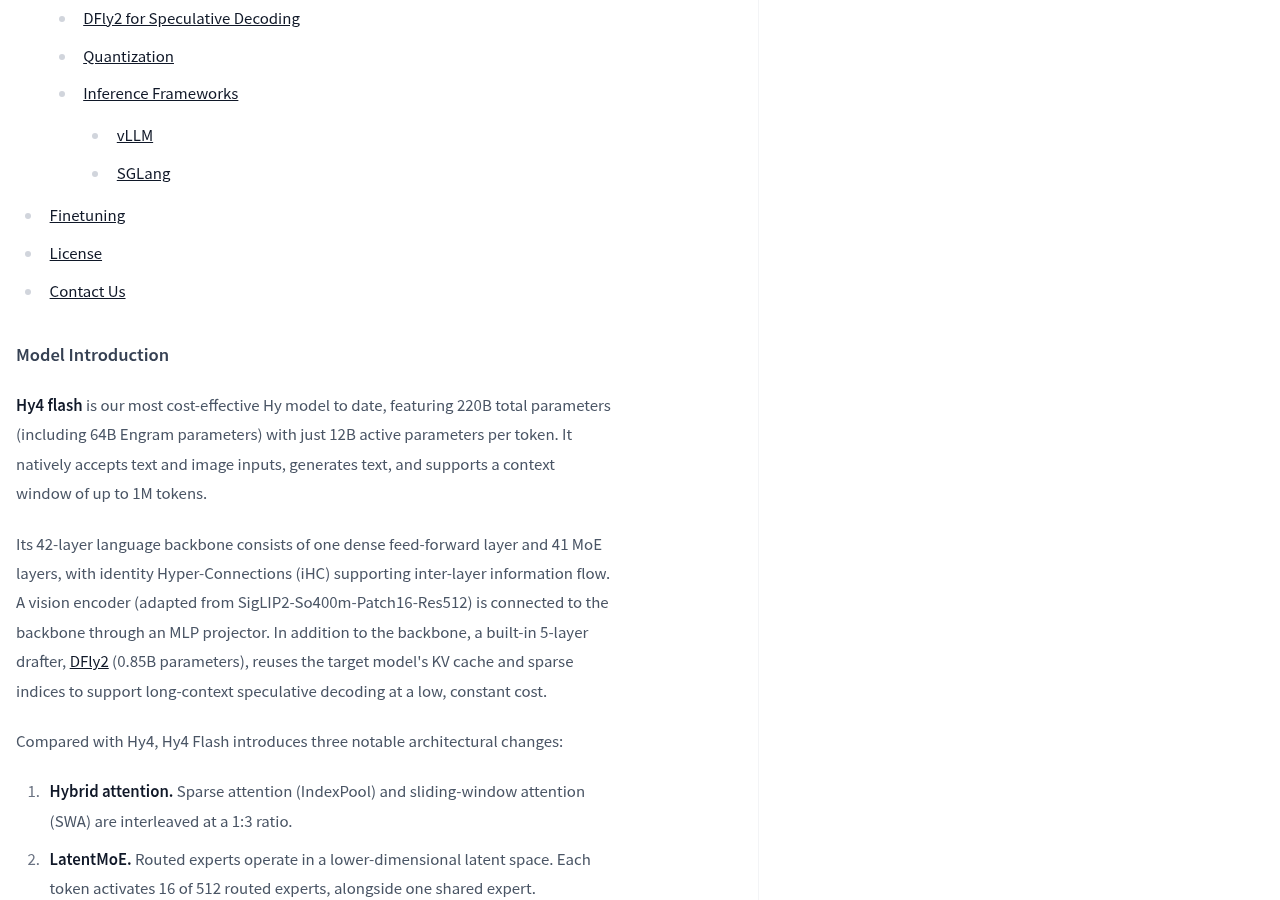
“Activation parameters” are another easily misread number. 220B is the entire model belongings, like a warehouse stacked with 220 tons of goods; but only part of each token is taken out when generated. The official table is very clear: excluding Engram, ViT, and DFly2, the main body is 155.5B, Engram accounts for 63.5B, vision encoder 0.43B, DFly2 drafts model 0.85B, and each token activates 11.3B text plus 0.43B visual input. Fewer activation parameters means each step requires little computation, but the inventory is still on the hard drive, and how much VRAM it occupies depends on how you install it.
What really takes up space in reasoning is the 220B weight itself. You can compare it to a courier: when the warehouse ships the entire 220B batch at once, only the 12B small bag is picked for sorting. Sorting is cheap, but the whole batch still needs to be pulled back and unpacked for storage. What really determines whether it can run is the weight volume, quantization format, and video memory, not the 12B one.
The two official deployment routes and their differences in thresholds
Production-grade service: officially starting at 8 cards
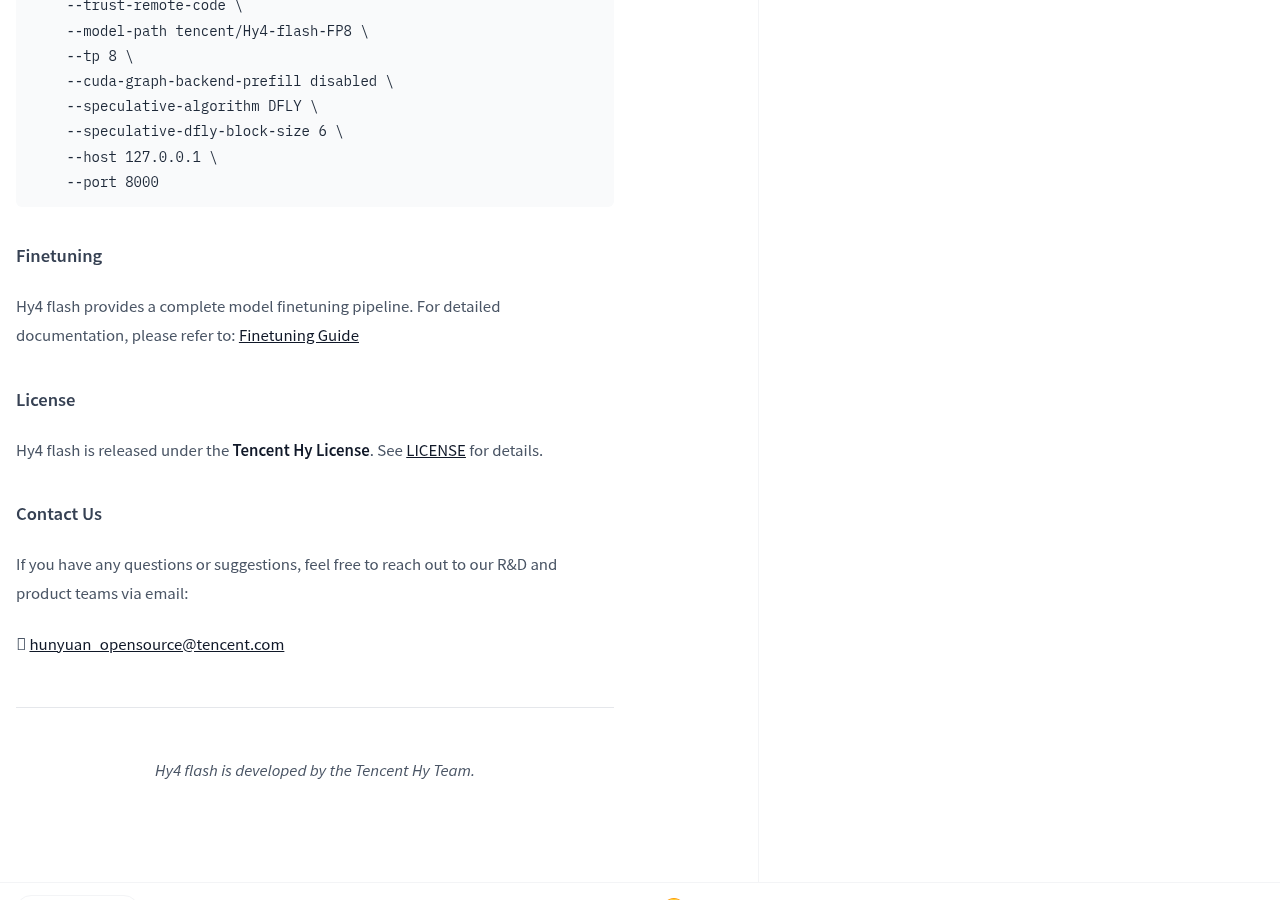
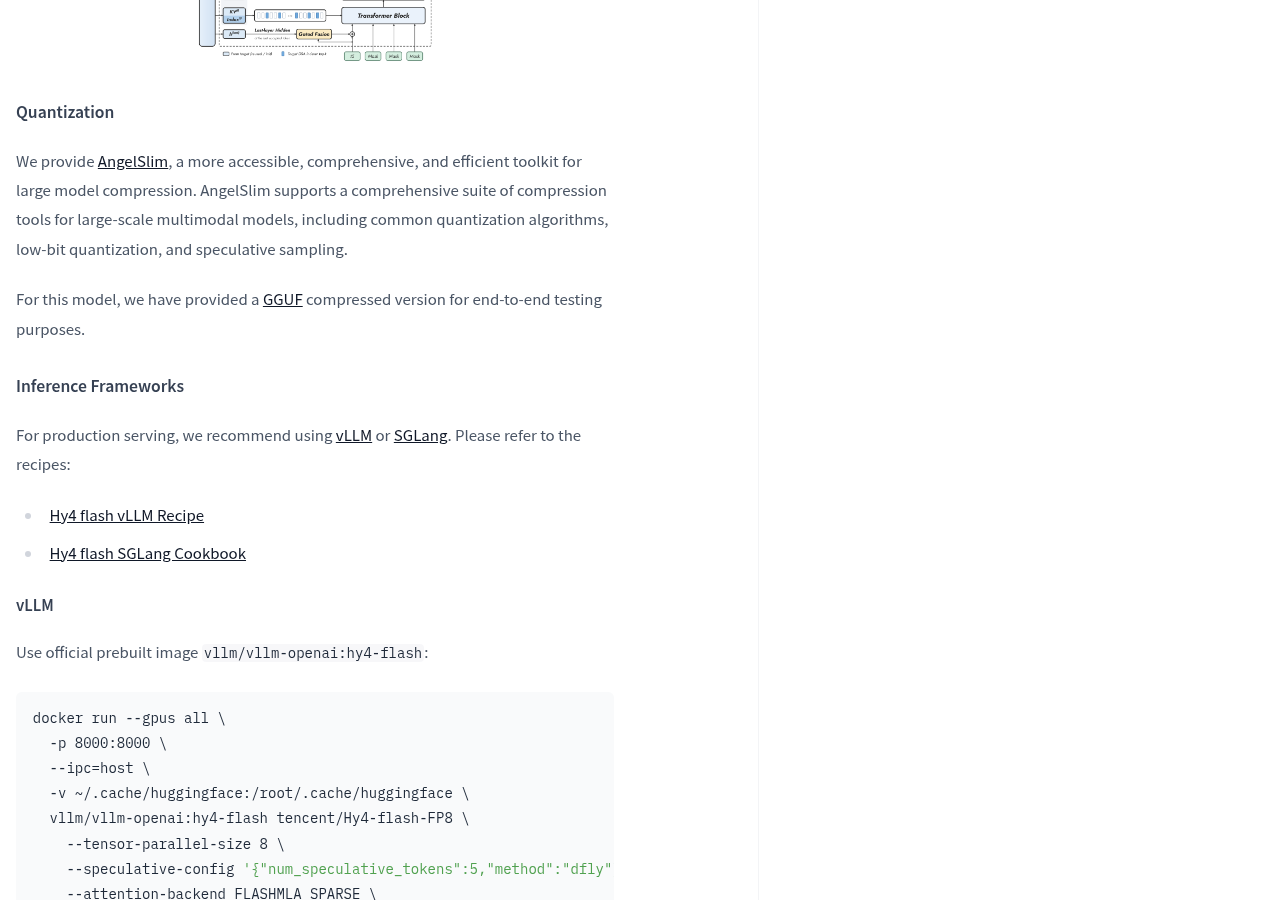
The officially recommended vLLM startup command says --tensor-parallel-size 8, and the SGLang side uses --tp 8. Both use FP8 weights (tencent/Hy4-flash-FP8). This is the official service configuration, which belongs to multi-GPU scenarios and is not the same as a personal laptop. The official also provides preset images vllm/vllm-openai:hy4-flash and lmsysorg/sglang:hy4-flash, the latter labeling multiple architectures, including x86 and Arm.
docker run --gpus all \
  -p 8000:8000 \
  --ipc=host \
  -v ~/.cache/huggingface:/root/.cache/huggingface \
  vllm/vllm-openai:hy4-flash tencent/Hy4-flash-FP8 \
    --tensor-parallel-size 8 \
    --speculative-config '{"num_speculative_tokens":5,"method":"dfly"}' \
    --attention-backend FLASHMLA_SPARSE \
    --tool-call-parser hy_v4 \
    --reasoning-parser hy_v4 \
    --enable-auto-tool-choice \
    --port 8000 \
    --served-model-name hy4-flash
Local attempt paths: Transformers and GGUF
The official documentation states that Hy4 flash support will soon be merged into the transformers main branch, and installation must be done from the specified commit before that. The sample code loads tencent/Hy4-flash using AutoModelForImageTextToText, and device_map assign it to auto. For quantization, the official AngelSlim toolkit is provided and explains that a compressed version of GGUF is prepared for end-to-end testing, hosted on AngelSlim/Hy4-flash-GGUF.
pip install "transformers[torch,vision] @ git+https://github.com/huggingface/transformers.git@refs/pull/50903/head"
These official commands answer “how to boot,” not “how much VRAM is needed.” The official materials do not provide minimum VRAM figures for single cards or consumer hardware; readers need to estimate based on quantized weighted volumes and test on their own machines, rather than treating the 8-card configuration as the entry option.
Speed and cost: official caliber and its comparable boundaries
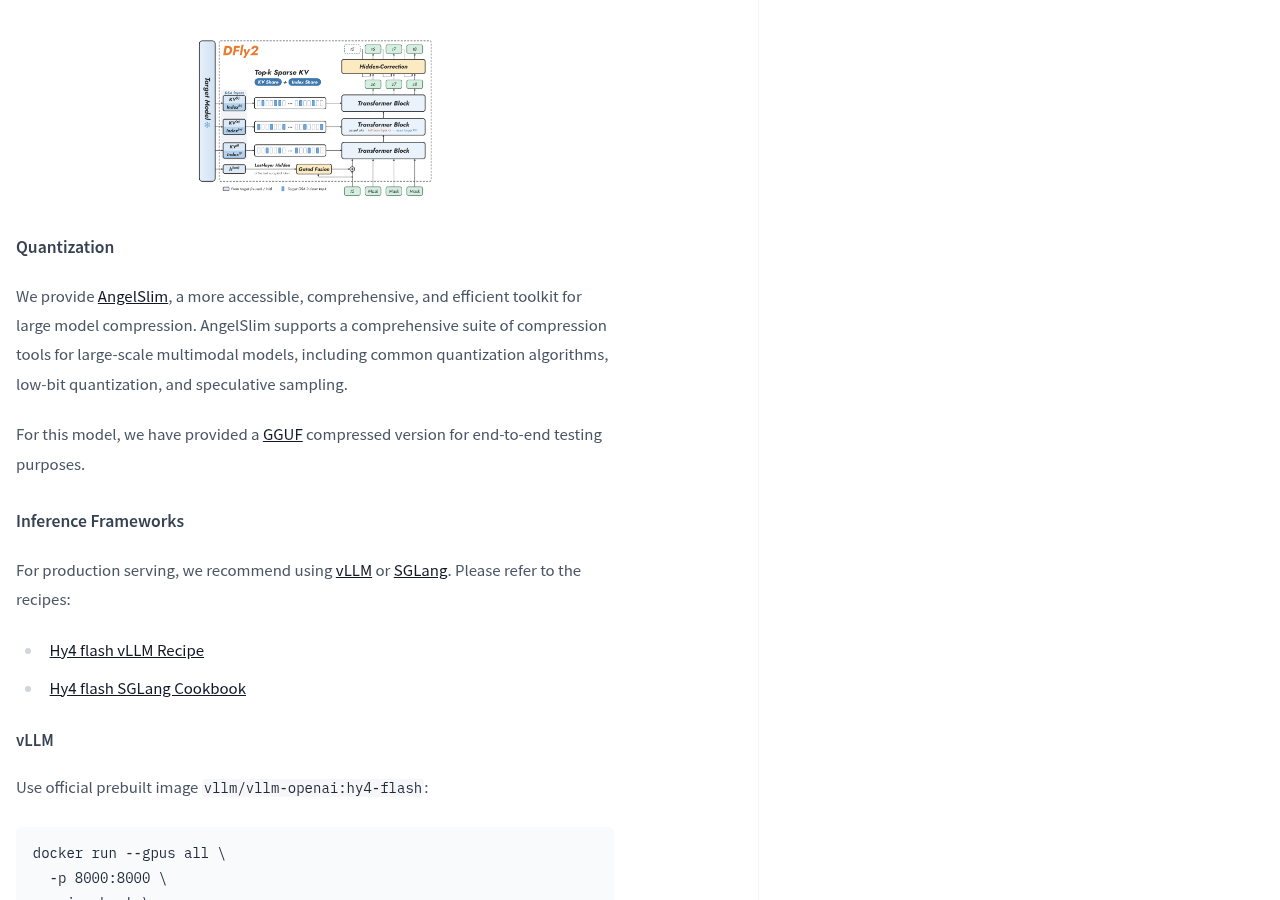
Officially, combining megakernels, 4-bit quantization, and DFly2 results in decoding speeds exceeding 150 tokens/s. DFly2 is a built-in 5-layer drafting model with 0.85B parameters. It reuses the target model’s KV cache and sparse indexes for long-context speculative decoding. The official benefits include up to about 2K keys per draft token, constant overhead independent of context length, and no need to maintain KV memory separately for draft models.
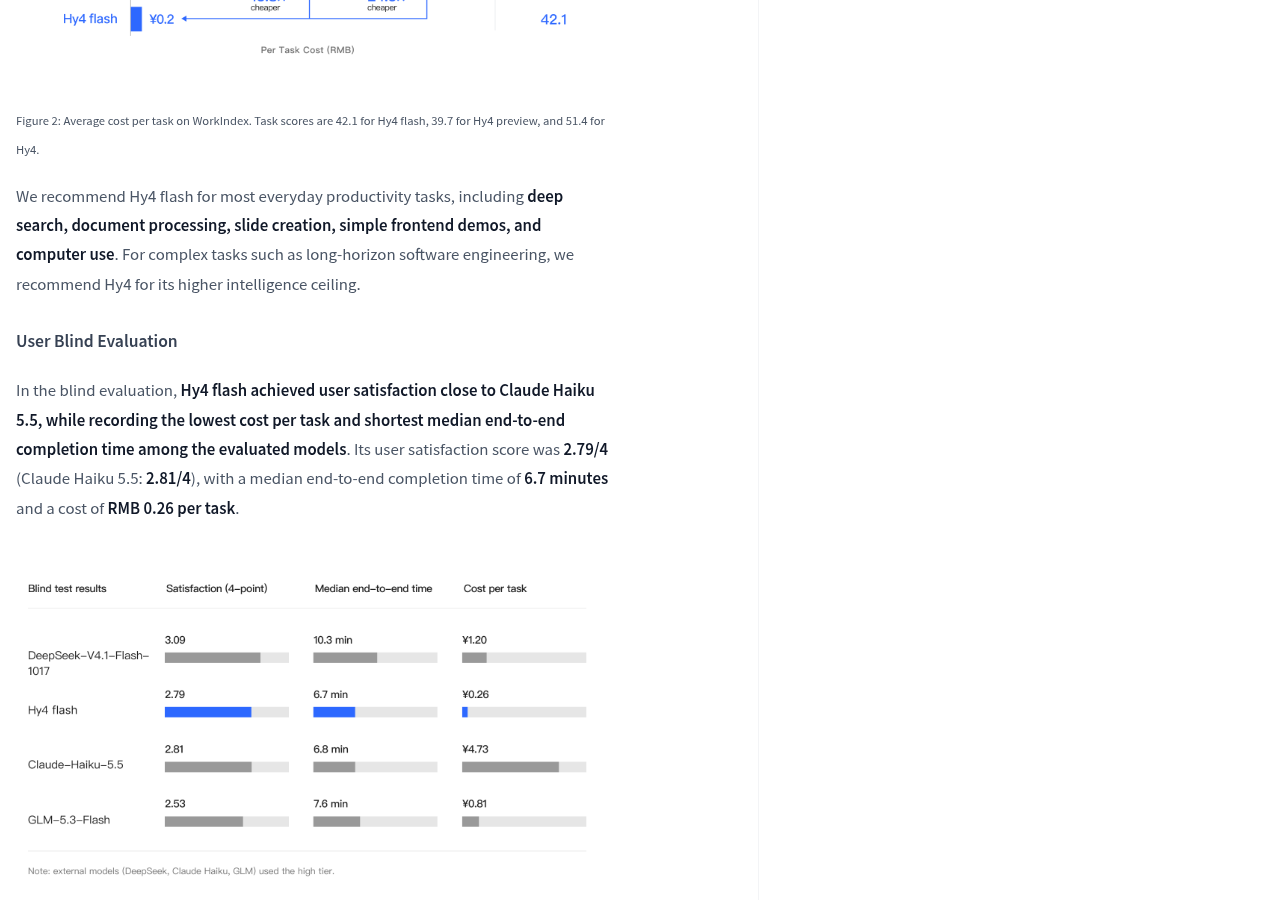
The cost comparison comes from the official internal WorkIndex benchmark: Hy4 flash score 42.1, Hy4 preview 39.7, Hy4 51.4; the official average cost per task for Hy4 flash is 1/13 of Hy4 preview, 1/20 of Hy4, and 1/8 of DeepSeek-V4.1-Flash-1017 (Max tier, peak pricing). For blind user reviews, the official figures are 2.79/4 (Claude Haiku 5.5 is 2.81/4), median end-to-end completion time is 6.7 minutes, single task cost is 0.26 RMB, sample 85 internal WorkBuddy users, 259 tasks, and 27 categories.
Tip These scores are all official reports or listed figures, and the benchmark is the official WorkIndex. The blind review audience comes from internal users, and horizontal comparisons use each official cost benchmark. They are suitable for understanding official product positioning and trade-offs, and are not equivalent to third-party independently verified horizontal review conclusions; When you switch to your own task for acceptance, you still have to run it again.
Additionally, the official documentation proactively includes a reminder: the base model encounters a large amount of synthetic instruction data during mid-stage training, and in few-sample evaluations, it occasionally answers in a format not expected and may affect scores. This self-disclosure is crucial for those who want to use it as a benchmark for reproduction—some ranking scores are affected by output formats.
What can be done now, and what cannot be done yet
- What you can do: Download the three versions of the open authority, use Transformers or vLLM/SGLang as in the official documentation, and call with OpenAI-compatible interfaces; Perform end-to-end local testing with the GGUF version; Perform fine-tuning (the official documentation provides a complete fine-tuning process)
- What cannot be done yet: treating an 8-card FP8 configuration as a personal computer solution; Assuming open weighting means any machine can run with one click; Looking forward to the officially hosted online inference service—the official model page shows that this model currently has no Inference Provider deployments
The official team also offers selection advice: for daily productivity tasks including deep search, document processing, slide making, simple front-end demos, and computer operations, Hy4 flash is recommended; For long-cycle, complex software engineering tasks, Hy4 is recommended because it has a higher intelligence ceiling. The practical meaning of this statement is: first decide whether your task is “one-time delivery” or “a long chain,” then decide whether to pay the hardware price for the 220B of assets.
Next step for acceptance: first decide which path you want to take—production services will follow the official recipe for vLLM or SGLang with hardware, and personal experiments will start with Transformers specified commits or GGUF compressed versions; On your own machine, measure three things: load download volume and actual usage after loading, the generation speed of a single request, and the output quality and format stability of the same task (especially the format drift issue left over from the base model’s synthesis instruction data). Before these three data items are released, the official numbers can only be used as reference coordinates.
Official information
Self-made software
Versions, changes and supported installers all come from the same public release records.
HyphenBox
A free model API radar and local router, with ongoing availability checks and keys kept on your device.
View public downloads and updates ↗LocalBrain
A local AI toolbox for transcription, speech, images, video, and MCP tools. Features vary by platform version.
View public downloads and updates ↗Support HyphenTech
Late nights and burned API credits went in,a cup of tea comes back out — only if you feel like it.
Save the QR codeScan with WeChatPress and hold to save the image, then open it from your album in WeChat Scan

WeChat tips · Any amount welcome



Comments
Loading comments…