
Info: Machine translation This post was machine-translated from the Chinese original. Wording may be rough in places — the Chinese version is authoritative.
Want to know which internal features are activated when Qianwen processes a sentence? ByteDanceSeed’s Cross-Layer-TopK-CLT provides a research entry point: extracting internal features from Qwen3-8B-Base and using these features to reconstruct some internal computational results. Those interested in studying internal model computations can continue reading; those who want to directly enhance chat performance do not make corresponding commitments.
It extracts internal features, not ready-made thought statements
Officially, it is called a cross-layer transcoder, abbreviated as CLT. You can temporarily think of the internal processing process of the model as a parish sorting: parcels pass through different stations, each containing information being processed. CLT reads this information from designated positions on each layer, converts it into a set of numbered features with activation values, and then reconstructs the output of the corresponding computing module using the selected features. Here, the numbers are like shelf locations, telling you where the features are and how strong they are activated; The numbers themselves do not include a pickup slip explaining the meaning.
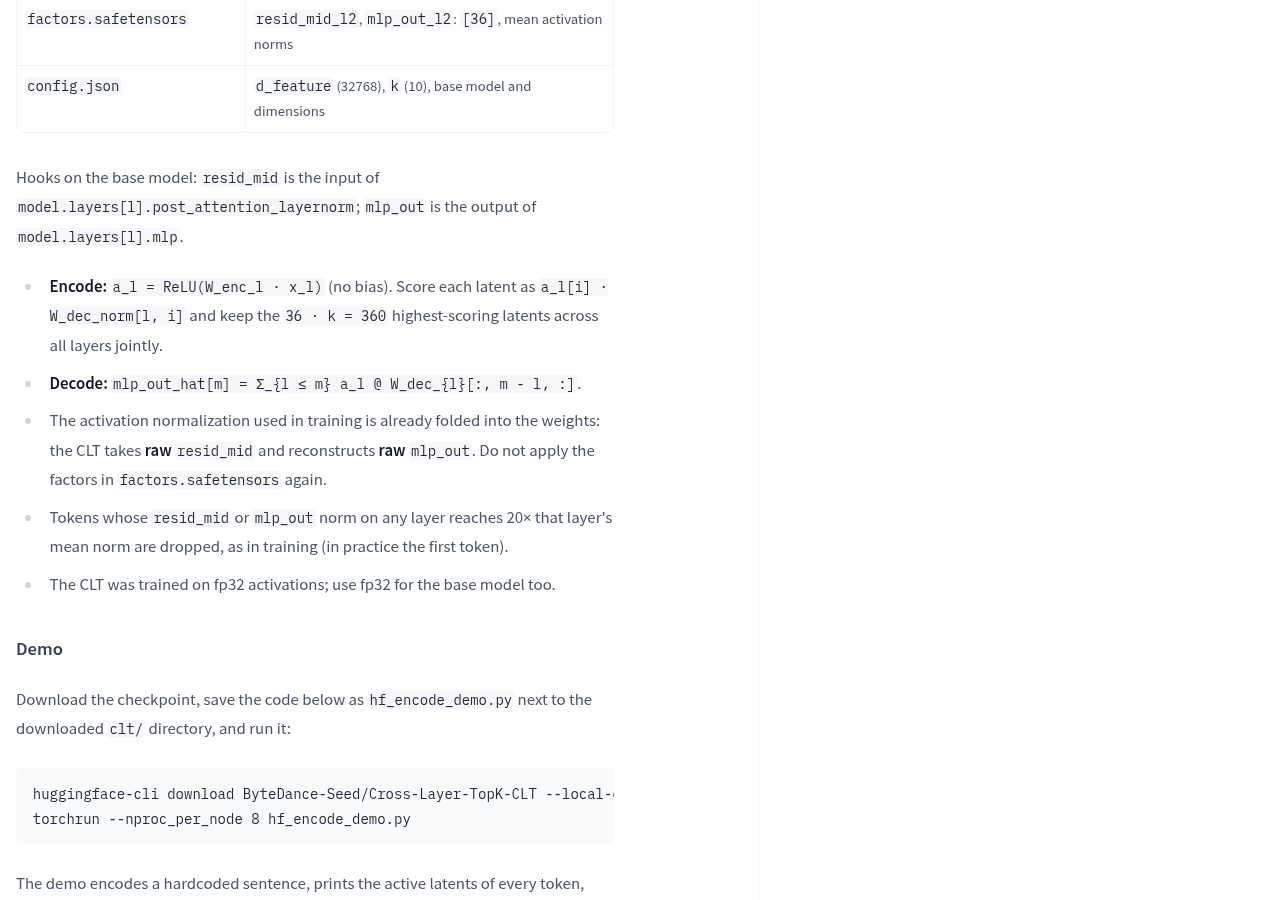
For this project, feature reading is the residual flow before the MLP of each feedforward computing module, officially denoted as resid_mid; The reconstruction target is the MLP output, denoted as mlp_out. Features from each layer can participate in reconstructing the MLP output of the current and subsequent layers, so the observed relationships span layer to layer and not remain confined to a single layer.
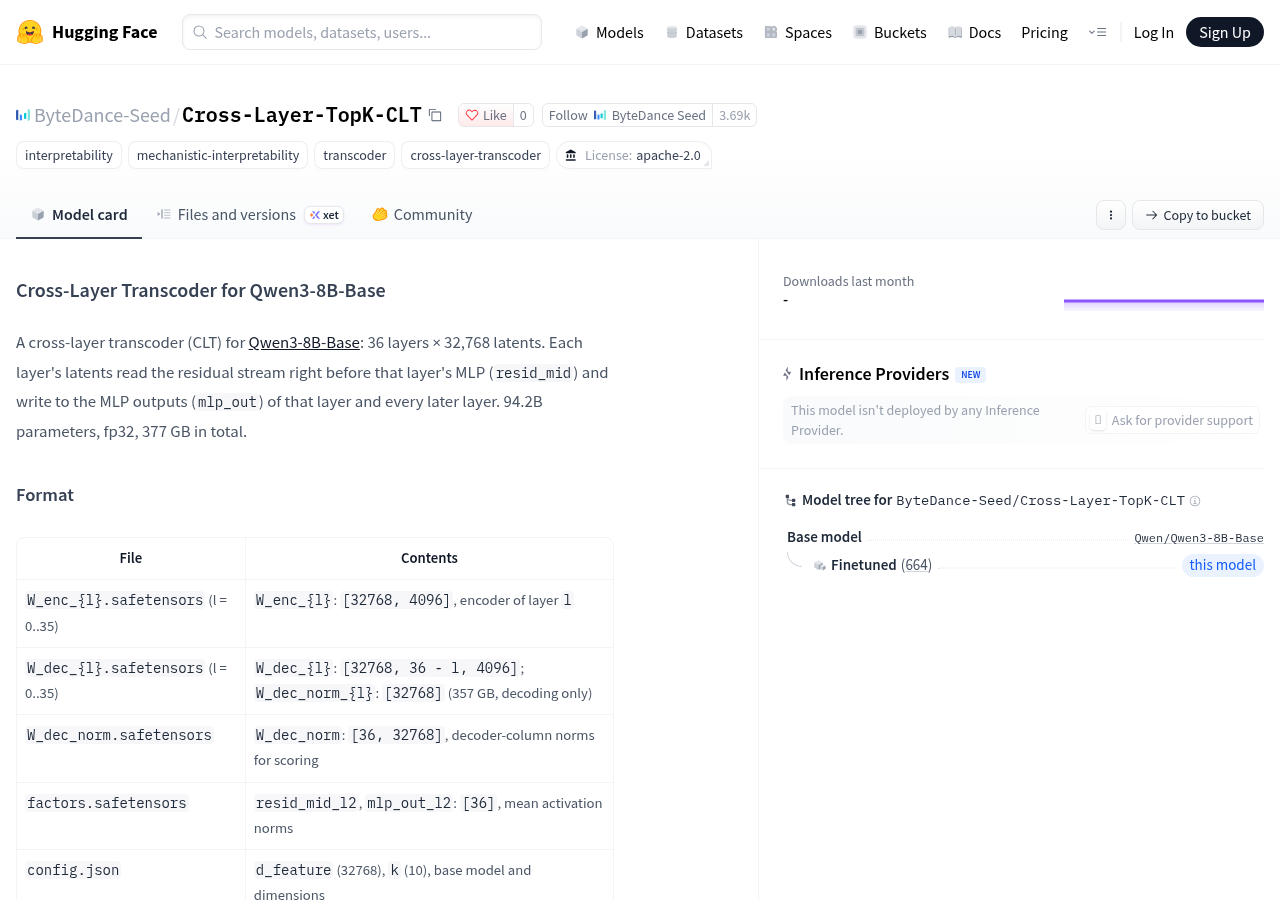
The officially listed structure consists of 36 layers, each containing 32,768 potential features. After encoding, the program scores the activation values and decoder column norms, jointly retaining the highest 360 features across all layers. Here, TopK is cross-layer joint screening, not each layer picking the same number of features.
This organizes internal calculations into sparse feature records for further analysis. However, the official example shows feature numbers, activation values, and the shapes of reconstruction results, without providing natural language meaning for each feature. To answer exactly what a feature corresponds to, a separate verification process must be designed, and the output list cannot be directly treated as a complete model explanation.
Choose encoding or rebuild first, then consider downloading
The number that most influences usage choice is size: the official CLT lists 94.2 billion, which is 94.2 billion parameters, using fp32 format, with a total file size of 377 GB. This reflects the scale of the codec itself, not rewriting the base model Qwen3-8B-Base to 94.2 billion, nor is it a rating for chat capability.
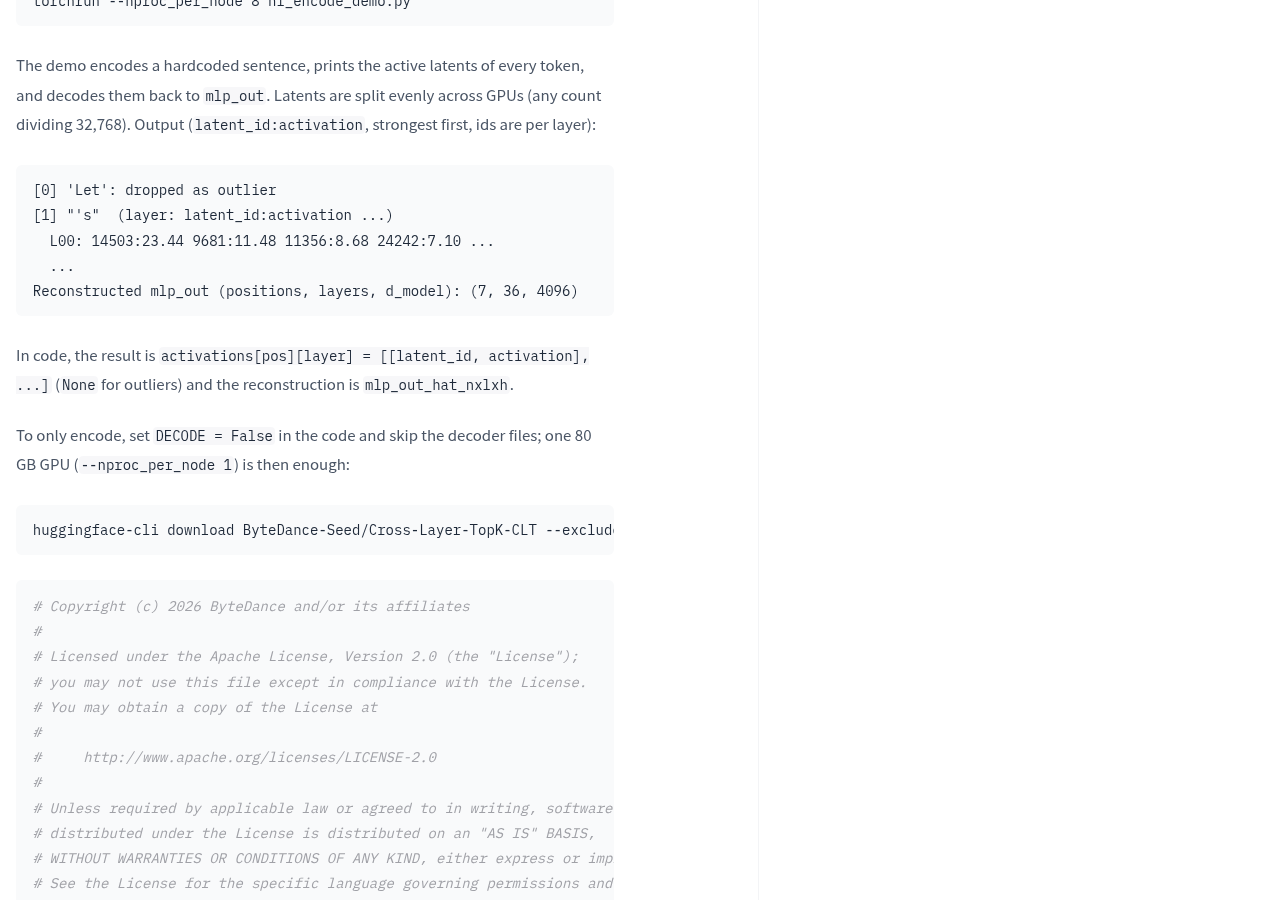
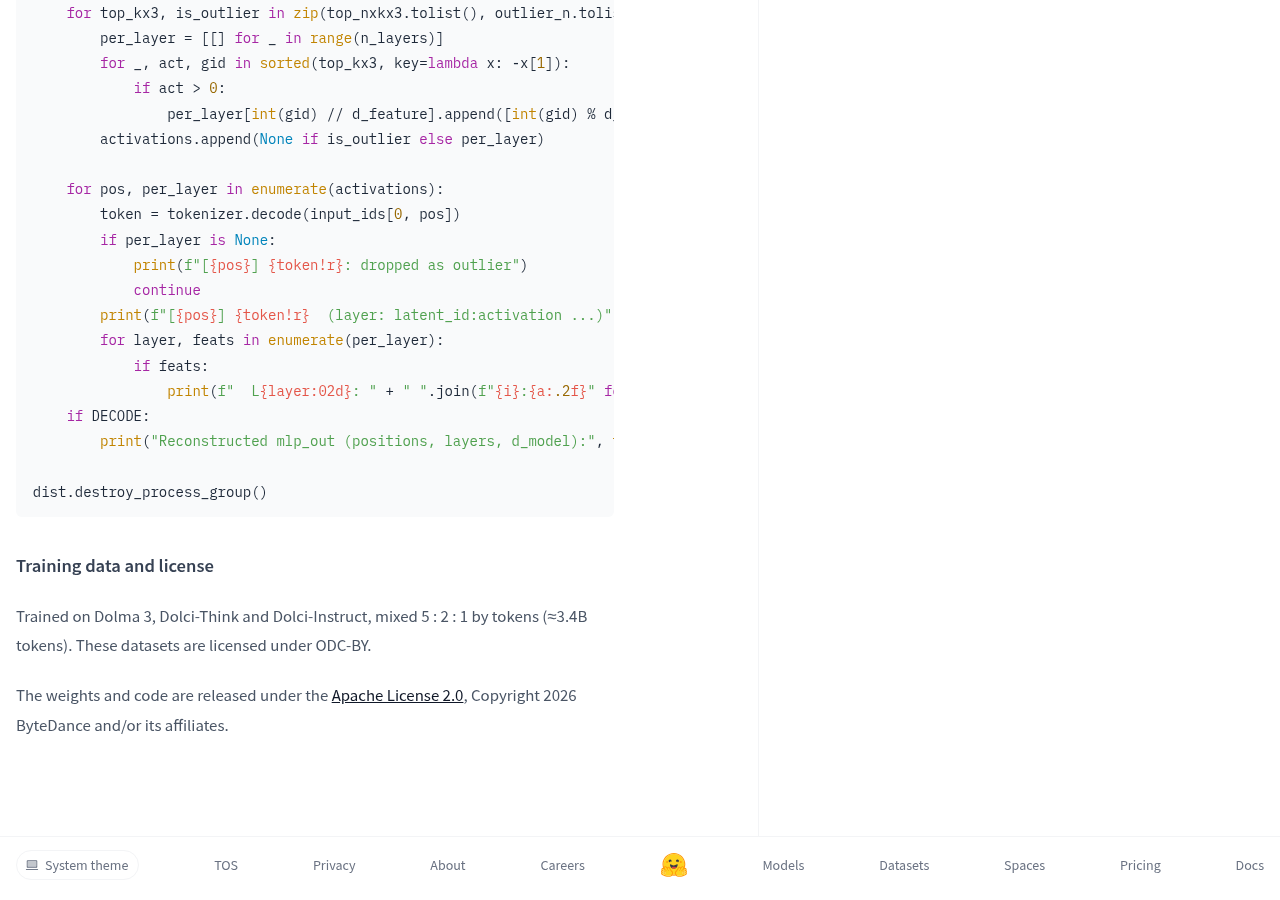
If the goal is simply to see which features are activated, you can choose to encode only. The official requirement is to set DECODE = False in the sample code and to skip the decoder file; The documentation states that an 80 GB graphics card is sufficient to run this encoding example. For research tasks that do not need to reconstruct output for the time being, this path is more worth checking first.
If you want to restore features to MLP output, you need a decoder. The official decoder file is labeled as 357 GB and provides a multi-card boot example using 8 processes. File size stores information, and the startup command is a sample configuration; The documentation does not provide a universal minimum video memory for complete reconstruction based on this, nor does it list runtime and cannot be directly converted to a computer’s available configuration.
The operation method should also be considered separately: the attached examples use PyTorch, CUDA, and NCCL. The documentation does not provide adaptation instructions for Mac, MLX, or other backend running devices. Therefore, the weights are already open and existing computers can run directly require separate confirmation.
After running out of the feature list, what should be accepted?
The official example uses preset sentences in the code, prints each word element to activate features, and then reconstructs them into mlp_out. A word element can be understood as a WeChat message cut into small segments by the model: one fragment may not correspond to a complete Chinese character or word. The example lists features at different layers according to these fragments, so when reading output, you need to look at the text fragment, the layer it is in, and the feature number together.
There are two settings during reproduction that can easily affect results. According to the official instructions, the activation normalization used for training has already been incorporated into the weights, so do not use the scaling factor in factors.safetensors; The base model should also use fp32 to maintain activation accuracy consistent with training. There is also outlier handling: when the norm of a correlation vector in any layer reaches 20 times the mean of that layer, the corresponding word element is discarded, and the first word element in the official example is marked as an outlier.
Therefore, acceptance can proceed along the actual output: whether the code produces element-by-word and layer-by-layer feature records, whether outliers are handled according to rules, and whether the expected output is obtained after enabling reconstruction. To further judge whether the reconstruction is good, it is necessary to compare the reconstruction value with the original MLP output of the base model. The page shows the shape of the reconstruction result but does not provide a reconstruction error score; The shape was successfully printed, but only the checks of the runway process were completed.
Who is it suitable for now, and where is the next step?
Official notes indicate that weights and code have been released under Apache License 2.0; Licenses related to training data are separately listed as ODC-BY. Before use or redistribution, the corresponding terms of the project and data should be reviewed separately. The page also shows that without an inference service provider deploying this model, the warehouse entry cannot be treated as an off-the-shelf online call service.
If you are studying the internal features of Qwen3-8B-Base and meet the operational requirements for official examples, you can first check the output from the encoded path before deciding whether to download the decoder and continue reconstructing comparisons. If the need is daily chatting or expecting the tool to automatically explain the meaning of each feature, the current documentation does not provide such a usage process.
Next, you can check official project description and weight entry, and focus on reading example runtime instructions and file format instructions. First, confirm whether the task requires coding or reconstruction, and whether the device matches the sample, then start downloading; After finishing the run, answer the real research questions using the original output and reconstruction results.
Official information
Self-made software
Versions, changes and supported installers all come from the same public release records.
HyphenAssistant
Continue your computer’s DeepSeek Harness session from a phone browser. The service, computer and network must stay online; model costs follow your existing setup.
View public downloads and updates ↗LocalBrain
A local AI toolbox for transcription, speech, images, video, and MCP tools. Features vary by platform version.
View public downloads and updates ↗HyphenBox
A free model API radar and local router, with ongoing availability checks and keys kept on your device.
View public downloads and updates ↗ScreenLex
Turn subtitles from your own films and shows into an English vocabulary library, entirely offline.
View public downloads and updates ↗HyphenScreen
Screen recording and editing with a Resolve-style timeline, automatic redaction and pre-export checks.
View public downloads and updates ↗Support HyphenTech
Late nights and burned API credits went in,a cup of tea comes back out — only if you feel like it.
Save the QR codeScan with WeChatPress and hold to save the image, then open it from your album in WeChat Scan

WeChat tips · Any amount welcome




Comments
Loading comments…