
Info: Machine translation This post was machine-translated from the Chinese original. Wording may be rough in places — the Chinese version is authoritative.
Seeing the Qwen3-30B-A3B-MoE-SAE appear in ByteDance’s Seed official model repository, don’t rush to treat it as a new chat model. The official description positions it as a sparse autoencoder analyzing the internal output of the Qwen3-30B-A3B, and the usage example requires loading the original Qwen model separately. If the goal is to directly switch to a more user-friendly chat assistant, this resource does not provide corresponding capability scores.
It is more suitable for another question: Can the cluster of numbers generated inside the model be broken down into features that are easier to study? Understanding this allows us to judge whether these weights are worth downloading and what should be accepted after downloading.
It breaks down internal output, not answers questions for you
MoE is usually translated as “mixed expert.” You can think of it as a community courier station: different shelves share different packages, but just looking at the last batch of packages retrieved, it’s hard to know the specific categories inside. Here, the sparse autoencoder, or SAE, is more like a sorting and marking method: it maps mixed internal outputs to a large number of candidate features, keeping only the strongest portion. Here, “expert” and “feature” are both computational structures in the model, not just someone hiding behind the scenes sorting.
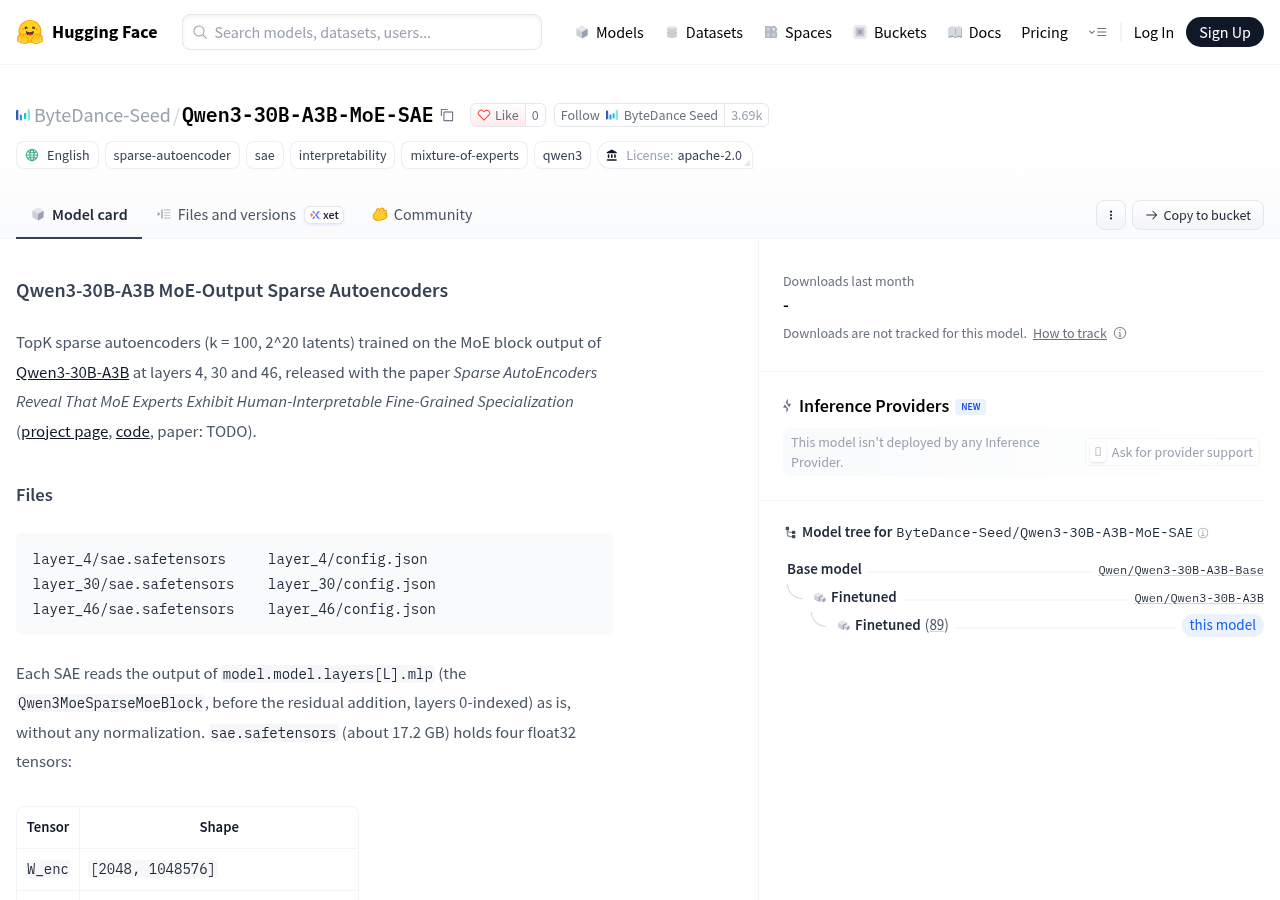
The official SAE is trained for layers 4, 30, and 46, with layer numbers counted from 0. They read the original output of the MoE module, positioned before the sum of residuals, and are not normalized. This position can be understood as the handover point before the package is merged with other batches: once the sampling position changes, what is read also changes. Therefore, which layer to connect to and which module to read is a condition that must be matched during reproduction.
This configuration contains 1,048,576 candidate potential features, using the TopK method to retain the strongest 100. Using the example of the courier station, the tag library is large, but only the most obvious current tag set is left each time. The official code then reconstructs the original output using these features to check how much information is lost during decomposition. The large number of candidate features does not automatically mean that each feature already has clear human semantics.
Before downloading, first check the additional VRAM overhead
The official page lists the SAE.safetensors and config.json for each layer, along with download and loading examples. The documentation states that each SAE weight is about 17.2 GB, with the float32 tensor stored internally. The usage example also specifically states that SAE occupies about 17 GB outside the base model. This number cannot be used as the VRAM requirement for the entire process.
The actual process first loads Qwen3-30B-A3B, then captures the output of the specified layer and hands it over to SAE for encoding and reconstruction. It’s more like connecting a set of inspection instruments to running equipment; the original equipment still needs power and space usage; The volume of the testing instrument does not include the original device’s volume. When determining whether it can run, the resource requirements of the base model and SAE need to be calculated separately.
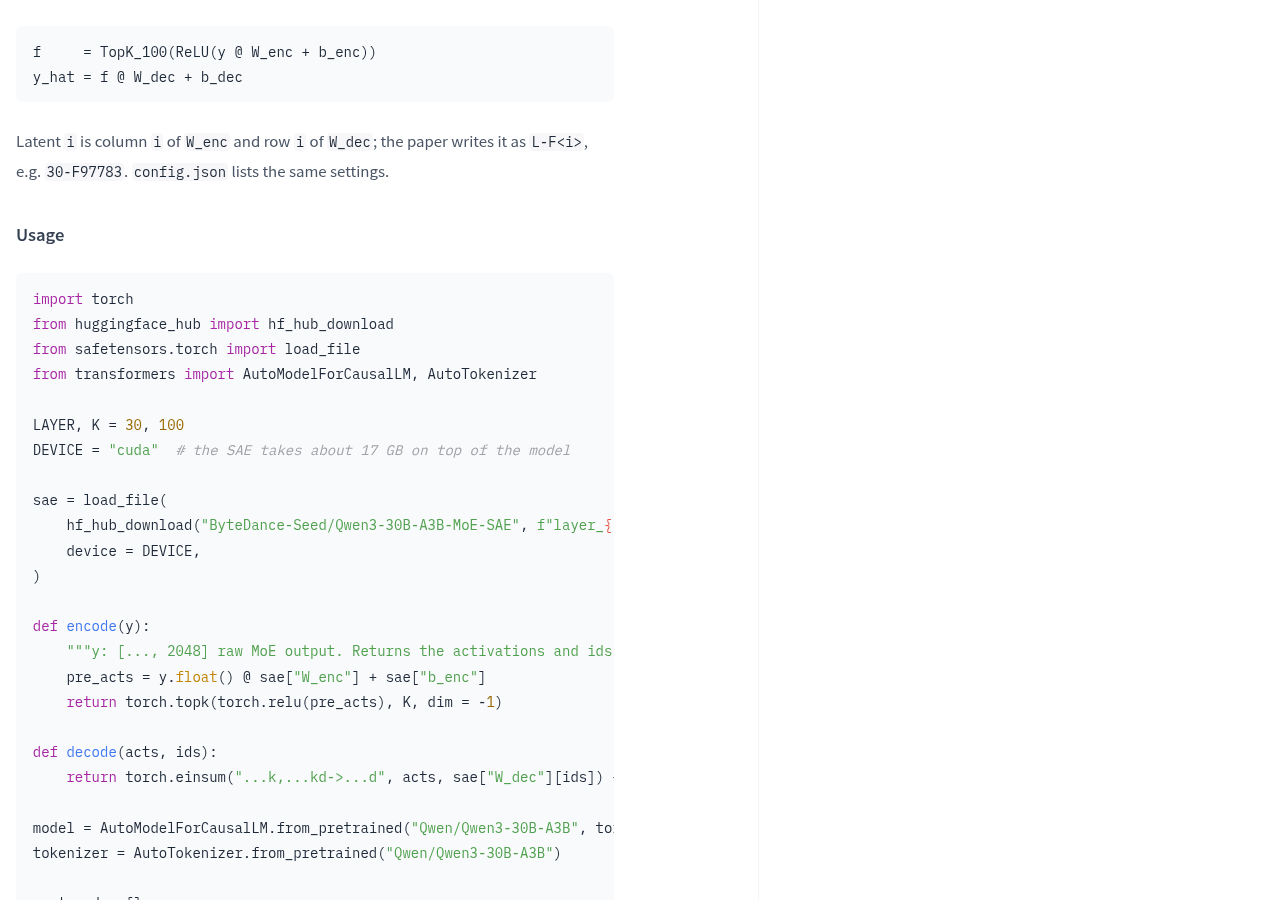
Increasing input length also increases the burden of intermediate computation. Words can be understood as small fragments cut into WeChat messages before entering the model; not necessarily one Chinese character corresponds to one word. Official reminder: dense pre-activation calculation requires 4 MiB per word element, so long inputs should be chunk-coded. This is a memory reminder for intermediate computation, not a pricing standard for each message, nor the memory required for full operation.
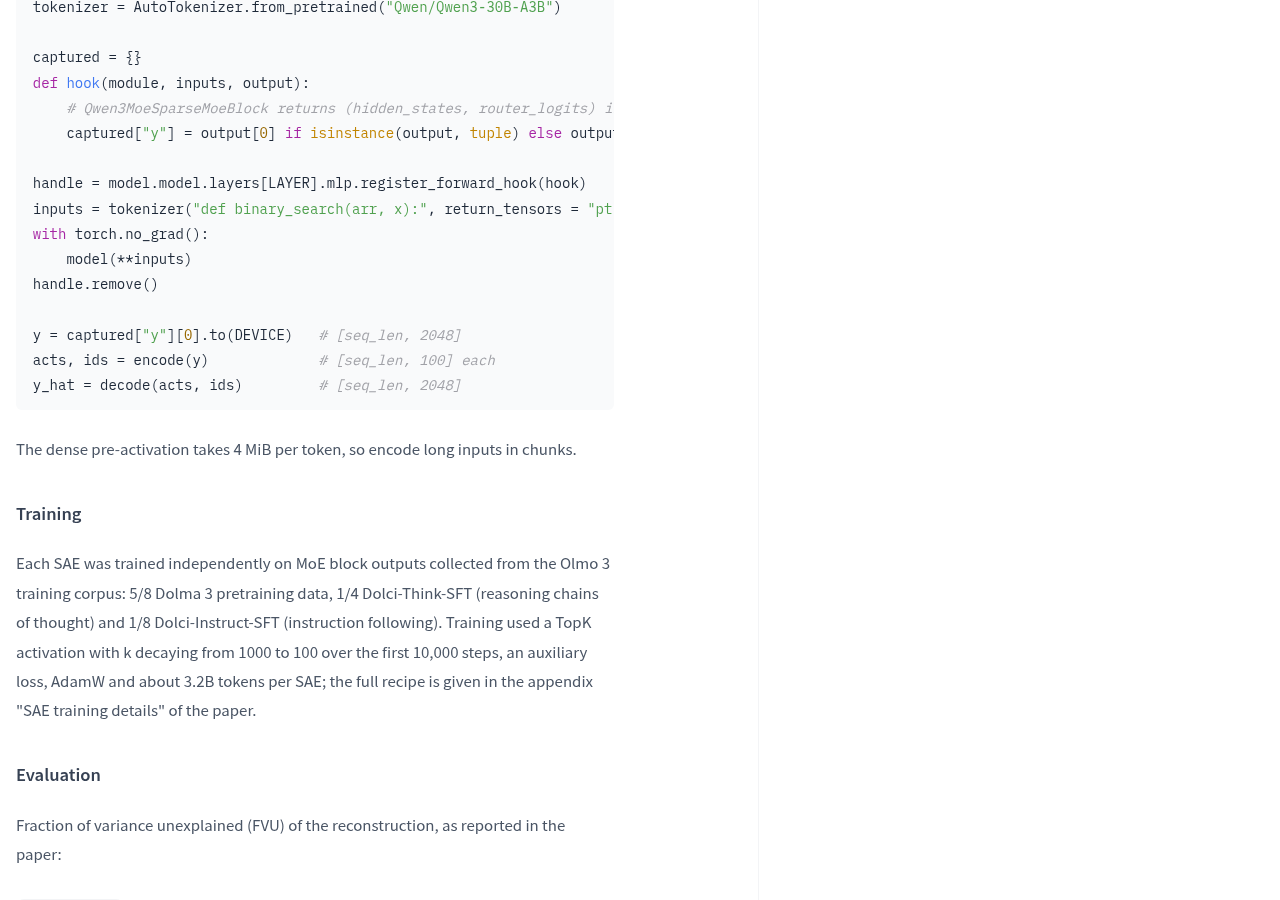
Existing examples use CUDA and include handling for transformers 4.x module return forms. When preparing for reproduction, it is necessary to verify the runtime environment and module interfaces; These codes themselves do not provide adaptation results for Mac, MLX, or other runways. Opening only with weight files cannot determine whether a personal computer can successfully complete the analysis.
Official results measure reconstruction losses, not chat levels
The official evaluation metric listed is FVU, which is the unexplained variance after reconstruction. Still understood as sorting: organizing a pile of packages into labels, then reconstructing the original distribution based on labels, some details are always missing. FVU measures these reconstruction omissions, not the accuracy of answers.
| Corresponding layer | Officially reported FVU |
|---|---|
| 4 | 12.6% |
| 30 | 25.1% |
| 46 | 7.6% |
These values come from the results of the paper as described in the official model description.
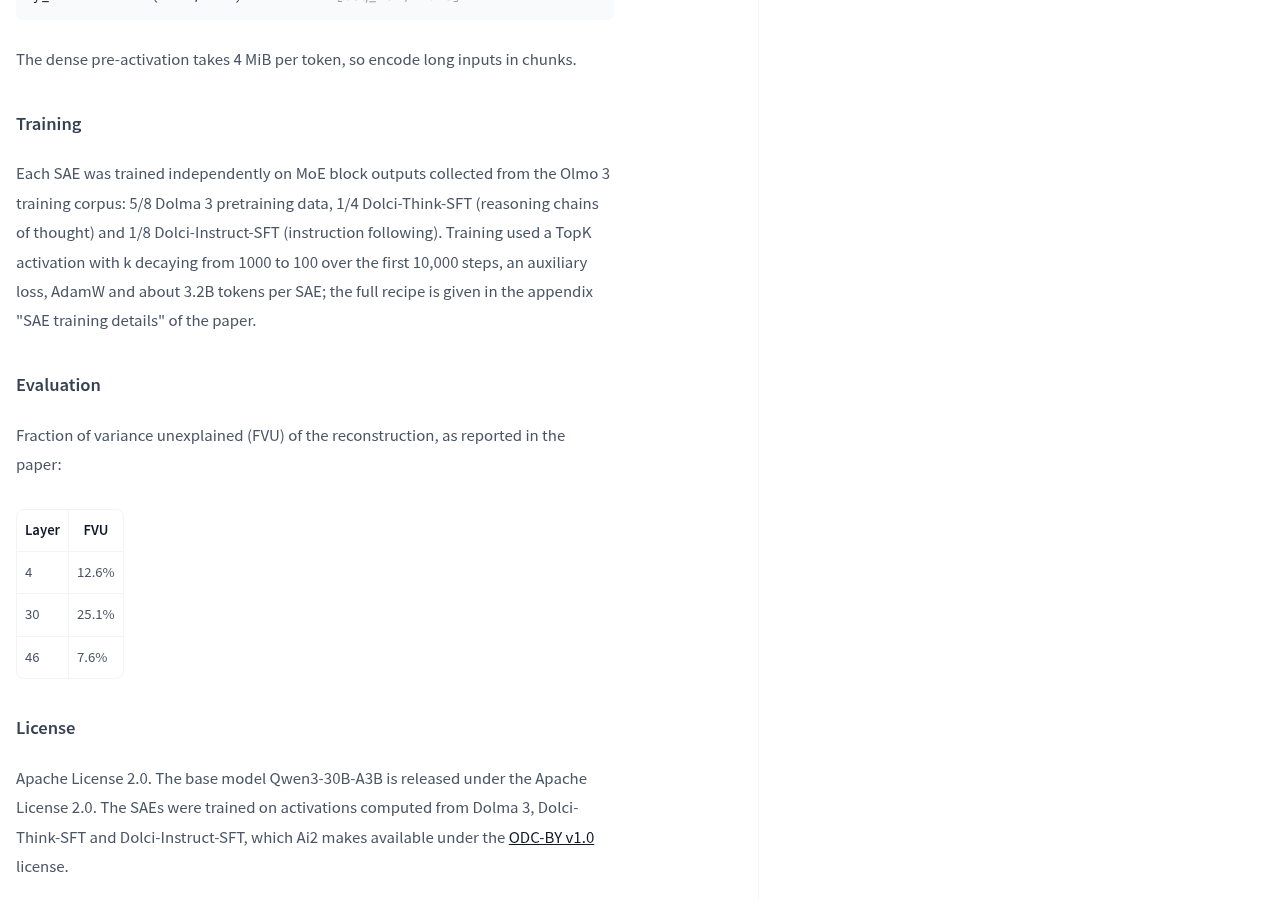
These results help researchers understand reconstruction performance at different layers, but when choosing an analysis layer, it is also important to consider where the problem arises. Fewer reconstruction omissions do not automatically mean features are easier to name or the model answers more accurately. If you want to use it to study a certain internal behavior, acceptance should continue to ask: Which inputs activate the target feature, and can this correspondence be repeated in other inputs?
It is suitable for researchers to start with; ordinary users do not need to rush to change models
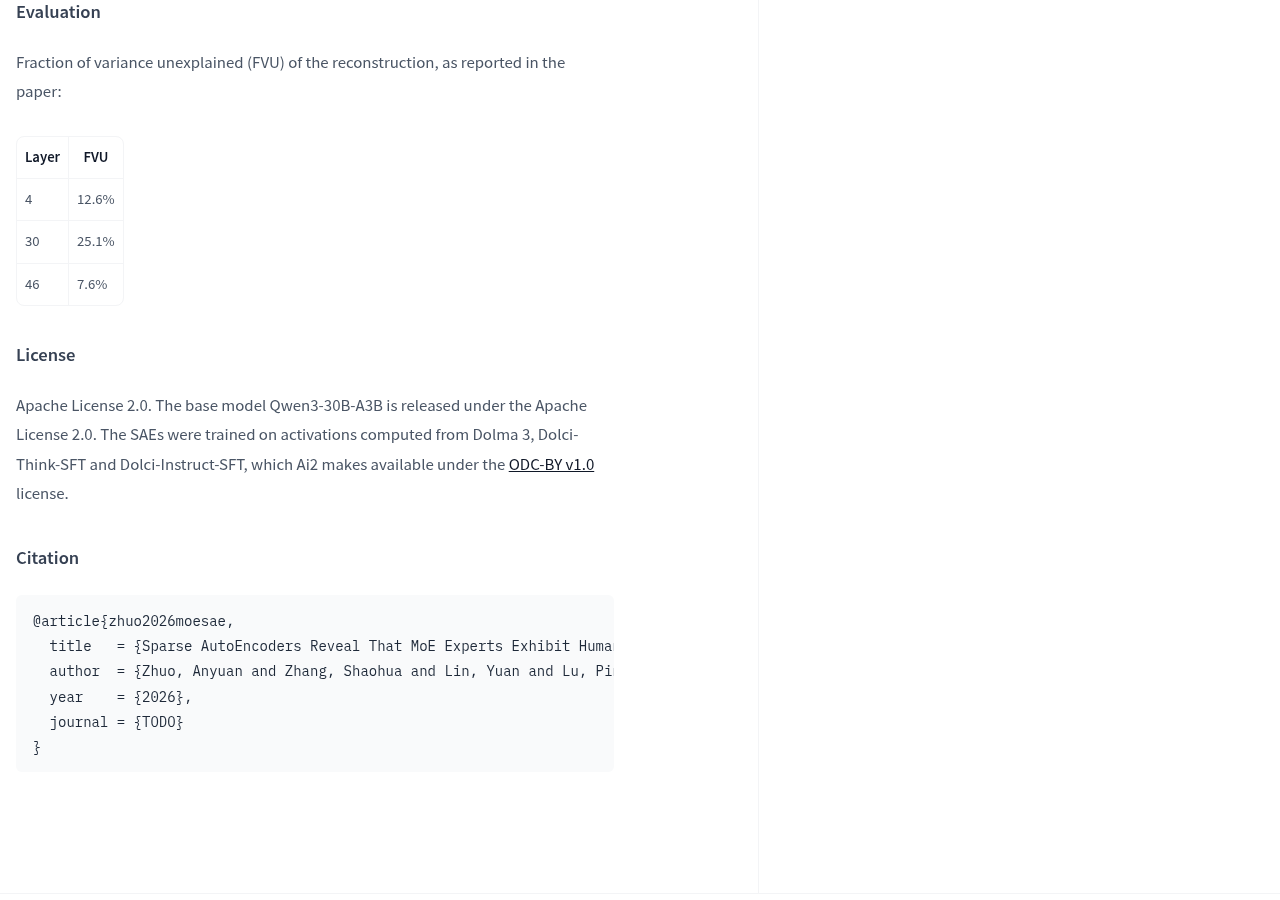
Licenses should also be viewed separately. The official description states that this SAE and the base model Qwen3-30B-A3B use the Apache License 2.0; the training activation comes from Dolma 3, Dolci-Think-SFT, and Dolci-Instruct-SFT, and the note notes that these data are provided by Ai2 as ODC-BY v1.0. When redistributing weights or processing related data, the corresponding terms should be checked separately; weighting licenses cannot be applied directly to all materials.
Regarding the status displayed on the official page, it already lists research weight files and usage code, but the page also states that no inference service provider has deployed this model. For users who want to directly open web chats and call ready-made hosting services, this is not an off-the-shelf entry point; For researchers preparing to analyze MoE internal outputs, it provides clear access locations, weight formats, and coding examples.
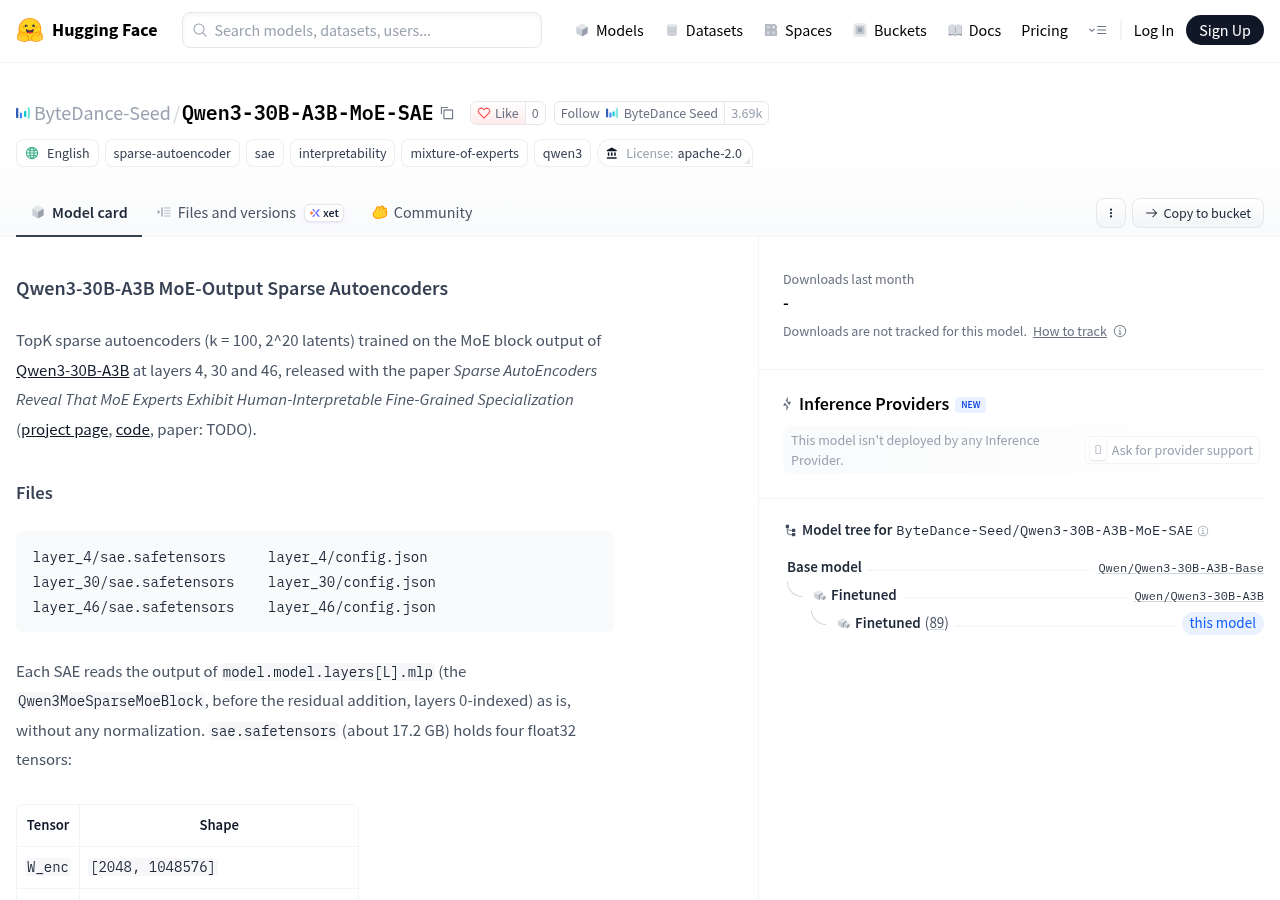
Get ready to get started, you can start with View the official model description and documentation list First, check the base model, additional video memory overhead, runtime interfaces, and licenses. Once the relevant environment is in place, use the official example to verify whether the output of the specified layer can be captured, whether features can be encoded, and whether the output can be reconstructed. Only after completing these steps can you continue to study the meaning of features; If you only need a chat assistant, there is no need to replace the existing model for this set of analysis weights.
Official information
Self-made software
Versions, changes and supported installers all come from the same public release records.
HyphenAssistant
Continue your computer’s DeepSeek Harness session from a phone browser. The service, computer and network must stay online; model costs follow your existing setup.
View public downloads and updates ↗LocalBrain
A local AI toolbox for transcription, speech, images, video, and MCP tools. Features vary by platform version.
View public downloads and updates ↗HyphenBox
A free model API radar and local router, with ongoing availability checks and keys kept on your device.
View public downloads and updates ↗ScreenLex
Turn subtitles from your own films and shows into an English vocabulary library, entirely offline.
View public downloads and updates ↗HyphenScreen
Screen recording and editing with a Resolve-style timeline, automatic redaction and pre-export checks.
View public downloads and updates ↗Support HyphenTech
Late nights and burned API credits went in,a cup of tea comes back out — only if you feel like it.
Save the QR codeScan with WeChatPress and hold to save the image, then open it from your album in WeChat Scan

WeChat tips · Any amount welcome



Comments
Loading comments…