Info: Machine translation This post was machine-translated from the Chinese original. Wording may be rough in places — the Chinese version is authoritative.
If you want to bring an ink painting to life, the easiest way to think of is to hand the entire image over to a video model. huashu-art-motion takes a different approach: scenes, objects, shots, and transitions are controlled by code, and the characters then use authorized character frames or generate materials as needed. It’s like building a small stage: first decide who moves, when, and where the audience is looking, then choose the painting style. This way, which actions can be adjusted repeatedly, it’s clearer than just waiting for a single generation.
What can it deliver?
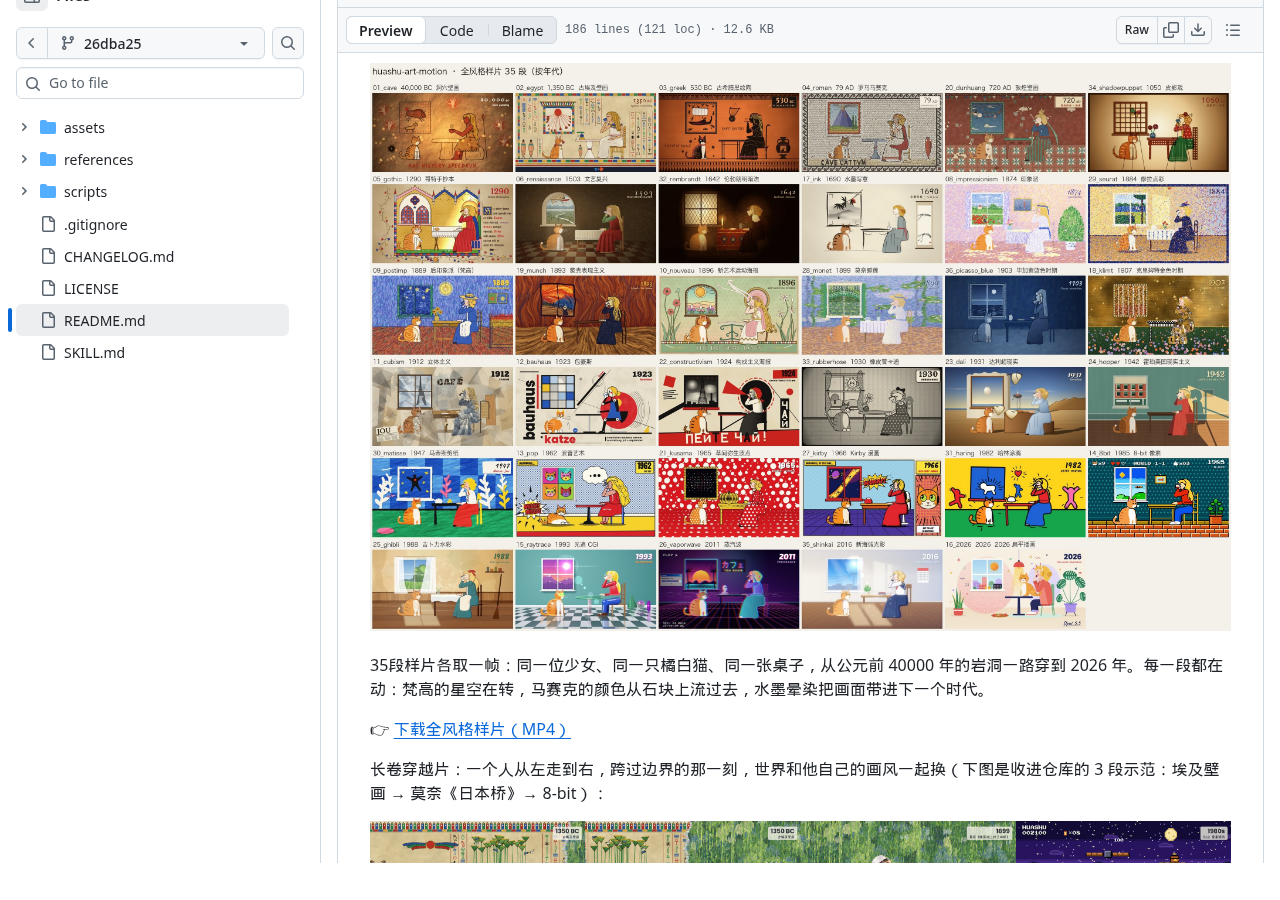
The author provided 35 style recipe cards, along with scene and transition codes. Styles such as ink, Dunhuang, shadow puppetry, and pointilism each have their own colors, shapes, and movement methods. The recipe cards here are like recipes: telling the task assistant how to combine elements, not just writing style names in prompts and counting as delivery. This time, only warehouse documents and files were verified; no code was run, so actual effects still require trial rendering.
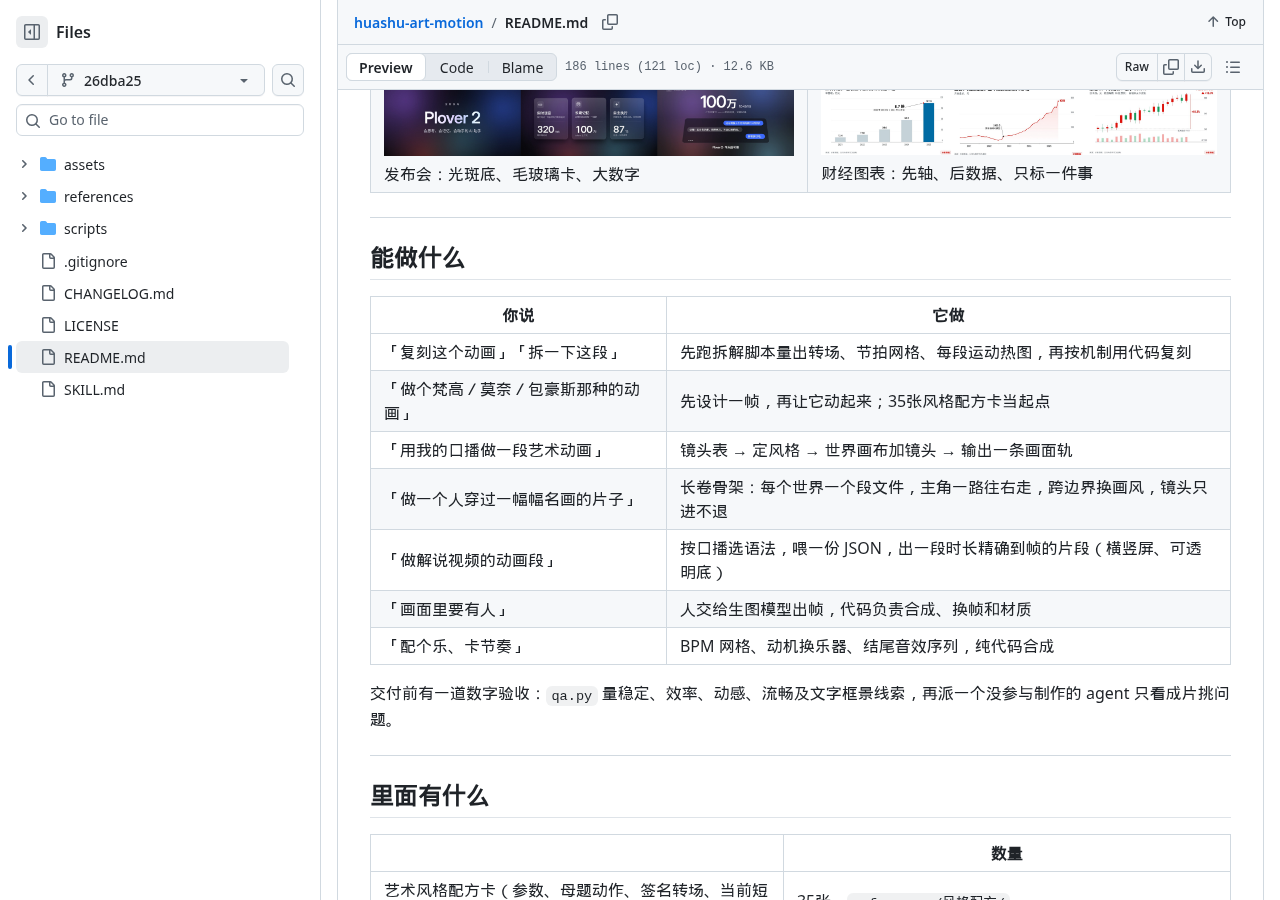
Additionally, there are 9 methods for expressing commentary animations, 8 of which include parameter-based rendering clips, including whiteboards, dynamic text, and financial charts. For example, when the commentator is explaining the gap between two sets of data, the chart should appear in that sentence and complete the comparison, rather than just the entire paragraph showing a shaky background. Parameter files act like a camera list, recording content and timing; The ninth type of narrator-style financial science popularization requires a self-prepared character; you cannot treat all routes as a complete ready-made template.
How does it break up animation for you?
When making commentary animations, the author requires first writing a shot list, then setting the style, arranging shots, and finally output the visuals. Pure music animation arranges actions according to the beat, like a stage performance moving through time. Long scroll cross-sections use a continuous canvas to organize different styles. These routes serve different tasks: first select the content you want to explain, then read the corresponding method, which is easier to control than cramming all effects into the short film at once.
Before delivery, it measures what it itself has
SKILL.md Clearly state: Must run uv run scripts/qa.py --project <工程> before delivery, with acceptance dimensions of stability, movement, smoothness, and text frame clues, then assign an agent who did not participate in production to just look at the finished film and pick on issues; For shallow backgrounds without subtitles, use subzone_gate.py again to check if the graphics have entered the subtitle area. It has a hard threshold for “the visuals must move”: each scene must have at least one main action plus two theme loops, and frame rate differences must be measured to avoid the impact of the 0.35-second shot after transitions.
Code, fonts, and characters each belong to their own domains
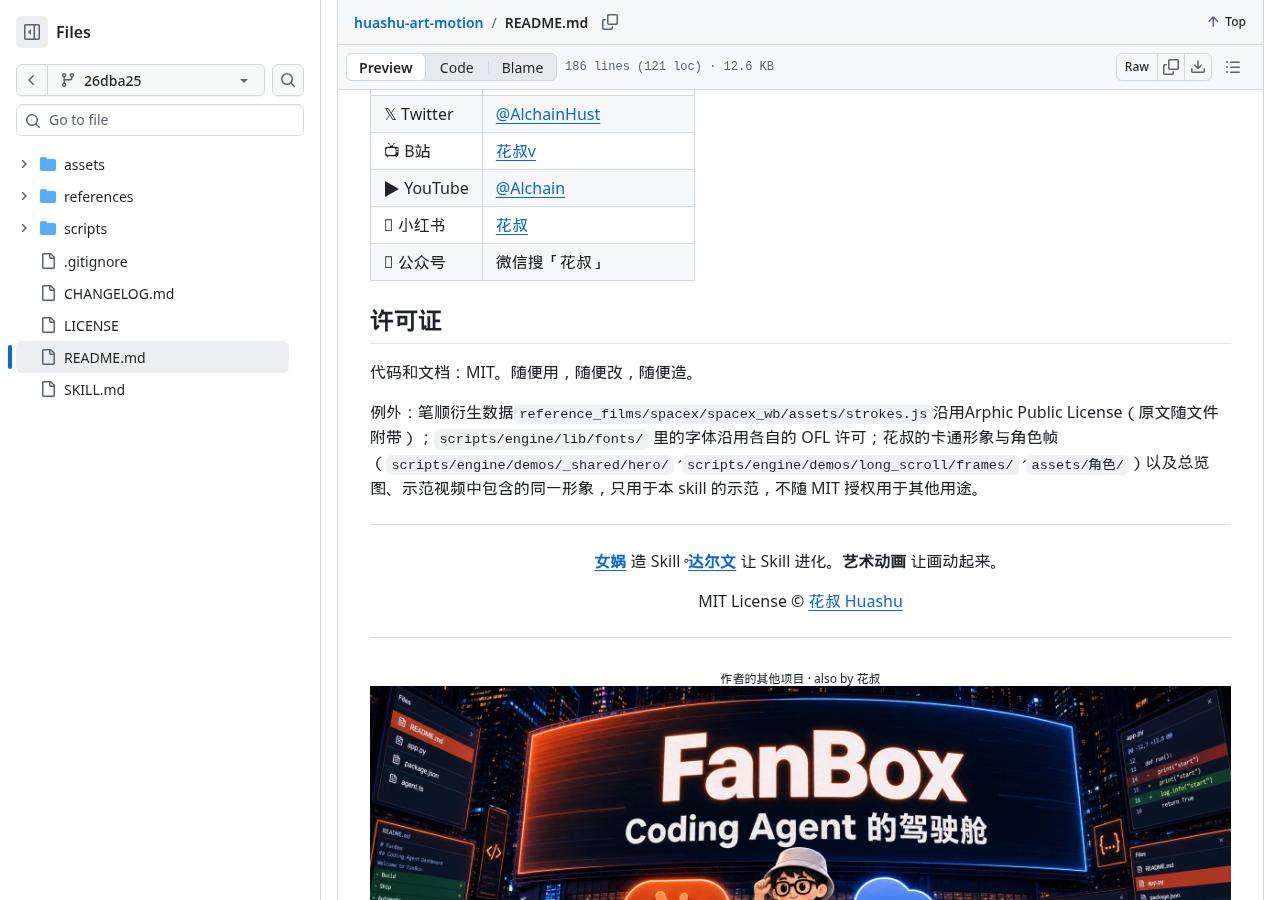
The license is MIT, but there are a few exceptions to distinguish: stroke order derivative data reference_films/spacex/spacex_wb/assets/strokes.js in the repository uses the Arphic Public License; Fonts in scripts/engine/lib/fonts/ use their respective SIL OFL licenses; The same image appearing in Uncle Hua’s cartoon character frames, demo videos, and overview images is “only for demonstration of this skill and not for other uses under MIT’s license.” This means that before moving characters into your own project, you need to replace or prepare your own character assets.
What must it be loaded first before it can run?
The environments listed by the author include UV, FFmpeg, and Playwright Chromium: responsible for preparing the runtime environment, processing videos, and rendering images in the driver browser, respectively. The installation entry point is npx skills add alchaincyf/huashu-art-motion. This command downloads and installs third-party code. First, check the source and permissions, then install according to the repository instructions; This time, it was not executed, nor was it verified on different computers and clients. For the first attempt, you can output a still frame from a scene first, then make a short video, avoiding direct long projects.
What are the things you still have to do yourself?
There are different ways to handle characters. Already licensed character frames can be used directly as materials; When new character styling is needed, you can call the raw image model to create continuous poses, then use code to swap frames and synthesize them, like flipping through a comic strip; Simple geometric characters can be directly drawn with code. Therefore, external raw images are not a paid step for every animation. Whether you need to pay depends on the character source, generation services, and additional materials; The consistency between character authorization and continuous frame images still needs to be checked yourself.
The author treats sample photos as “can be done,” not “passed.”
README mentions that this skill comes from a real 15-second “Art History Speedrun” by X user Tak (@cherry_mx_reds) (dated 2026-10-04). The repository contains frames, screenshots, or audio without the originals, with scene composition following the original approach, all scenes redrawn with code, and the author also made a 2-minute 08-second “Uncle Hua Travels Through Famous Paintings” showcasing 23 different art styles. However, the warehouse still defines it as an “author statement/author sample,” not an independent rerun by a third party or our side.
What can be done now, and what cannot be done yet
If you’re already using an AI assistant that can execute code, this project is worth studying how to make shots, movements, and art styles adjustable in engineering. Having licensed materials or choosing geometry roles first can reduce reliance on cloud-based image generation. But what we currently have are author documentation, code structure, and sample instructions, not standalone finished products; Actual rendering time is still uncertain, error recovery, and client compatibility.
What is the next step for acceptance?
You don’t have to try all 35 different visual styles the first time. Take a short clip of existing narration recording, choose a style that helps understanding, arrange a clear action, then check: does the video explain that sentence, if the movement is smooth, and if the subtitle position is obscured? Program checks can only find some technical issues; watching the short film at normal speed is still a necessary step. It’s more suitable for those willing to adjust the project and bring artistic expression to real explanations; If you only want to enter a style name and get the whole video for free, don’t treat it as a ready-made video generation website for now.
Tip The code is licensed by MIT; characters, fonts, and some derivative data have separate terms. Authors should not directly import their work into their work just because the repository is open source; Before production, check and replace with materials you have permission to use.
Project firsthand information
🧰 Tools I build
I maintain all of these tools myself. Preview builds are clearly labeled; the release pages are the source of truth for downloads, updates and known limits.
Info: HyphenBox Status: Official releases
A radar for free LLM APIs: availability is re-tested continuously, one local interface for all of them, and keys stay on your machine
Info: LocalBrain Status: Official releases
A multimodal MCP toolbox for local models: TTS, Whisper and video generation in one place
Info: ScreenLex Status: Official releases
Learn new words while you watch shows. Free, for Mac and Windows
Info: HyphenScreen Status: Official releases
Screen recording and smart editing in one: a DaVinci-style timeline, automatic redaction and a check of the finished video before export. Free
Quote: HyphenTech Make AI your superpower Local deployment · Free resources · Self-made software https://hyphentech.top
Late nights and burned API credits went in,a cup of tea comes back out — only if you feel like it.
Scan with WeChatPress and hold to save the image, then open it from your album in WeChat Scan

Comments
Loading comments…