
Info: Machine translation This post was machine-translated from the Chinese original. Wording may be rough in places — the Chinese version is authoritative.
Summary Parameters are very small, formatting is complete, and the context is long; Don’t write “can be loaded into memory” as “can already work”. HyphenTech · 2026-09-09

Local models have had a strange misalignment over the years: everyone has always focused on the “smartest one,” but after installing it in software, the most commonly used chip is the one that boots fast, has small memory, and can be woken up at any time. The MiniCPM5-2B released on September 7 belongs to this latter category.
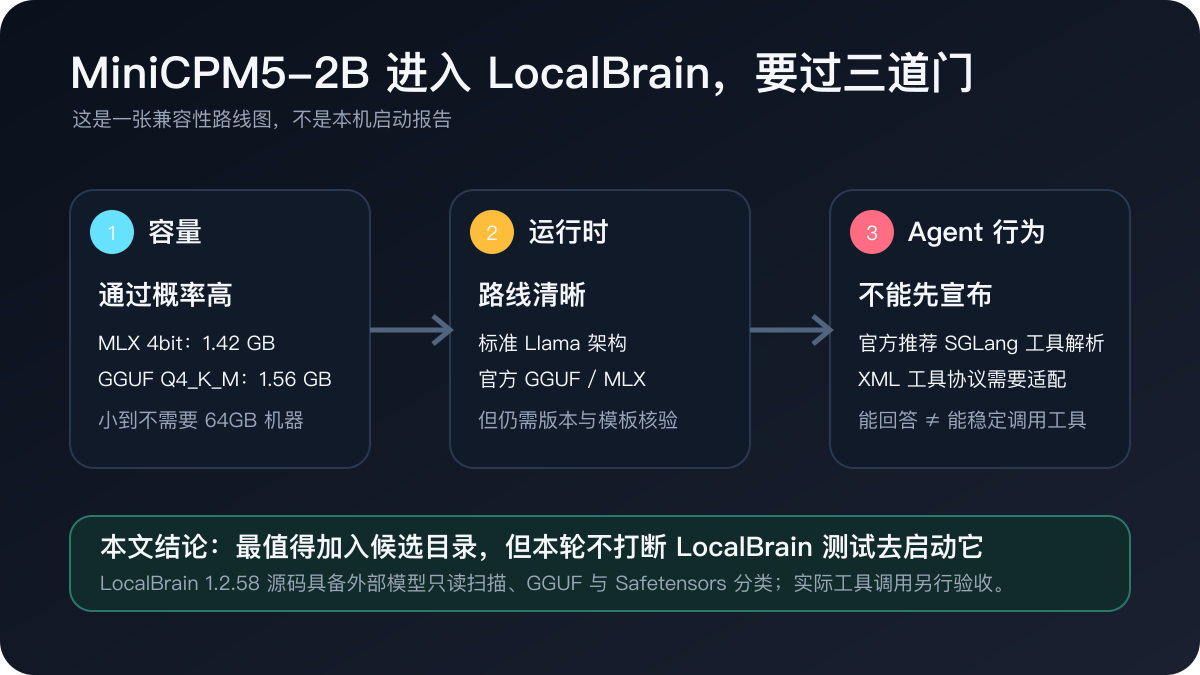
Its total parameters are only 2.517 billion, the official MLX 4bit warehouse is about 1.42GB, GGUF Q4_K_M about 1.56GB, yet it provides 131,072 contexts, and it also puts agent data, reinforcement learning, and tool calls all on the table. The title asks “Can it really be a local agent?” The answer isn’t a benchmark score, but three doors: can be installed, protocol can connect, and long tasks don’t crash.
To conclude first: it is well-suited to be included as a lightweight candidate for LocalBrain, but this article does not do native reasoning nor preemptively announce that it is already supported.
🎯 ▍Why Bet on 2B Now: Large Models in the Cloud, Small Models Compete for Device Entry
Why is OpenBMB now making 2B agents? Because cloud large models are already crowded, and new entry points are in phones, computers, cars, and home servers. The more resident the model is, the easier it is for hardware vendors to turn AI into system capability, and software developers can reduce token-based billing; Cloud vendors earn less from simple calls, but difficult tasks are still routed back to the large model.
Who benefits is very specific: users get offline and low latency, app developers get controllable costs, and model teams get wider device distribution. Who pays the maintenance bill is also specific: local format, runtime adaptation, quantitative regression, and security updates don’t automatically happen just because the weight is only 1.4GB.
🔍 ▍2B isn’t the only notable number for the MiniCPM5
MiniCPM5-2B is a dense 42-layer model with a hidden size of 2048, 16 query headers, 2 KV headers, and a native context of 131,072.
The architecture is standard LlamaForCausalLM, and Apache-2.0 is open source. This combination doesn’t have the impact of 512 experts or trillion-parameter launch events, but it offers another kind of engineering comfort: it’s easier to understand when mature runtime.
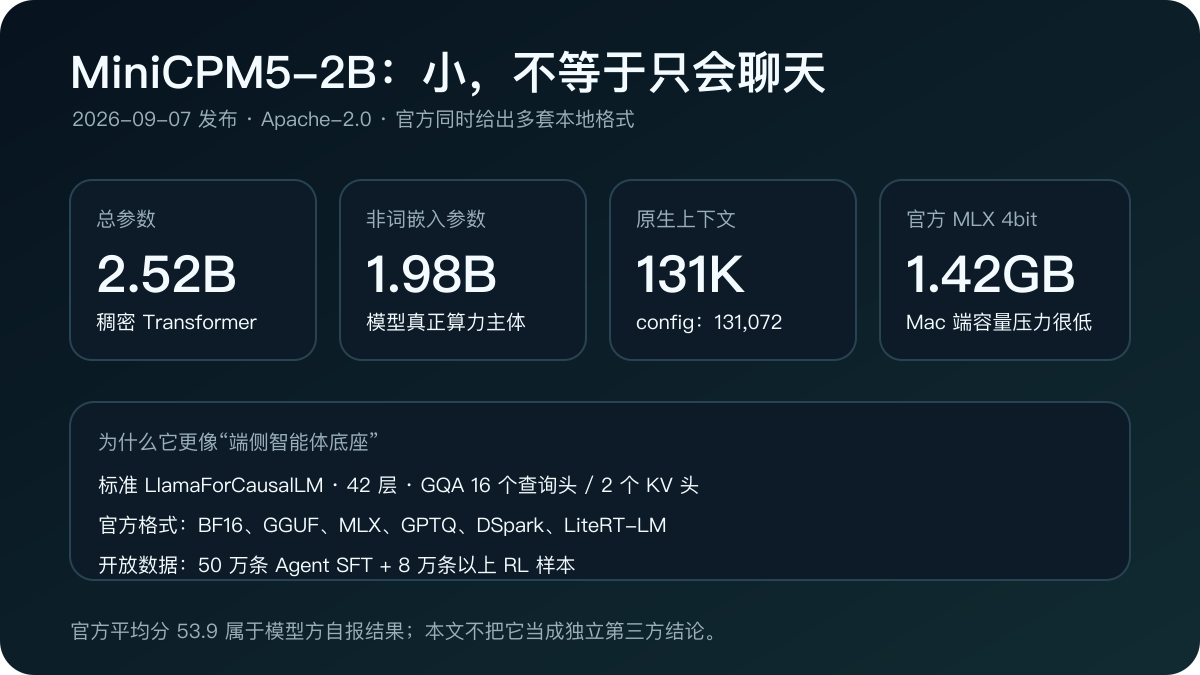
More importantly, the delivery method. Back in the first wave of open-source large model enthusiasm, the common scenario was for the official team to just throw out a BF16 repository and let the community gradually fill in the format; This time, OpenBMB simultaneously provided GGUF, MLX 4bit, GPTQ, DSpark, and LiteRT-LM.
For regular users, this is more valuable than two extra points on the model card: the official acknowledges that Mac, quant GPUs, mobile, and on-device inference are all target environments.
⚡ ▍Why does it dare to call itself an Agent model?
The most common fake agent for small models is to spit out a tool_call during demonstrations, and when multi-round tasks occur, they lose parameters, forget formats, and treat tool results as user messages. Last time the on-device model mainly optimized chat and summarization, tool protocols were usually just add-ons; The release approach of MiniCPM5-2B at least addresses this issue positively: the official release released 500,000 Agent SFT data points and over 80,000 reinforcement learning data records, and also released UltraX and UltraData-Code.
Its tool calls use an XML structure, with the official server recommending SGLang and specifying the minicpm5 parser.
This detail is far more important than the six words “support function calling”: the agent is not just a model that can write the formatting alone; the server must parse correctly, the host executes the tool, and then the result is sent back using the same dialogue template. At any level of misalignment, the agent is left with only a promotional image.
The official overall average score is 53.9, and it is claimed that post-training significantly improves general and agent capabilities. These numbers help determine training direction, but they are still official reports and not independent retesting in this article. The true value of a small model depends on its success rate in its own tasks: whether it can reliably read parameters, whether it is incorrectly called, and whether it remembers the first step of long task eight steps.
💰 ▍1.4GB weight doesn’t mean 130,000 yuan only consumes 1.4GB
This is the most easily swept away by the title. The model weight is indeed small, but every conversation still saves the KV cache.
Theoretically estimating with 42 layers, 2 KV heads, and 128 head dimensions, BF16 KV per token is about 43,008 bytes; If you really take the full 131,072 context, KV alone is about 5.25GiB, q8 is about 2.63GiB.
And that’s just a paper estimate, excluding runtime buffering, system usage, input processing, and concurrent requests. The good news is, even after all this, it’s still far below the memory threshold for 27B and 35B models; The bad news is, you can’t promise “any machine can run 130,000 copies” with a download volume of 1.42GB.
🧩 ▍If you join LocalBrain, where is it best to stand?
I only read and checked the current LocalBrain 1.2.58 model entry, but there was no connection or interruption of the running instance.
It can scan external GGUF and Safetensors/MLX directories; MiniCPM5-2B also uses the standard Llama architecture, and both GGUF and MLX are directly provided by the official team. From the perspective of “being recognizable and handing over to mature runtimes,” it is a more suitable candidate than the newly introduced custom architecture.
| Connected to the sluice gate | Current evidence | Further testing is still needed |
|---|---|---|
| Capacity | MLX 4bit is about 1.42GB | Context growth versus concurrency peaks |
| Architecture | Standard LlamaForCausalLM | Actual loading at the current runtime |
| Format | Official GGUF with MLX | Quantify quality and speed |
| Tool call | Official XML and minicpm5 parser | LocalBrain protocol adaptation and multiple rounds of backfilling |
| Permanent mission | The small size helps with quick wake-up | Stability, hallucination calls, task success rate |
If future tests pass, I won’t let it compete head-on with large models for encyclopedic knowledge, but will place it in more suitable positions: local file classification, fixed structure extraction, tool routing, short instruction execution, offline backup, and first deciding “who should be assigned this task” for the large model. Historically, embedded chips have also shifted from pursuing all-around to making fixed tasks cheap and reliable. Small models may not be suitable as managers, but they might be very suitable as duty officers.
🚀 ▍OpenBMB Truly Bets on “Embeddability”
Large model vendors compete over who is more like an all-round employee, while MiniCPM5-2B is more like competing for the overlooked backend position in every device. It doesn’t need to win every problem; as long as it reliably completes a narrow task at extremely low cost, it can access translators, players, home servers, office software, and local AI hubs.
Therefore, its potential should not be described as “2B counter-killing 70B.” More accurately: when the weight is reduced to 1.4GB, the official format is sufficiently comprehensive, and agent training is no longer a bonus, local agents finally have the chance to transform from a demonstration on an expensive workstation into a component that ordinary software can call at any time.
Summary: Now you can confirm and what cannot be confirmed Confirmed: 2.52B dense model, official MLX 4bit about 1.42GB, GGUF Q4_K_M about 1.56GB; Standard Llama architecture, 130,000 contexts, with official multi-server format and agent training. Not yet confirmed: LocalBrain real support, tool success rate, Mac speed, and full context memory; This article does not conduct inference testing.
Tip Primary source MiniCPM Official Warehouse: https://github.com/OpenBMB/MiniCPM MiniCPM5-2B: https://huggingface.co/openbmb/MiniCPM5-2B Official MLX 4bit: https://huggingface.co/openbmb/MiniCPM5-2B-MLX Official GGUF:https://huggingface.co/openbmb/MiniCPM5-2B-GGUF
The KV cache figures in this article are theoretical estimates based on model configuration and are not actual peak values for the local machine.
🧰 Tools I build
I maintain all of these tools myself. Preview builds are clearly labeled; the release pages are the source of truth for downloads, updates and known limits.
Info: HyphenBox Status: Official releases
A radar for free LLM APIs: availability is re-tested continuously, one local interface for all of them, and keys stay on your machine
Info: LocalBrain Status: Official releases
A multimodal MCP toolbox for local models: TTS, Whisper and video generation in one place
Info: ScreenLex Status: Official releases
Learn new words while you watch shows. Free, for Mac and Windows
Info: HyphenScreen Status: Official releases
Screen recording and smart editing in one: a DaVinci-style timeline, automatic redaction and a check of the finished video before export. Free
Quote: HyphenTech Make AI your superpower Local deployment · Free resources · Self-made software https://hyphentech.top
Late nights and burned API credits went in,a cup of tea comes back out — only if you feel like it.
Scan with WeChatPress and hold to save the image, then open it from your album in WeChat Scan

Comments
Loading comments…