
Info: Machine translation This post was machine-translated from the Chinese original. Wording may be rough in places — the Chinese version is authoritative.
Summary Spread OpenCode public usage, Unsloth local 500.7GB quant documentation, and 121,000 Star Caveman warehouses on the same table HyphenTech · 2026-11-18
When you come across a set of public data in today’s AI programming community, many people’s first reaction is that costs are almost zero. The OpenCode dashboard shows that in the past 7 days, developers worldwide invested 185 trillion tokens (185T) into DeepSeek V4.1 Flash; Almost simultaneously, the open-source skill caveman, which can save agents 65% of output tokens, surged to 121,053 stars on GitHub, and llama.cpp also released the official v1.0.0.
But if you casually open the local quant documentation for DeepSeek-V4.1-Flash-1017, the digital style instantly reverses: even if you switch to UD-Q4_K_XL, disk still occupies 500.7 GB, and Unsloth’s official minimum memory requirement remains 128GB or more. On one side is the cloud running hundreds of billions of words and screenshots saving up to 65%; on the other is the physical threshold that laptops simply can’t fit. Which money really goes into your own pocket, and which just shifts expenses somewhere? Let’s open and calculate the first-hand public documentation and source code one by one.
1. OpenCode Seven Days 185T: Why Development Tools Diverted All Main Traffic to Flash
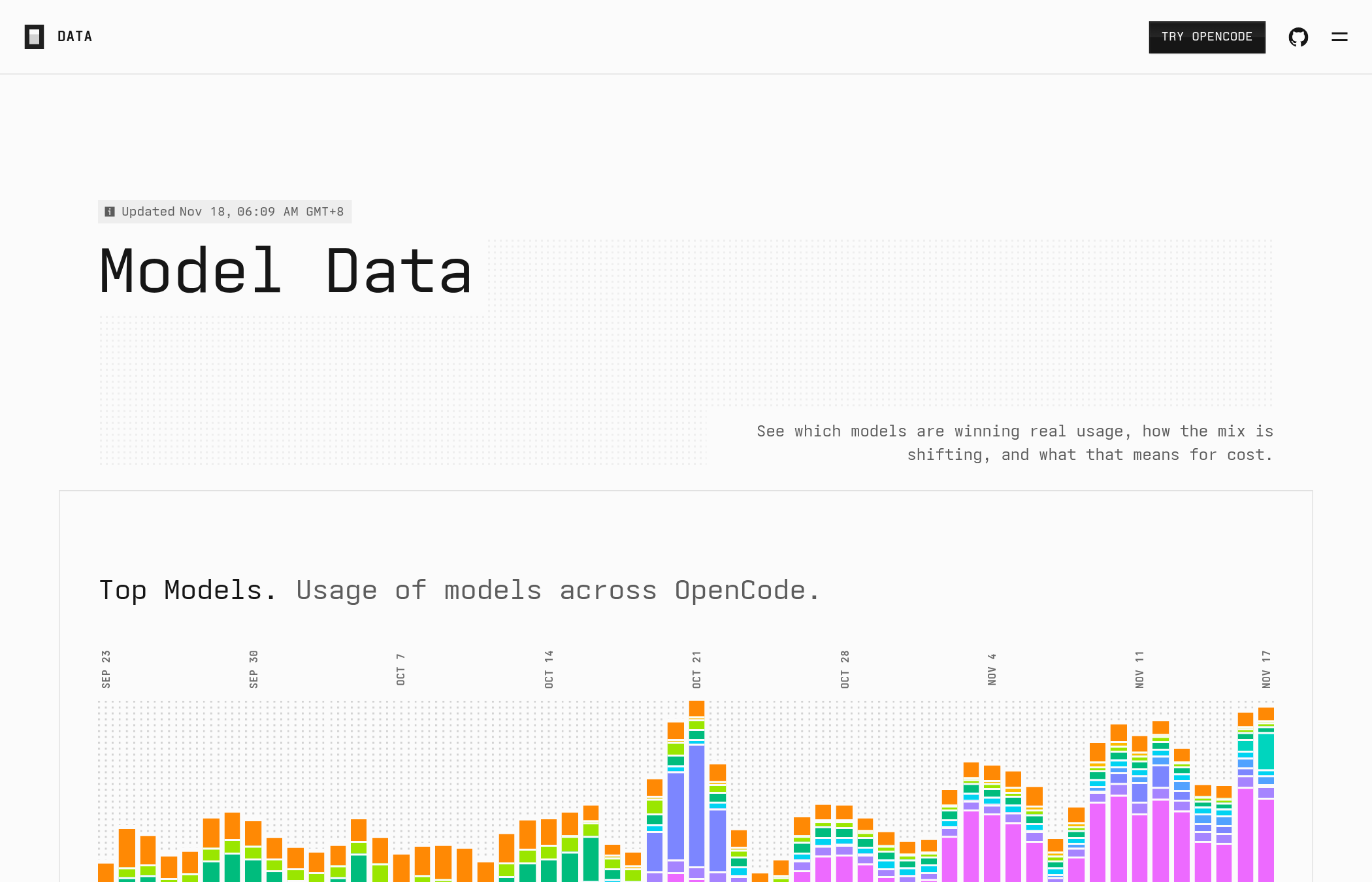
First, let’s look at the official OpenCode dashboard statistics for the 7th day as of November 17, 2026, 22:09 UTC.
On November 17, the entire site surged above 39 trillion CNY (38TB on the 16th). In the past 7 days, the top three rankings were all fast routing categories: DeepSeek V4.1 Flash took the top 185T**, second place Zhipu GLM-5.3-Flash at 9.2T, and third place Xiyu MiniMax-M3.1-Flash at 8.9T. The usage volume of the first place alone already surpassed the combined usage of the second and third places (18.1T** by 10 times.
This huge skew is mainly due to changes in the actual billing structure of programming agents. You change a line of function in the terminal, and the agent reloads the project directory, error stack, and previous conversation history into context for each round to send to the model. The real money-burning part is often not the hundreds of words of code patches spat out at the end, but the input context repeatedly retransmitted each round.
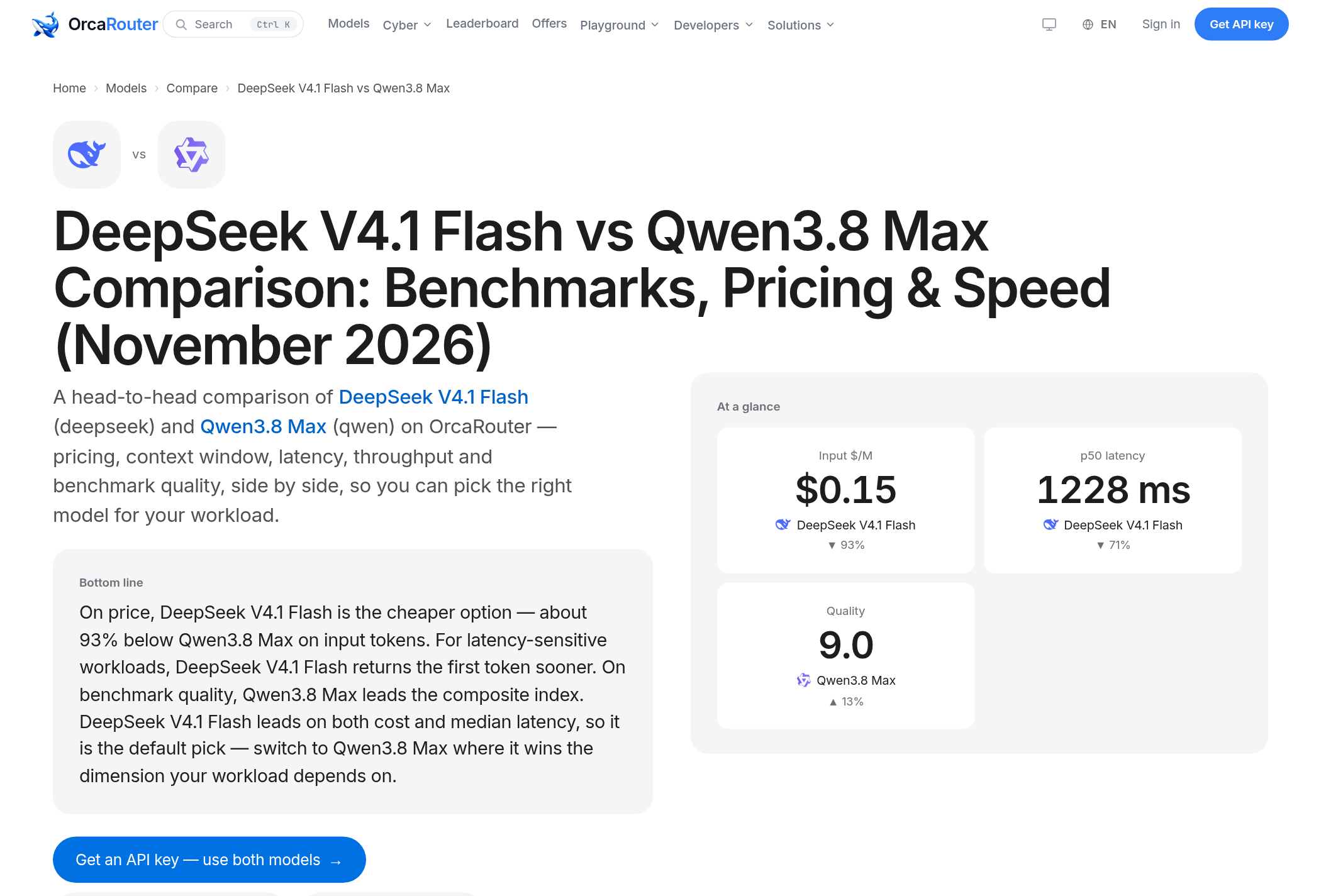
Comparing the OrcaRouter public page with DeepSeek V4.1 Flash and the high-end flagship Qwen3.8 Max makes sense. Both models are at the 1M context window tier, with unit price and response speed on two separate lines: Flash input $0.15 per million words, output $0.60, p50 initial latency 1228 ms, stream throughput 181 tokens/s; Qwen3.8 Max input $2.00, output $6.00, p50 latency 4305 ms, throughput 52 tokens/s.
Let’s do a direct arithmetic calculation based on public unit price and throughput: assuming a single 40 consecutive rounds of code modification dialogue consumes 2 million input words and 80,000 output words, the total cost of DeepSeek V4.1 Flash is about $0.348 (about two and a half RMB), with a wait of about 5.5 seconds for every 1,000 words output; If you switch to Qwen3.8 Max, these 40 rounds also cost $4.480, increasing the bill by nearly 12.9 times, and the wait time for every 1,000 words also extends to about 19.2 seconds.
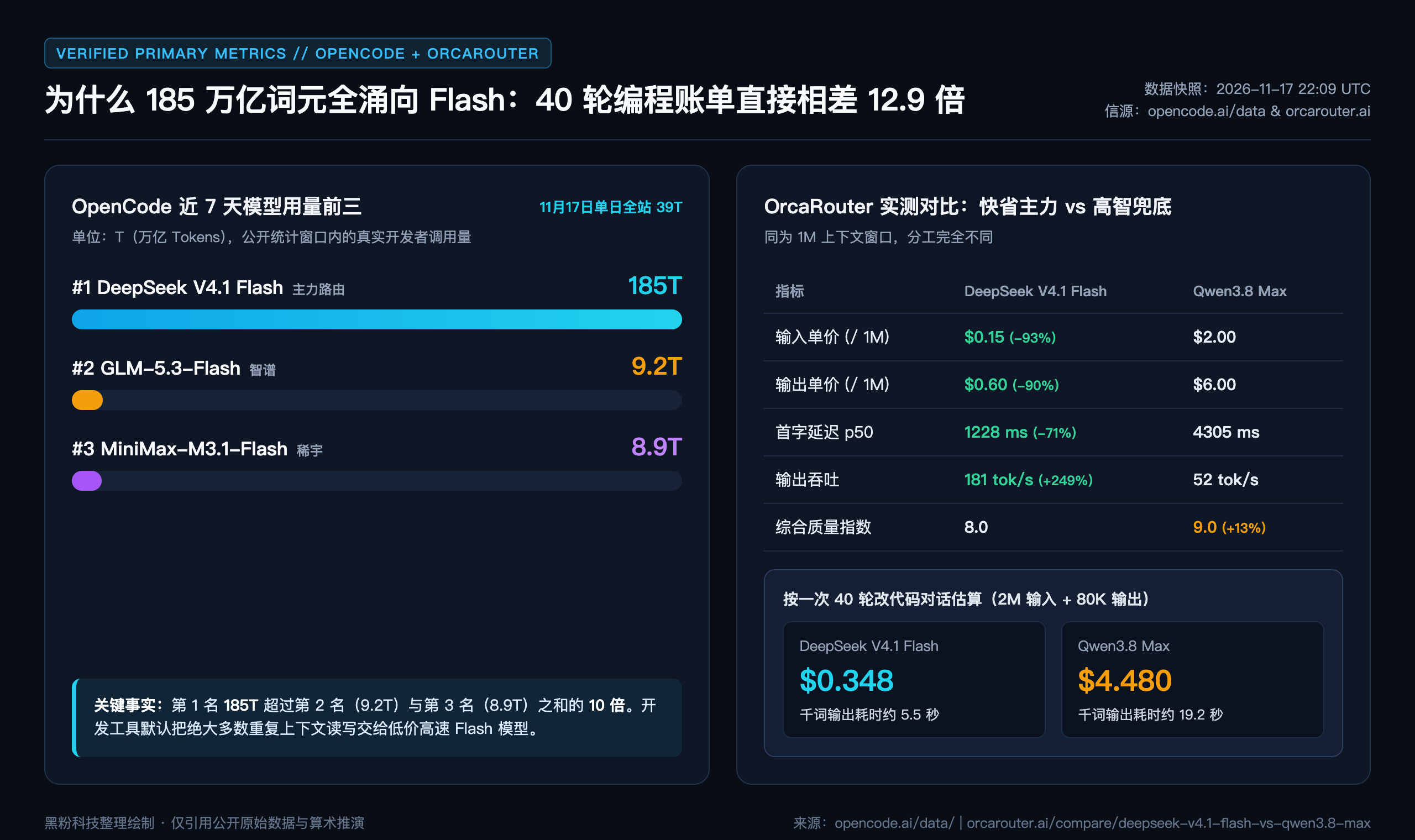
This doesn’t mean high-level large models are being phased out. In the same OrcaRouter comparison table, Qwen3.8 Max’s overall quality index is 9.0, which is 13% higher than Flash’s 8.0. A common reliable setup in actual projects is letting Flash handle 90% of file reads, tests, and syntax loops, then switch to 9.0 flagship shutdowns once or twice when facing cross-module refactoring or stubborn architectural blocks. The real money saved comes from node-based tiered routing, not just downgrades.
2. Moving back locally to hit the memory wall first: the real boundary between a 500.7GB digital file and a 12GB laptop
With such heavy cloud usage, many people casually searched for “DeepSeek V4.1 local deployment,” only to find that two completely different types of hardware were mixed into one basket. This week, there was indeed a solid breakthrough in the local inference community: on November 13, ggml-org officially released llama.cpp v1.0.0 on the Hugging Face blog. This foundational project supporting open-source on-device inference ran for three and a half years, and for the first time, it froze the semantic versions of Libllama and ggml’s C interfaces, then did client encapsulation and upgrade dependencies, so at least they no longer had to follow the backbone every few days to dismantle and refactor.
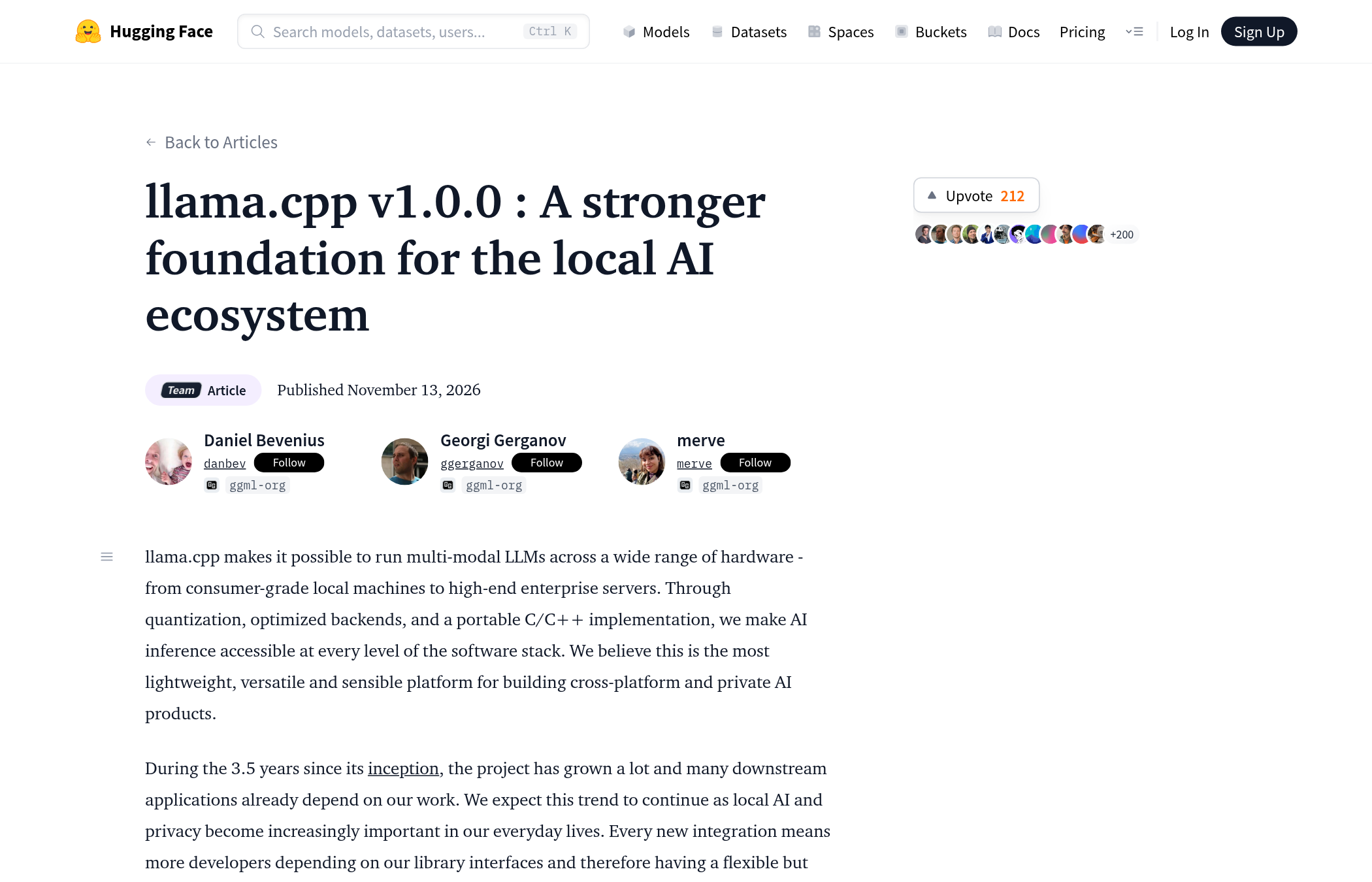
There are also solid public tests on the speed side. Emergent recently conducted single-card tests based on llama.cpp v1.0.0: running speculative decoding on the well-known 24GB RAM RTX 3090, the generation speed increased by 55% at its peak.
At the same time, Unsloth’s Dynamic V3.1 quantization solution provides a comparison in the documentation: accuracy can increase by 10% to 15% at the same size, and output output with less nonsense by about 30% of tokens; Combined with Unsloth Desktop’s CPU + VRAM + n-gram offloading llama.cpp, inference efficiency is about 3 times faster than other conventional unloading tools.
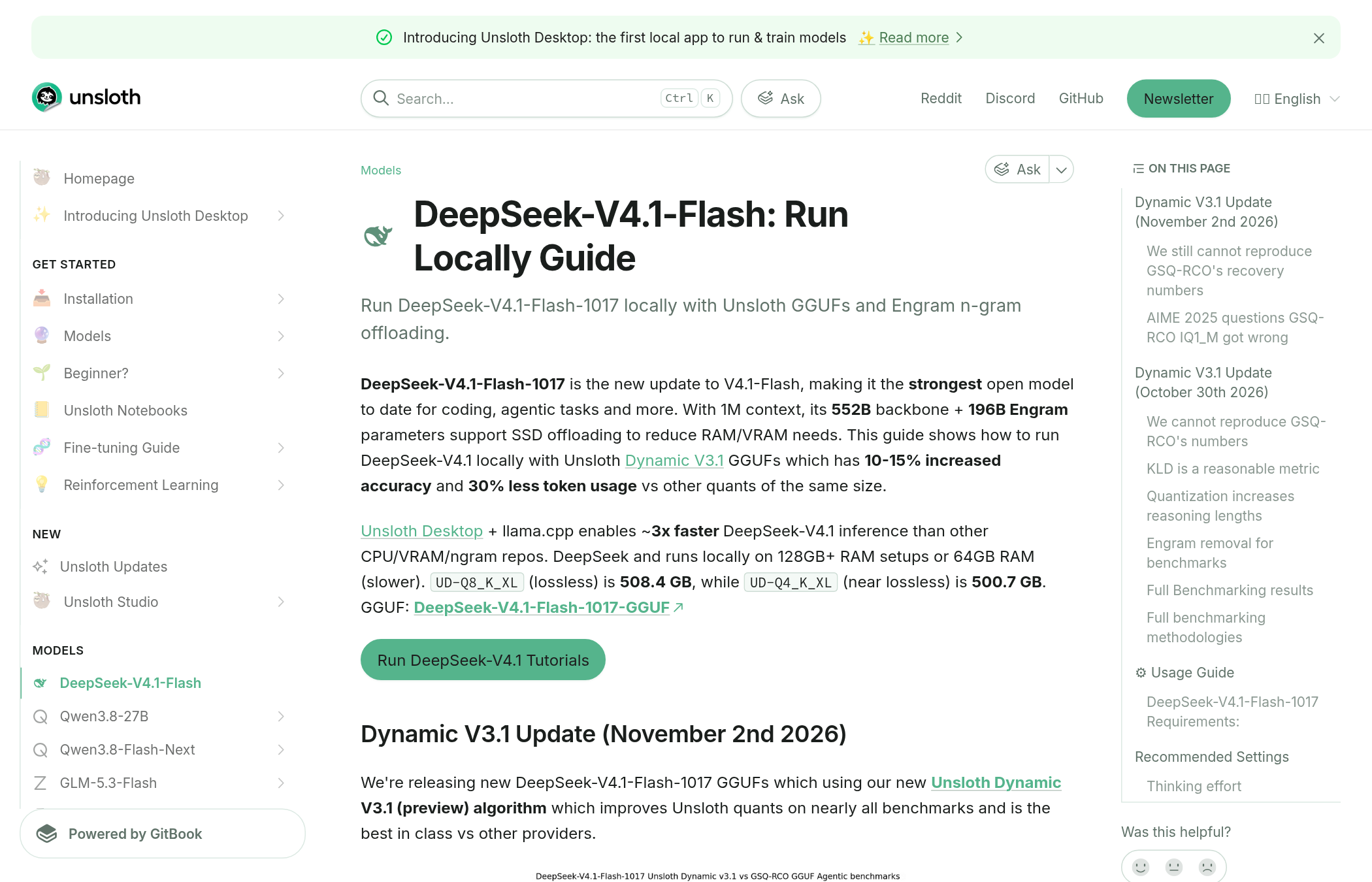
But if you really follow the documentation to pull the weights of DeepSeek-V4.1-Flash-1017, you’ll immediately hit a physical parameter wall. Its core is a 552B trunk plus 196B Engram parameters. Even if you uninstall Engram n-grams using an SSD, the UD-Q4_K_XL still occupies 500.7 GB of storage, while a more complete UD-Q8_K_XL is up to 508.4 GB.
The Unsloth page states in black and white that the minimum requirement is 128GB or more system memory. Although 64GB RAM can be forcibly mounted, speeds will noticeably drop. Ordinary laptops with 8GB of VRAM or 16GB~32GB of memory simply can’t handle this big Buddha at this stage.
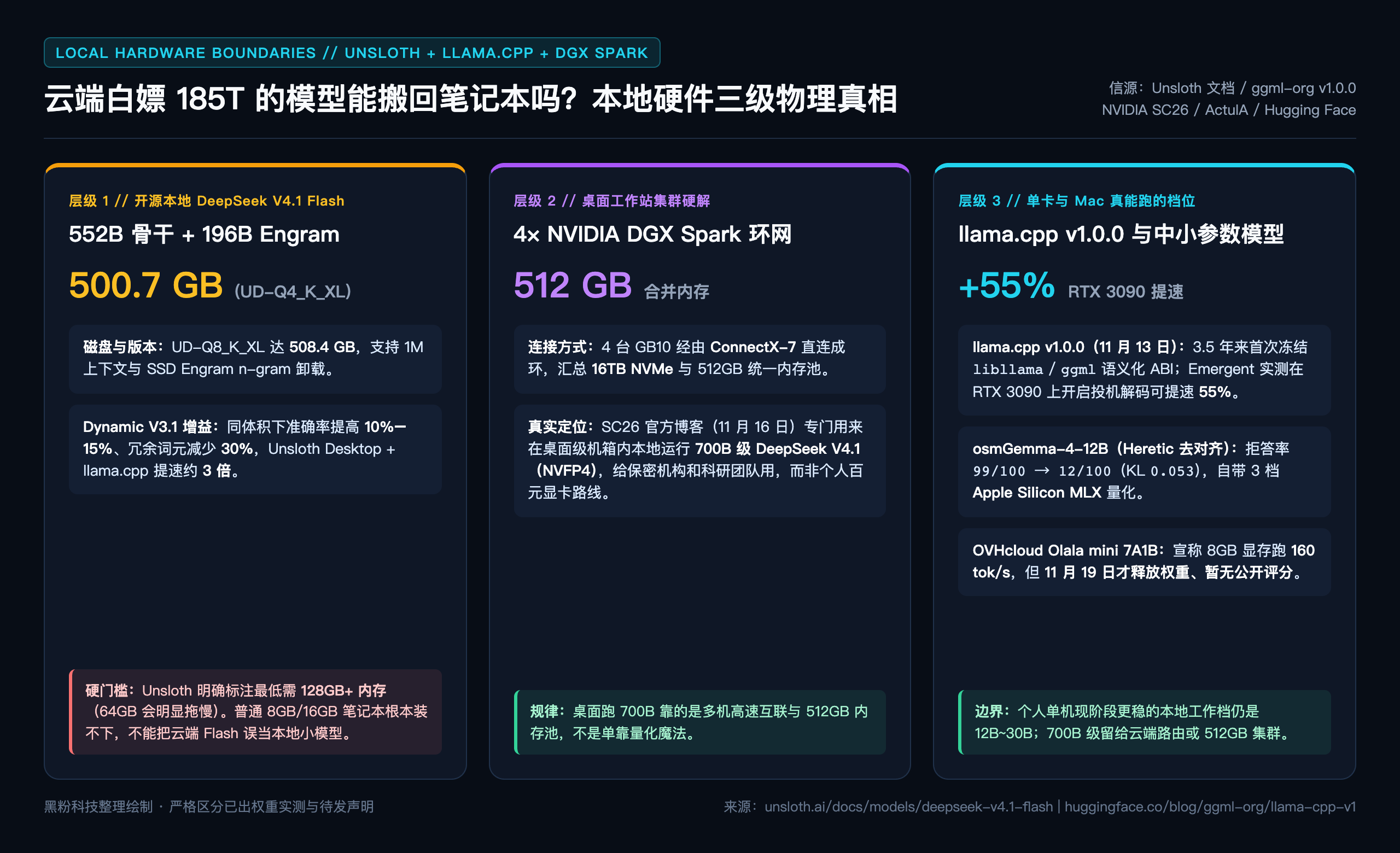
To firmly fit 700B weights into desktops, the industry’s solutions don’t rely on some magical quantization code, but rather stack hardware. NVIDIA just demonstrated a solution on the SC26 blog on November 16: to string 4 DGX Spark (GB10) units with ConnectX-7 high-speed network cards into a desktop ring network, merging them into a 512GB unified memory pool and 16TB NVMe hard drive, so that NVFP4 can run the DeepSeek V4.1 model directly on desktop.
Back to the 8GB discrete graphics or Apple Silicon Mac that most developers have, the ones that truly land steadily are still the small to medium-sized market. For example, the Heretic de-aligned osmGemma-4-12B-uncensored updated by the Hugging Face community this week. The test the author posted reduced the rejection rate from 99/100 to 12/100, controlled KL divergence at 0.053, retained the visual audio weight, and gave Mac 3 levels of MLX quantization, making it very suitable for offline red team security testing and local privacy classification.
As for the OVHcloud Olala mini 7A1B (7B total parameters / 1B MoE activated), which was rumored to be running 160 tok/s on the same day, ActuIA’s report clearly states that the weights will only be released on November 19, and there are currently no publicly available benchmark scores. Whether it’s worth using as a backup for daily coding will have to wait for actual test scores to decide.
| Target model/scenario | Hardware thresholds and space usage | Disclosure status and speed reference | True applicable boundaries |
|---|---|---|---|
| DeepSeek-V4.1-Flash-1017 (UD-Q4_K_XL) | 500.7 GB disk; 128 GB+ memory | Unsloth SSD Engram uninstall speeds up by ~3x | High-memory workstations / Mac Studio running long offline tasks with 64GB noticeably slows down |
| 4× NVIDIA DGX Spark desktop ring network | ConnectX-7 connectivity; 512GB RAM + 16TB NVMe | SC26 official demo 700B NVFP4 running | Confidential intranet or small multi-machine solutions for laboratories, not targeting 100-yuan consumption cards |
| llama.cpp v1.0.0 + RTX 3090 | 24GB single video memory card + standard desktop memory | Emergent tested speculative decoding speed up to 55% | The most cost-effective desktop single card base for daily running 12B~32B encoding and reconstruction |
| osmGemma-4-12B (Heretic) | 12B mode; Includes 3 levels of Apple Silicon MLX | Rejection rate 99/100 → 12/100, KL 0.053 | Local Mac offline security boundary testing and data organization without external network connection |
| OVHcloud Olala mini 7A1B | Claims 8GB of VRAM to run (Apache 2.0) | Claimed A4500 at 160 tok/s, weights issued on November 19 | There are no public quality benchmarks yet; let’s wait and see how the code becomes available after the weights go live |
3. When will the 120,000-star “65% Token-Saving” artifact actually make you lose money?
After discussing models and graphics cards, let’s look at the third most common pitfall: the influencer repository JuliusBrussee/caveman on GitHub these past few days that has 121,053 stars and over 7,100 forks. The most widely circulated claim on social media is, “With this skill, Claude Code and endpoint agents instantly save 65% of tokens.” This script sounds very satisfying because no one complains about API fees being too low, and the repository star ratings are so high that people don’t bother to open the documentation.
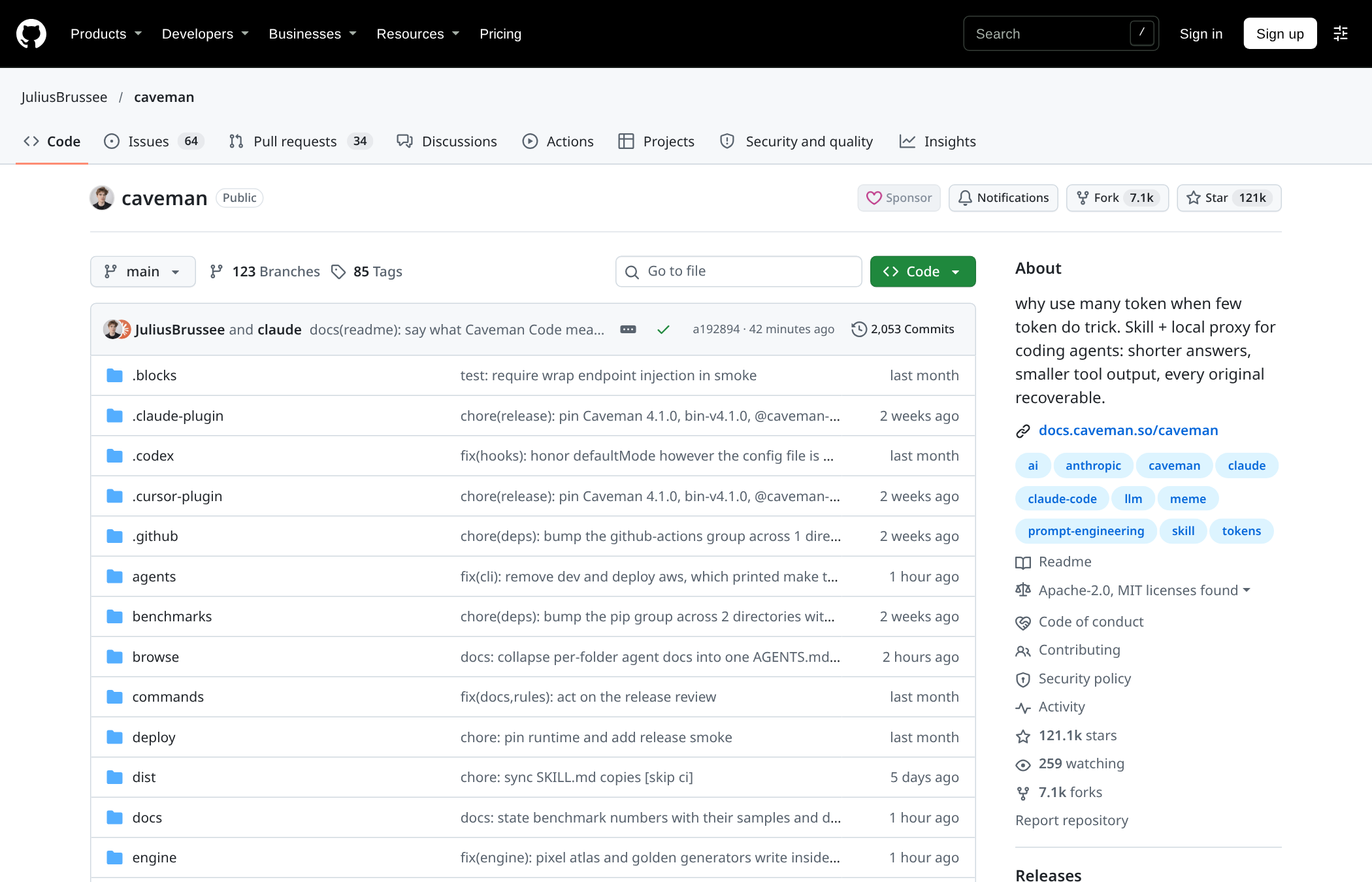
But if you look up the HONEST-NUMBERS.md and Zentor team’s 54-round Claude Code audit blog in the caveman documentation, the accounts aren’t that one-size-fits-all. That famous 65% drop was only measured in the number of “output tokens” in 10 sample problems—letting the modeling primitives speak, skipping small talk, transitions, and long explanations, the output end really gets shorter.
The problem lies in the system prompt tax that must be included with every call. HONEST-NUMBERS.md I write very frankly: as long as this prompt skill is enabled, each round of requests requires about 1,000 to 1,500 additional words to be inserted into the input context. If your question originally only requires a response of one or two hundred words, or your question is already very concise, even if the output side cuts 65% of it, the saved hundred or so words cannot make up for the over 1,000 input terms submitted each round—resulting in a net loss, with total consumption increasing instead of decreasing.
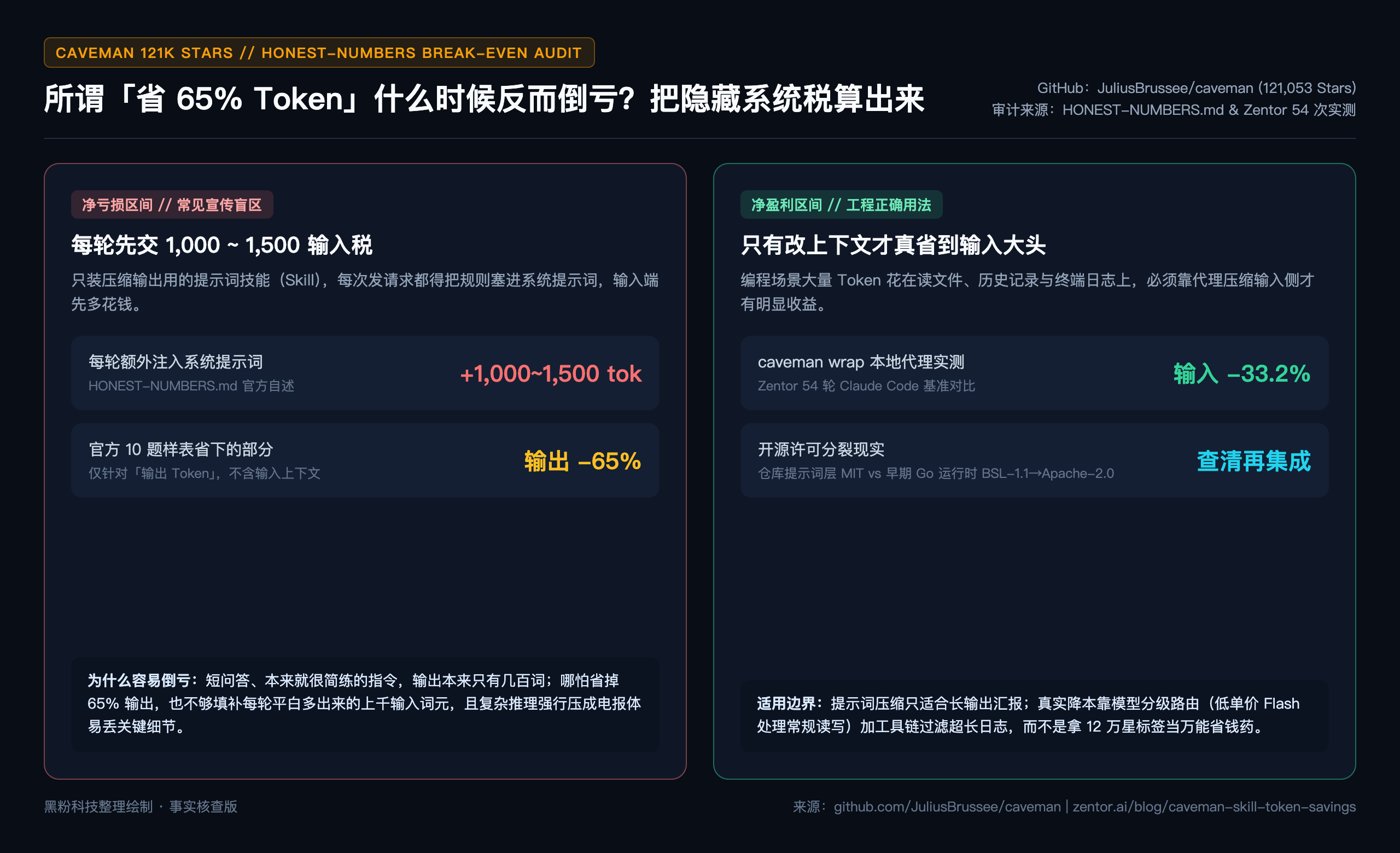
When will it really help you save money? Zentor’s control group audit of 54 real Claude Code tasks pointed out a condition: don’t rely solely on soft prompts for compressed output; you need to work with the caveman wrap local proxy in the repository to compress terminal command output and overly long input file noise.
After launching this proxy chain, the service provider’s statistics showed a 33.2% drop in input token, and only after long-term multi-round development did it start to enter the net profit range. Also, before integrating into the company’s toolchain, you need to review the protocol history: its prompt layer is MIT, and early Go runtime proxies used BSL-1.1 before switching to Apache-2.0. When pulling the queue, be sure to confirm which branch license you are installing.
I also checked a batch of “free AI toolkit lists” that have been shared along with the trend, such as the recently circulated DevAnimecx/free-ai-agent-stack. Checking this repository via GitHub, so far it only has 2 stars, labeled as NOASSERTION. For this new list that has just been built and hasn’t passed community testing or long-term retesting, I suggest not directly applying it to mainstream production scripts.
The money-saving methods are actually simpler. Take my daily maintenance of the free API radar tool HyphenBox—it’s not just a few mysterious codes, but scripts that regularly test whether each free channel has traffic limits or crashes, and feeds the channels that work into a local unified interface, keeping the key only on the local machine; What really drives the one-time development bill is always low-cost, fast models paired with major tasks, high-intelligence models left for tough challenges, plus filtering out useless long logs before entering context.
| Cost-cutting measures | Which side of the bill did you touch? | Hide prerequisites or additional taxes | Return to Cost Judgment |
|---|---|---|---|
| Single-hang caveman outputs compressed prompts | Output side (-65% sample reference) | Each round of input is a fixed +1,000~1,500 word tip tax | Only long text output will break even; Short Q&A and simple bug fixes will result in net losses |
| Caveman wrap native command line proxy | Input side (-33.2% / 54 rounds tested) | Note that early runtime protocol history is compatible with terminal interception | Multi-turn reading of giant logs and long-distance code proxy scenarios generate net returns |
| Cloud-based tiered routing (Flash + flagship backup) | Input+Output Bilateral Unit Price (-90%~-93%) | Complex architecture issue: Flash quality index is 13% lower, requiring manual/rule model cutting | Currently, programming agents offer the most direct and effective cost-reduction solution |
| Continue to retest local free channel gateways | No monthly fees / zero trial-and-error costs | The free limit has limits on concurrency or stability, and keys must be stored locally in isolation | Suitable for lightweight daily assistance and multi-channel backup |
When you put the whole account together, the bottleneck is just in a different position
Lining up these three things together actually creates a single network of mechanical principles. In AI systems, compressing a single cost never lets total consumption disappear into thin air; it only shifts the pressure onto the most expensive or toughest shortcomings upstream and downstream.
Development tools dump all 185TB of traffic into Flash because the most expensive part of multi-round programming is repeatedly rereading input, pushing the input price down to 90% before loops can work; Local open-source models, even if uninstalling SSD Engram bypasses part of the video memory, shifts the bottleneck from the graphics card to the 500.7GB storage bandwidth and 128GB memory threshold; The prompt compression plugin cuts 60% of the output word count, but then overloads over a thousand words of rule tax back onto the input, accidentally causing trouble in short interactions.
What truly saves you money and time for yourself is never the astonishing percentages on the poster, but the real numbers before starting to allocate tools against three real numbers: “each round’s total ledger, local real memory, and the break-even net return line.”
Main sources of verification
- OpenCode 7-Day and Single-Day Real-Time Model Call Volume Rankings (opencode.ai/data)
- OrcaRouter: DeepSeek V4.1 Flash vs Qwen3.8 Max Unit Price and Latency Comparison
- Hugging Face Official Blog :llama.cpp v1.0.0 Semantic Version Release Notes
- Emergent:llama.cpp v1.0 speculative decoding acceleration test on the RTX 3090
- Unsloth Official Documentation: DeepSeek-V4.1-Flash Quantization Volume, SSD Uninstallation, and Memory Requirements
- NVIDIA SC26 Blog: 4× DGX Spark 512GB Desktop Ring Network Running 700B Model Solution
- ActuIA: OVHcloud Olala mini 7A1B 8GB VRAM Device-Side Hybrid Expert Model Report
- Hugging Face: Heretic Dealigned Version osmGemma-4-12B-uncensored with MLX Quantization
- GitHub: JuliusBrussee/caveman repository and HONEST-NUMBERS.md description
- Zentor: caveman 54 rounds Claude Code Testing and License Split Analysis
Self-made software
Versions, changes and supported installers all come from the same public release records.
HyphenAssistant
Continue your computer’s DeepSeek Harness session from a phone browser. The service, computer and network must stay online; model costs follow your existing setup.
View public downloads and updates ↗LocalBrain
A local AI toolbox for transcription, speech, images, video, and MCP tools. Features vary by platform version.
View public downloads and updates ↗HyphenBox
A free model API radar and local router, with ongoing availability checks and keys kept on your device.
View public downloads and updates ↗ScreenLex
Turn subtitles from your own films and shows into an English vocabulary library, entirely offline.
View public downloads and updates ↗HyphenScreen
Screen recording and editing with a Resolve-style timeline, automatic redaction and pre-export checks.
View public downloads and updates ↗Support HyphenTech
Late nights and burned API credits went in,a cup of tea comes back out — only if you feel like it.
Save the QR codeScan with WeChatPress and hold to save the image, then open it from your album in WeChat Scan

WeChat tips · Any amount welcome





Comments
Loading comments…