Info: Machine translation This post was machine-translated from the Chinese original. Wording may be rough in places — the Chinese version is authoritative.
Gemini 4 Argon Global Launch: API, Pricing, and Official Testing Boundaries
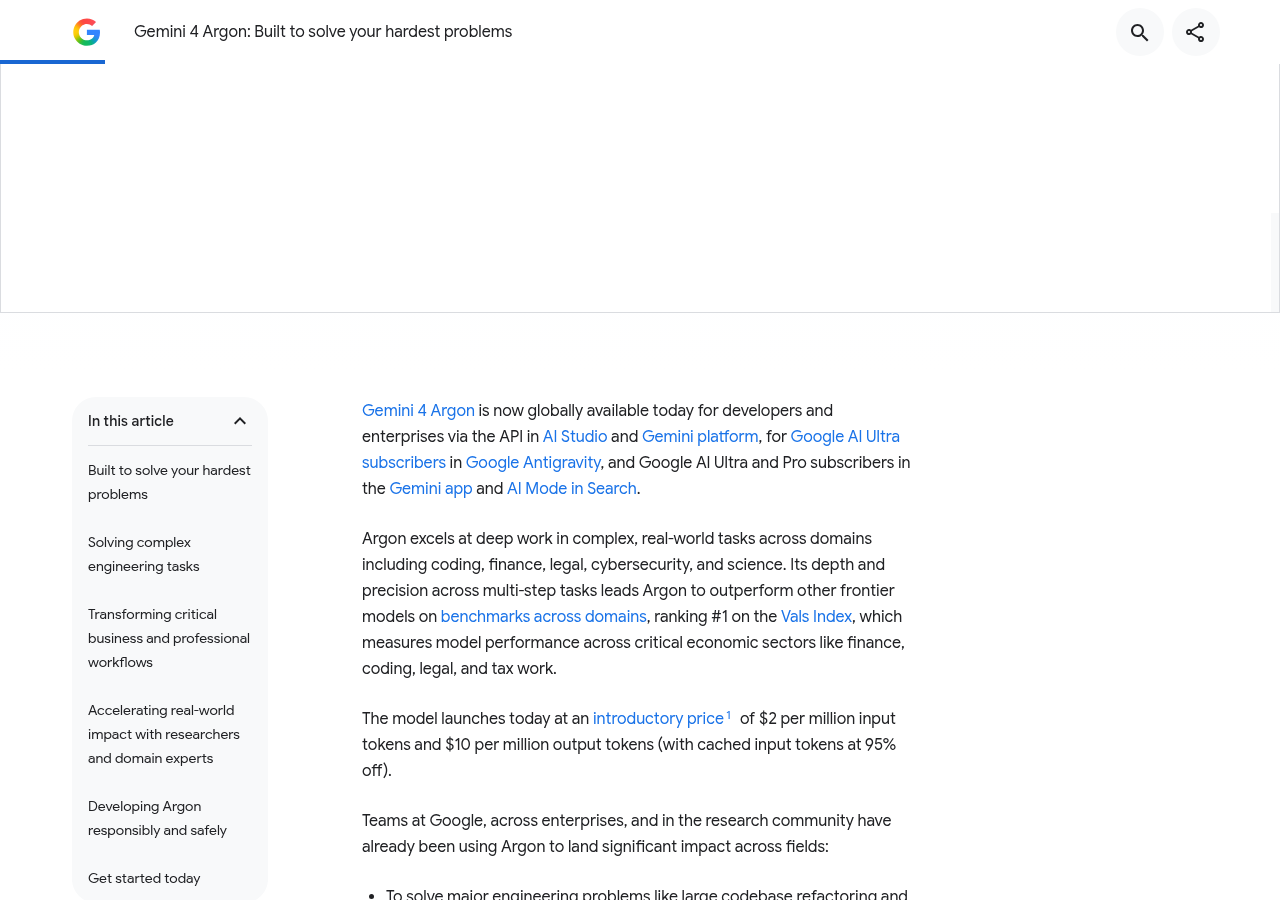
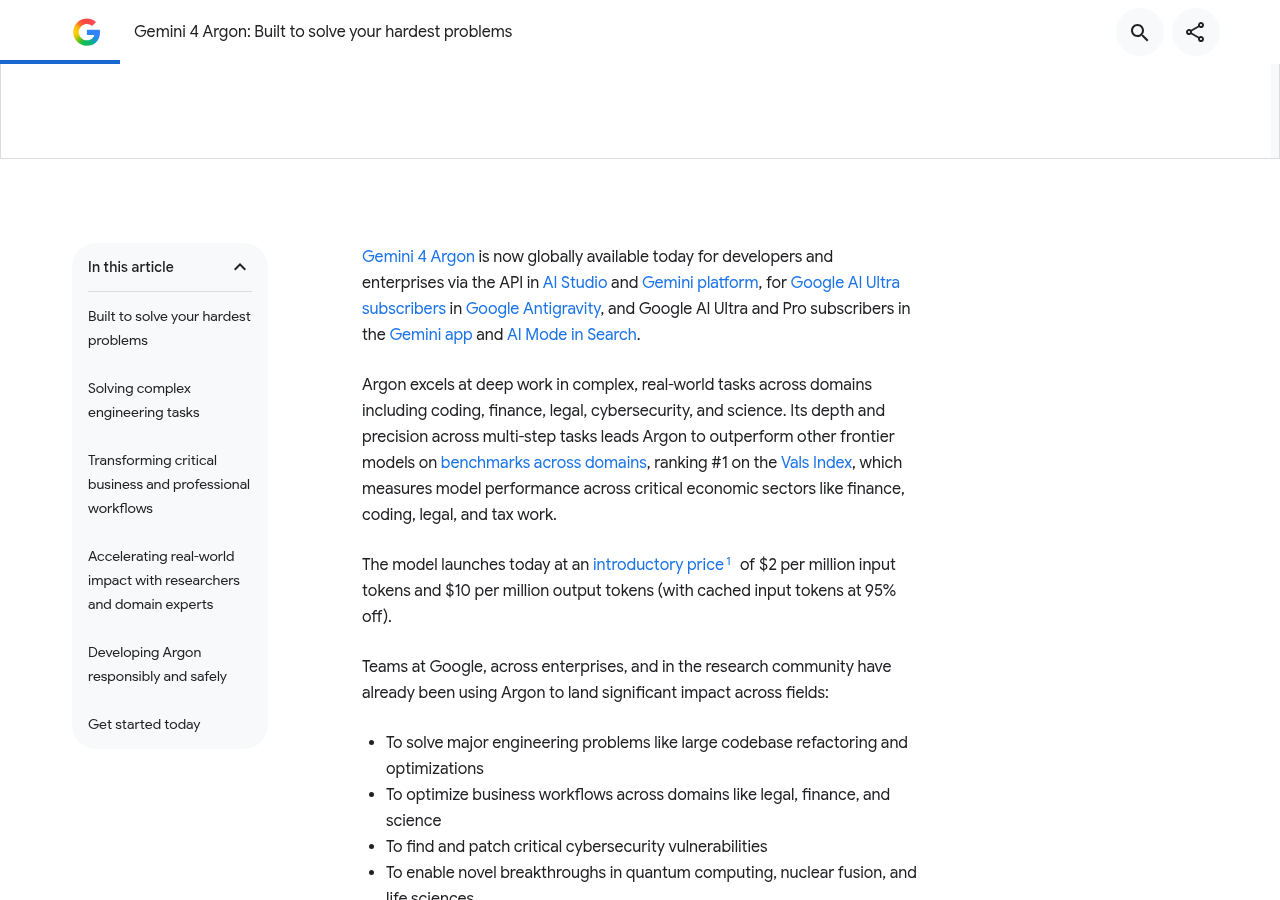
Google DeepMind announced in its official blog on October 13, 2026, that Gemini 4 Argon is officially open globally. Developers and enterprises can call the Gemini platform API via AI Studio; Google AI Ultra subscribers can use it in Antigravity; and Gemini App and Search AI Mode are available to Ultra and Pro subscribers.
This release didn’t follow the “put the paper first, wait for the interface” approach, but instead put the model, price, and entry points all on the table. For those who truly want to get work with it, the only question remains: is the task it handles worth the price?
Who can use it now, and where to do it
The official entry point is divided into several lines: developers use the Gemini API paid tier, which can build in AI Studio and Android Studio; enterprises use Gemini for business, API, and Antigravity; Regular users can experience it in the Gemini App and AI Mode in search from that day on, provided they subscribe to Google AI Ultra or Pro. Researchers and cybersecurity defenders have separate application channels, which will be discussed later.
Pricing and Billing: Listing price, buffer discount, and expiration date
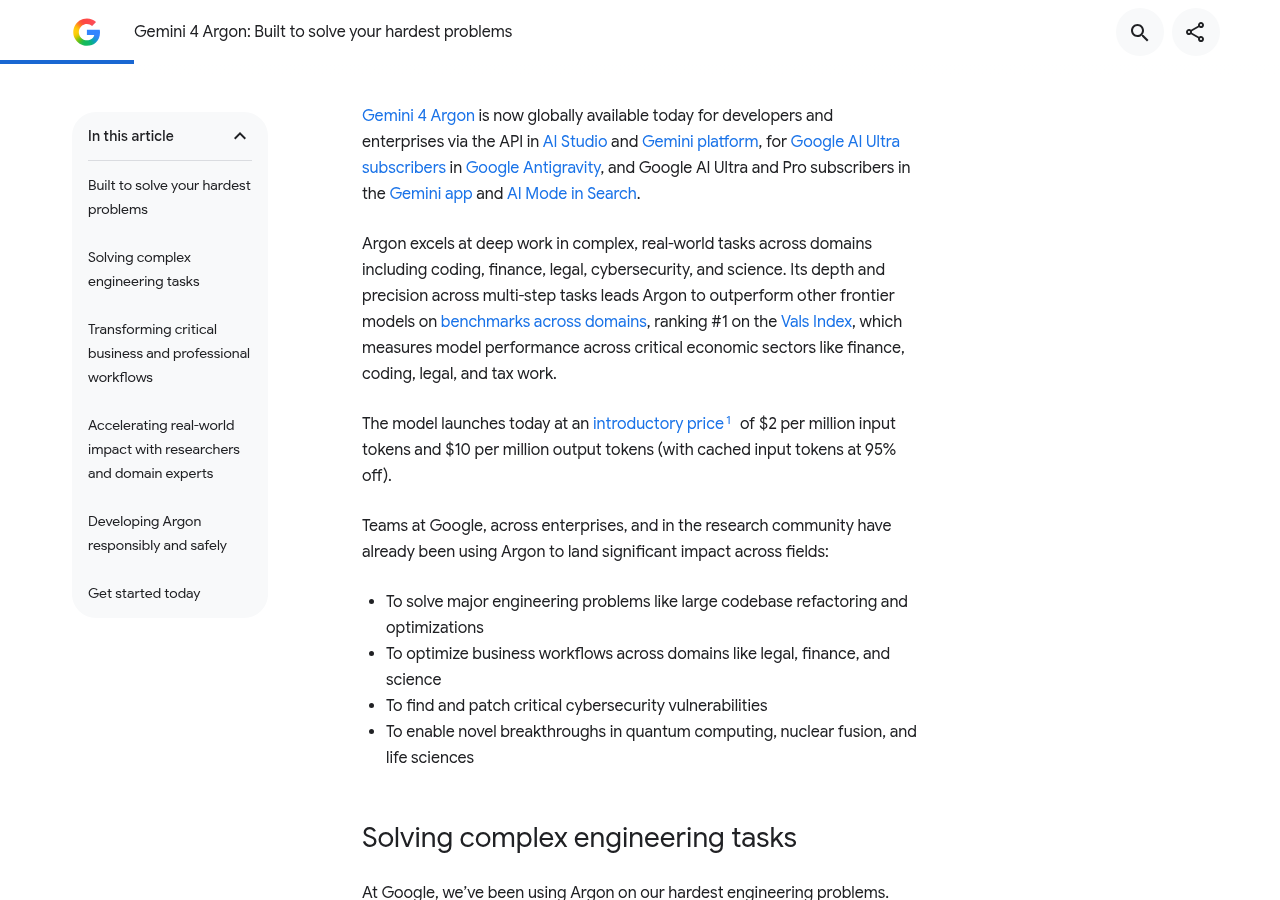
Argon’s launch price is $2 per million input tokens and $10 per million output tokens, with cached input tokens charged at a 95% discount. Here, the token can be roughly understood as the minimum billing unit for model read/write, similar to courier delivery charging per parcel: the prompt you send is input, the model returns output output, and pricing is separate.
Note that this price tag includes “introductory.” The official footnote states that after the introductory period ends on November 30, prices of $4 per million input tokens and $20 per million output tokens will apply, and this price only applies to the publicly accessible Argon model. In other words, the price seen now is not a long-term commitment; the invocation cost will directly double before expiration.
Officially listed engineering and research cases
The official announcement devoted most of its content to actual tasks rather than just running scores. Some cases with clear numbers include:
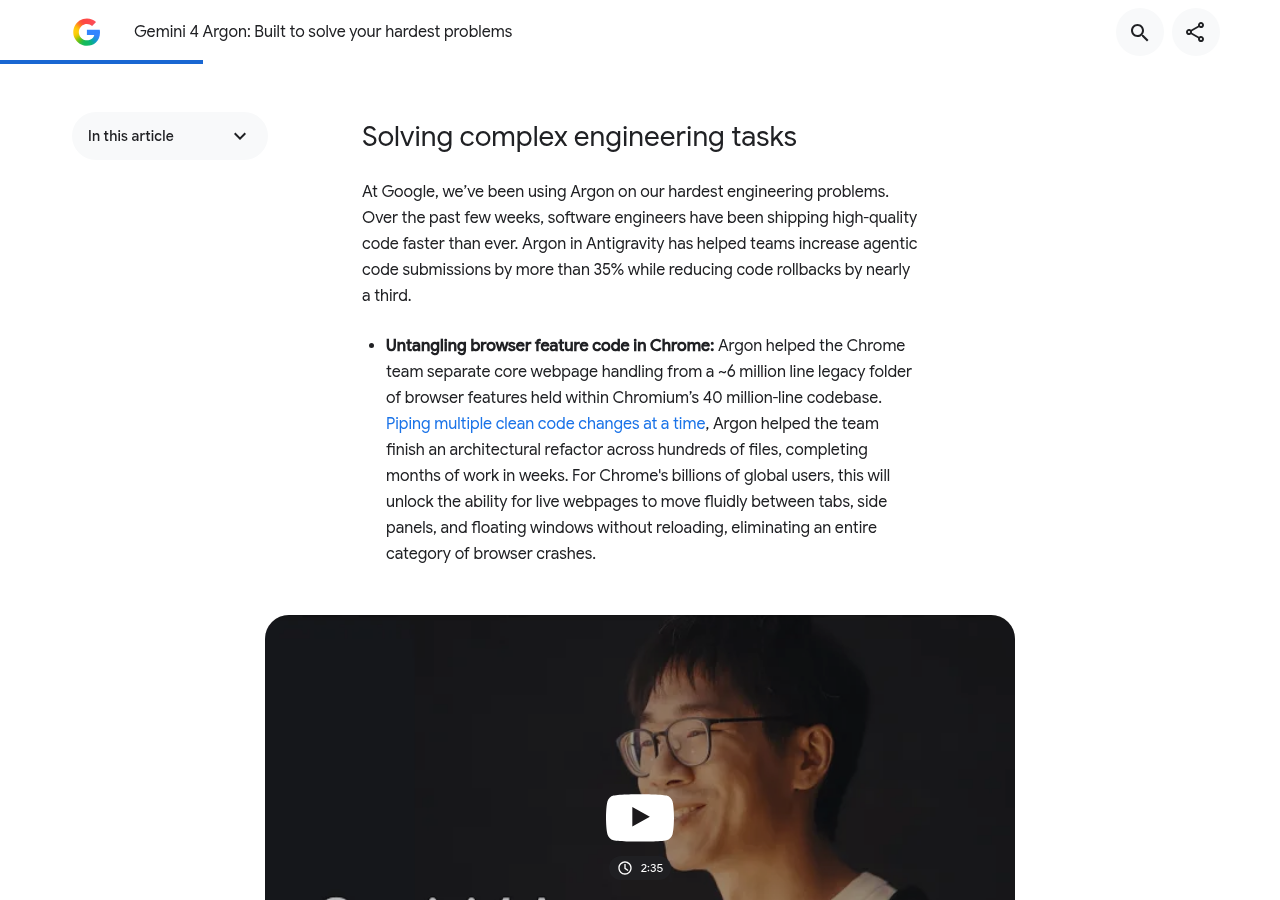
- The Chrome team used Argon to separate core web processing from browser code functionality, involving a legacy directory of about 6 million lines from Chromium’s roughly 40 million lines of codebase. The official statement said it compressed the architecture refactoring that would have taken months to just weeks.
- Google’s open-source Agent Development Kit (ADK) team enabled Argon to autonomously optimize overnight use in Antigravity, reducing memory preparation time for long sessions by 40%, improving cold start import speed by 21%, and the changes have been made available in the Google/adk-python repository.
- After Argon optimized the open-source quantum chemistry package xTB, molecular structure prediction speed increased by up to 2.3 times, conformation search speed by 1.8 times, and changes have been submitted to the official xTB GitHub repository.
- Google used Argon on the A100 and vLLM to increase the end-to-end inference speed of Gemma 4 E2B by 2.85 times, raising throughput from about 37,900 tokens/second to over 108,000 tokens/second. The company claims it remains 100% token consistent with no quality degradation.
These cases all come from Google itself or early partners, are official reports, not third-party retests. They show that Argon produced quantifiable results under specific codebases, hardware, and task settings, but cannot be directly extrapolated to “any old project can turn one week into three.”
The official evaluation results are as cited
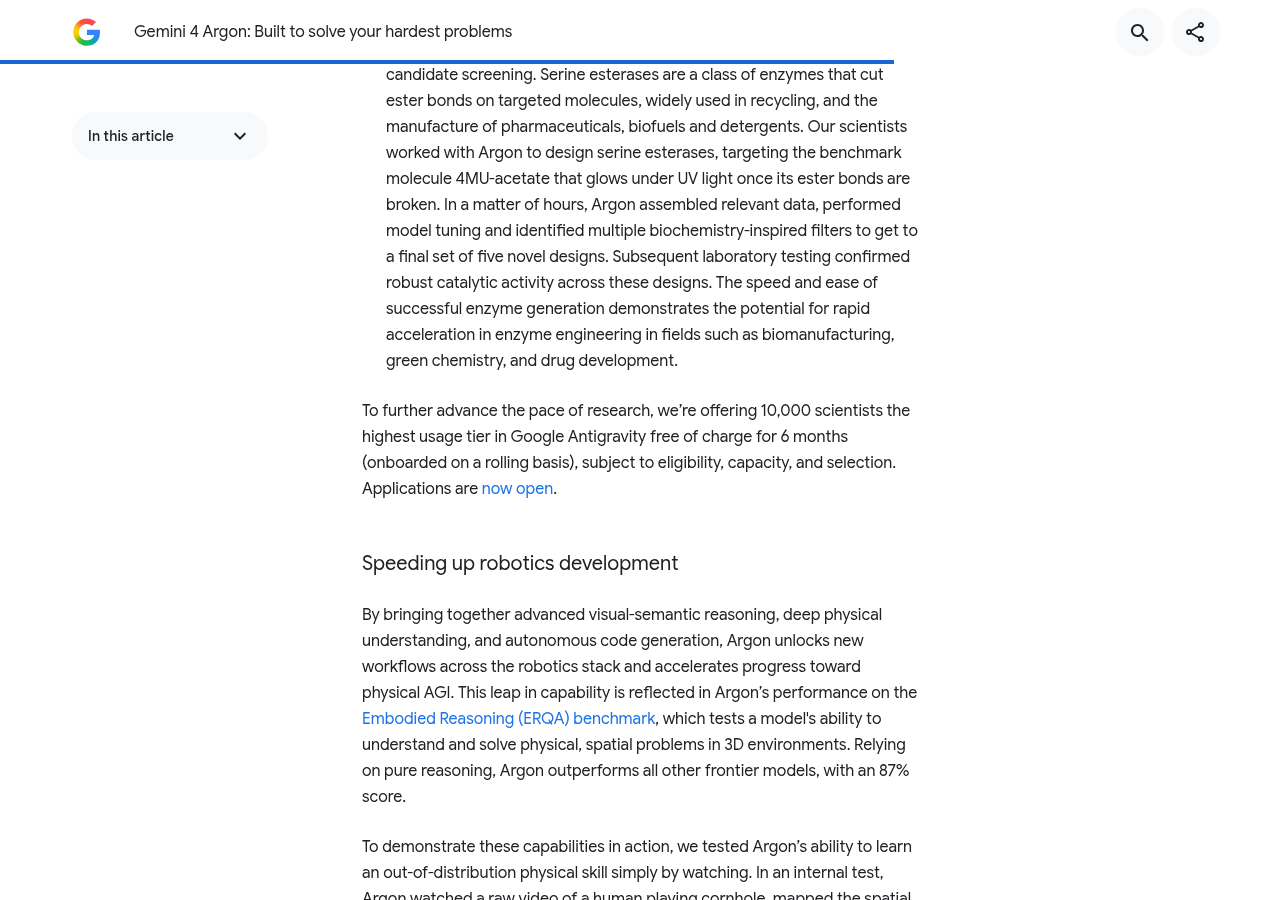
On the official blog’s list, Argon ranked first on the Vals Index, which measures model performance in key economic areas such as finance, programming, law, and taxation; It scored 87% on the ERQA benchmark for physical spatial reasoning in 3D environments, which the official claims surpassed other cutting-edge models; On the Gray Swan Indirect Prompt Injection (IPI) benchmark, the success rate of 15 adaptive attacks was suppressed to 0.7%.
To be clear: these numbers are the results reposted in the official announcement; this article does not independently reproduce them, nor does it verify sample versions or scoring criteria for each ranking. They can serve as reference signals during selection, but should not be taken as the final conclusion for fair horizontal evaluation.
Safety and alignment measures
Google makes the security stack one of the key focus for its release. Officially, Argon’s capabilities were evaluated under the Frontier Safety Framework, and a defense layer combining jailbreak resistance, monitoring, and execution was deployed; In external creature red team testing, less than 1% of creature subtasks could be unlocked. For dangerous requests, Argon’s violation rate on the adversarial test set was nearly half that of the previous Gemini model.
Regarding proxy alignment, the official team stated that Argon was trained to respect system boundaries, truthfully report negative results, and pause for human confirmation before taking irreversible steps; On the model’s programming benchmark without retaining motivation, shortcut attempts dropped to 2%. At the same time, Google built an automatic misalignment monitor that reads step-by-step agent reasoning and actions in real time, capturing and blocking unauthorized workarounds.
What can be done now, and what will be the next step for acceptance?
For ordinary developers, the most direct acceptance path is: open AI Studio or Gemini platforms, run a real multi-step task using a paid API, record the number of input/output tokens and actual time taken, then estimate costs against the release price. Don’t just look at the official demo 3D scenes or game prototypes; those are ideal demonstrations and don’t prove your codebase can be compressed in the same way.
For researchers, Google is offering 10,000 free spots for the highest antigravity usage tier for 6 months, with rolling reviews requiring eligibility, capacity, and filtering criteria. For cybersecurity defenders, the Fairwind Program offers Argon access without a network shield, which also requires an application. Neither of these channels is “instant registration” and is suitable for teams with clear research or defense scenarios.
The Gemini 4 Argon is just the first card in the Gemini 4 family. The official statement has clearly stated that “this is just the beginning,” and future models and pricing strategies are worth continuing to follow. Currently, if you have complex code refactoring, long document analysis, or multi-step proxy tasks, you can conduct a small-scale verification based on the entry points and cost criteria above; If the task is simple and has low call volume, the long-term cost after doubling the release price needs to be calculated first.
Official information
Self-made software
Versions, changes and supported installers all come from the same public release records.
LocalBrain
Turn your Mac into a private AI toolbox for transcription, speech, images, video and MCP tools.
View public downloads and updates ↗HyphenBox
A free model API radar and local router, with ongoing availability checks and keys kept on your device.
View public downloads and updates ↗ScreenLex
Turn subtitles from your own films and shows into an English vocabulary library, entirely offline.
View public downloads and updates ↗HyphenScreen
Screen recording and editing with a Resolve-style timeline, automatic redaction and pre-export checks.
View public downloads and updates ↗Late nights and burned API credits went in,a cup of tea comes back out — only if you feel like it.
Scan with WeChatPress and hold to save the image, then open it from your album in WeChat Scan

Comments
Loading comments…