
Info: Machine translation This post was machine-translated from the Chinese original. Wording may be rough in places — the Chinese version is authoritative.
Summary Its potential goes beyond just reading images, allowing agents to see web pages and software interfaces; Even with the latest minimal visual quantization, it still cannot cross the physical boundary of 64GB of unified memory. HyphenTech · 2026-09-02
👁 Instead of adding a picture button to the chat box, it is installing sensors on the Agent
After the weighting of DeepSeek-V4-Flash-Vision-Exp was opened, the word most easily misled by the title was “vision.” If you only understood it as object recognition, OCR, or picture-based speaking, the value of this update would be greatly diminished.
The three official cases are not for photo Q&A, but for making travel PPTs, redoing websites, and generating 3D frontends. **The model first understands the current image, then continues to write code, adjust tools, and modify results. **
This is the real piece of the puzzle it wants to fill. Text models can write plans, but can’t see what the browser will ultimately render them like; They can generate code but don’t know if buttons are overflowing or if the charts are drawn incorrectly. Once vision enters the Agent loop, the model has the chance to complete “Observe—Judge—Act—Observe Again.” **Being able to read images is just the surface of capability; seeing the interface and continuing to complete tasks is real potential. **
When large models first integrated into search tools, the change wasn’t just an added search button, but that answers could catch up with the outside world for the first time. Vision played a similar role, but it connected the web pages, software, charts, and computer states humans face every day. DeepSeek connected these eyes to V4 Flash, clearly aiming not at photo albums but at the workflow on the computer.
The visual version’s upper limit is not determined by how many objects it can recognize, but by how many steps it can complete after viewing the screen.
📊 The results aren’t overwhelming, but visuals do make up for Agent’s shortcomings
In official results, TerminalBench 2.1 rose from 82.7 to 83.9, still slightly below Opus 4.8’s 85.0. DeepSWE increased from 54.4 to 59.3, even surpassing Opus’s 58.0.
Toolathlon rose from 70.3 to 75.9, almost matching Opus’s 76.2. **Plain text tasks haven’t changed dramatically; the deeper the multimodal engagement, the more valuable the visual version becomes. **
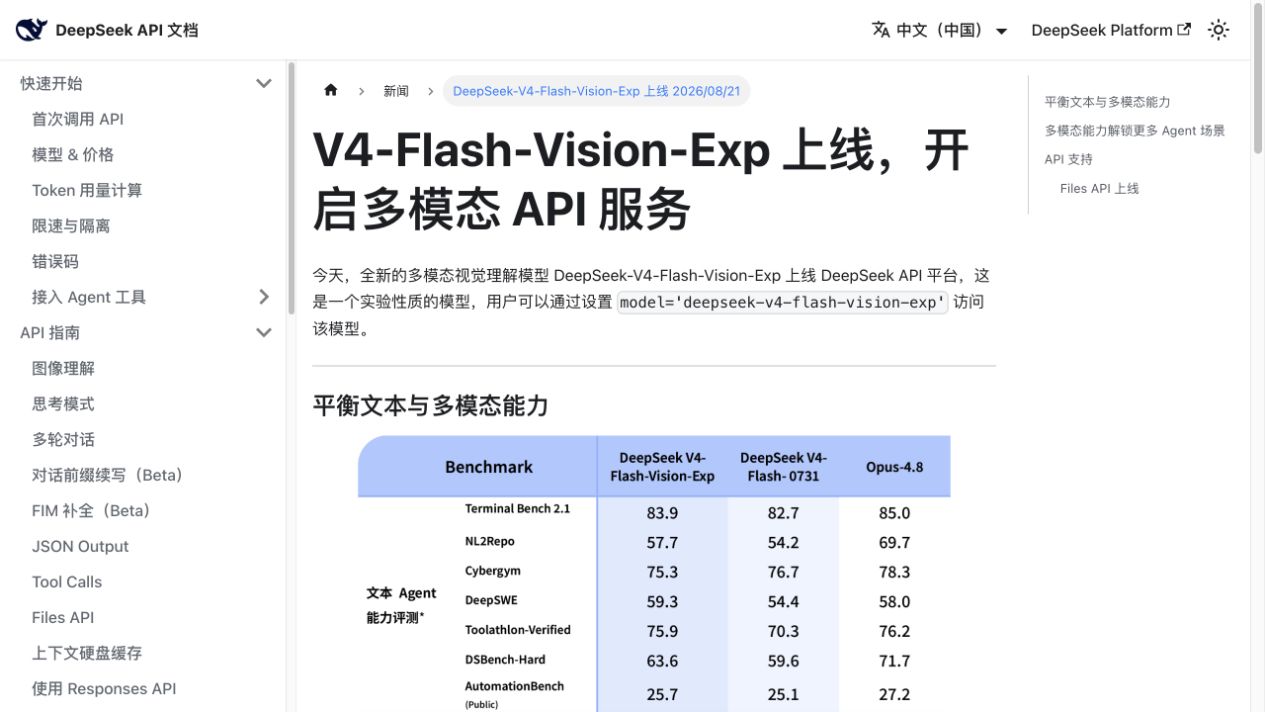
| Agent tasks | Vision Exp | Text Flash | Opus 4.8 | How to see it |
|---|---|---|---|---|
| TerminalBench 2.1 | 83.9 | 82.7 | 85.0 | Close, not overtake |
| DeepSWE | 59.3 | 54.4 | 58.0 | The visual version overtook him |
| Toolathlon | 75.9 | 70.3 | 76.2 | Almost even |
| ApexBench | 36.5 | 26.2 | 39.4 | The improvement is significant, but there is still a gap |
| Agents’ Last Exam | 27.3 | 25.2 | 25.7 | The visual version overtook him |
Source: DeepSeek official model card. The official note states that some text models in the controls ignore multimodal elements; This is not a third-party blind test.
And don’t rush to write it as “Comprehensive Surpass.” This set of results was published by DeepSeek itself, using DeepSeek Harness Minimalist mode, max mode, temperature=1, top_p=0.95.
In ApexBench and Agents’ Last Exam, text Flash even ignores multimodal content. It proves that “having eyes is better than doing problems with eyes closed,” but it cannot alone prove that the visual version has won in all real workflows.
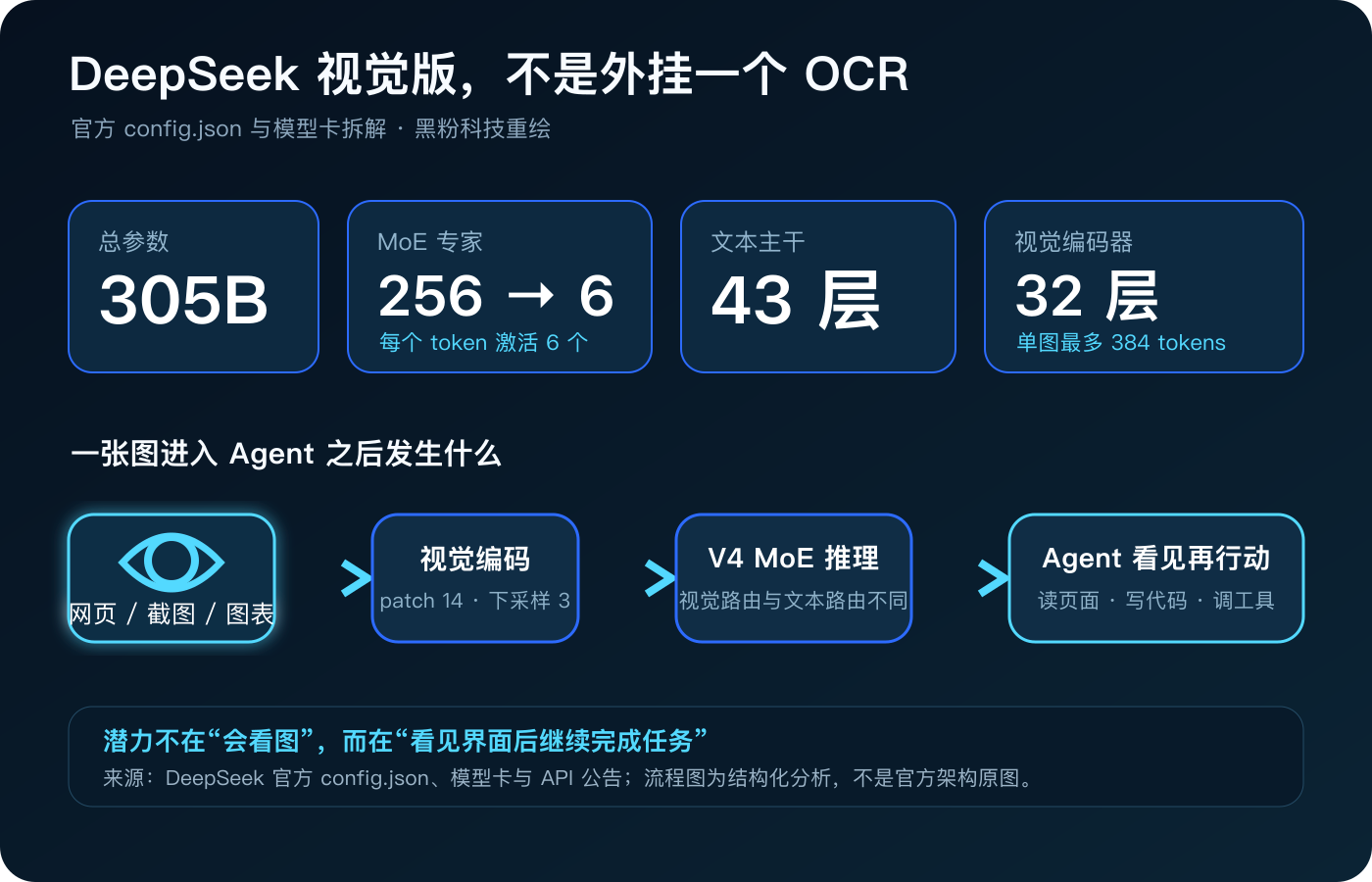
The configuration file makes the direction more straightforward: about 305B parameters, 43 layers of text backbone, 256 routing experts, 6 activated per token, plus 1 shared expert; The vision encoder has 32 layers, 1024 dimensions, 16 heads, and can be compressed into up to 384 vision tokens per image. **Maximum position length of 1,048,576, leaving room for long workflows and extensive tool records. **
It’s not about stuffing an independent OCR result into the input text. After entering the V4 backbone, the visual token has its own expert routing bias, which is why community conversion requires a dedicated patch: if this set of tensors is lost, the image token will select experts based on text preference. **The model can see the image file, but that doesn’t mean it’s using the right brain area. **
🧭 Implement the API first, then assign weights: DeepSeek is competing for the Agent entry point
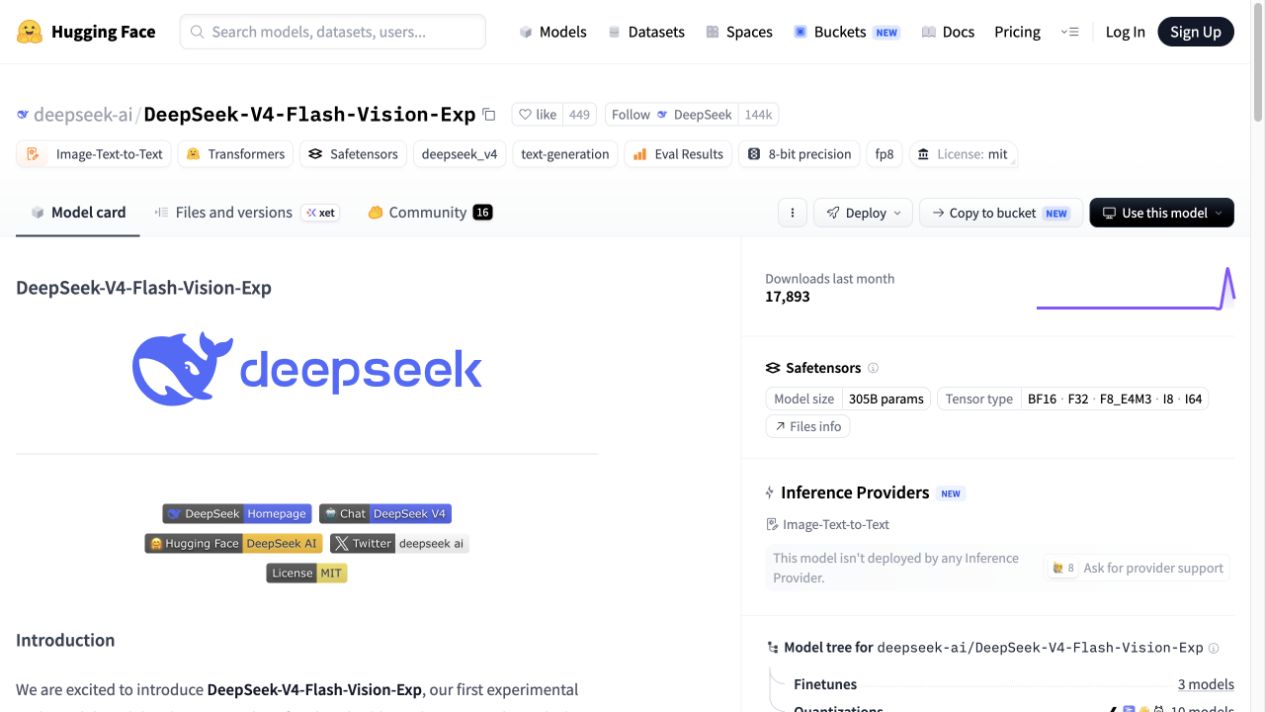
Timelines speak louder of strategy than slogans. On August 21, Vision Exp entered the API first; On August 31, MIT weights and reference inference code were fully implemented on Hugging Face.
About 10 days in total, forming two steps: first, developers validate requirements with ready-made services, then the weight is given to inference frameworks, quant authors, and local communities to expand coverage. Why is DeepSeek doing this now? **V4 Flash and Pro have already laid out the Agent interface, and the visual interface is just right for the observation interface. **
The official has also made migration resistance very low: the Visual Edition is priced the same as V4 Flash and supports Chat Completions, Messages, and Responses.
Images can be imported via base64, URL, or Files API, which is currently free. For Agent developers already connected to V4, switching to a model ID can start testing. This isn’t just about showing parameters, but about grabbing the entry point for “who will do the next step after the model sees the computer.” **
As early as the April 24 V4 preview, DeepSeek prioritized 1M context and agent capabilities; On August 13, V4 Pro supplemented the Responses API, Codex adaptation, and inference strength tiers. The visual edition is not a sudden side line but pushes the same Agent route from “reading text” to “reading interface.”
Who benefits first? Cloud agents, server deployments, and high-memory hardware. Who pays the bills? Ordinary users bear bandwidth, memory, patches, quantization losses, and troubleshooting time for the initial ecosystem. DeepSeek is willing to set weights because the community can provide more hardware and tools for it; Users get choices, vendors get ecosystem expansion—this exchange is not mysterious.
💻 64GB Mac: Theoretically reversible, but not worth being productive in practice
First, let’s look at the official raw weight: 48 shards totaling 167,819,404,368 bytes, which is 167.82GB or 156.29GiB.
The official reference deployment is a 4×GB300 node with Tensor Parallel 4, FP8 KV cache, and DSpark. **The official warranty is the server route, not Apple Silicon. **
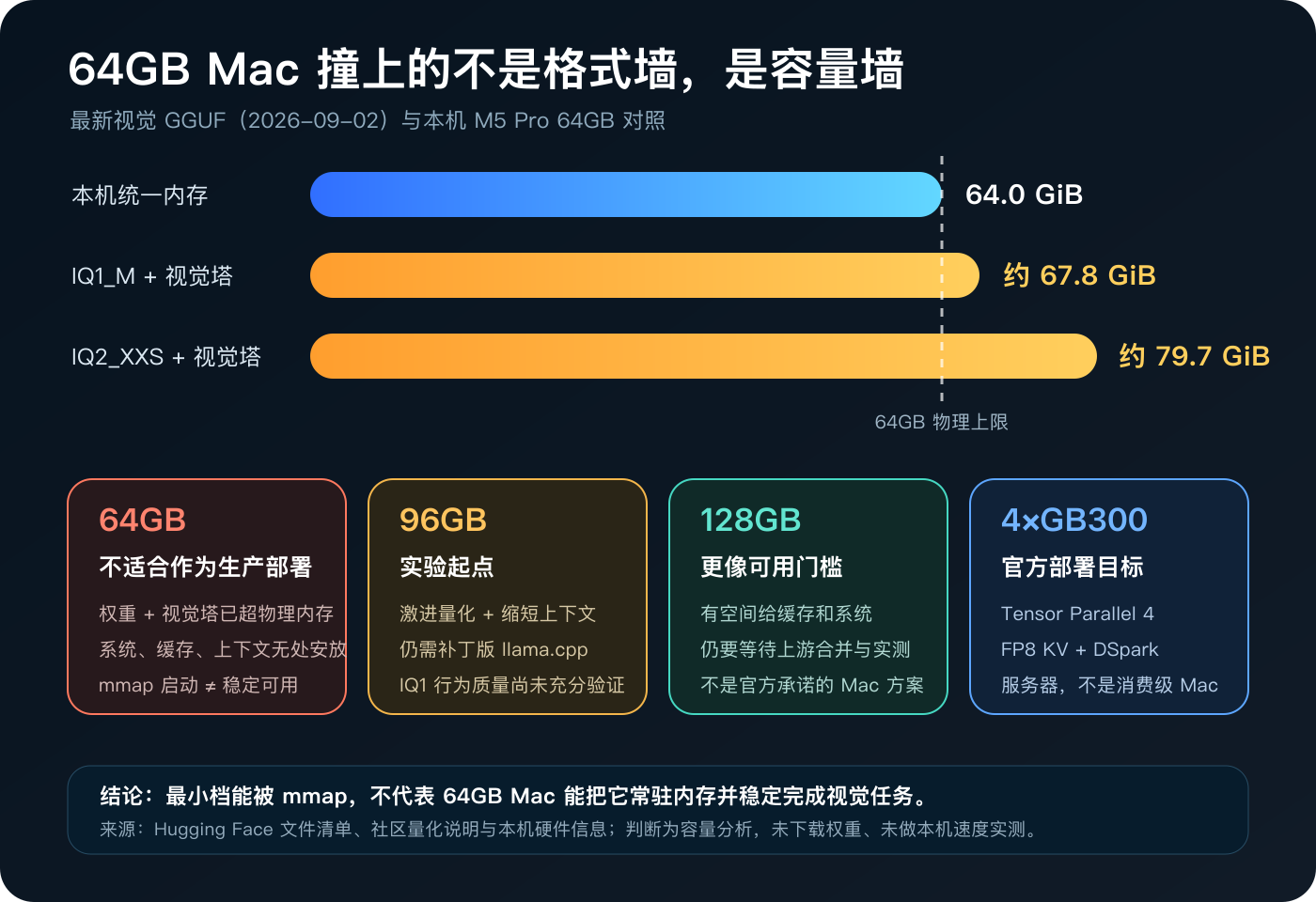
Now let’s look at community quantification. As of today, the smallest tier with a full visual tower is IQ1_M: weight 66.9GiB, visual tower about 890MiB, totaling about 67.8GiB. It already exceeds 64GB of physical memory; And the Mac’s unified memory must also be used for macOS, resident software, KV cache, and compute buffer simultaneously. **Mistaking the “1” in a file name for a 64GB pass is the most dangerous misjudgment. **
The community notes do say: 64GB VRAM can be used to IQ1_M and shorten context. But 64GB of dedicated VRAM is not the same as 64GB of unified memory—the former usually includes host memory, while the latter even houses the system desktop in the same pool. A more stable IQ2_XXS plus a visual tower is about 79.7GiB. **Running 1MB of context on a 96GB GPU has reached a peak of 96.9GB. **
| Equipment | Current feasibility | The main obstacle | Suggestion |
|---|---|---|---|
| 64GB Mac | Not suitable for stable deployment | The smallest visual combination is ultra-physical memory | Online APIs or continued use local small models |
| 96GB Mac | The starting point of radical experimentation | Low bit quality, patching, and context margin | Only verifying, not being the main force |
| 128GB Mac | It is more like a usable threshold | Still lacking stable upstream and Apple testing | Wait until it runs officially before downloading |
| 4×GB300 | Official reference route | Cost and server environment | Suitable for team deployment |
This is the capacity and ecosystem assessment as of 2026-09-02, not actual local speed measurements.
Can mmap be used for hard boot? This possibility exists. Model pages are mapped to disk, expert weights are read as needed, and hypermemory models do not necessarily exit in the first second.
But in MoE, each token may switch experts, and disk access drags generation speed into waiting; Visual paths also require patch llama.cpp, upstream PR #28133 hasn’t merged yet, and the minimum IQ1_M is the least validated. **Successful startup only means “the program isn’t dead,” not “the model can work.” **
There are currently no shortcuts to MLX. As of press time, mlx-community can find multiple V4 Flash text conversion methods, but no visual conversion for the same name as this Vision Exp. Last time, many people saw “already have an MLX warehouse” and assumed multimodal can run by default, but later realized that conversion, visual towers, and routing implementation are three different things. **Having a format does not mean a complete capability chain already exists. **
🔧 What changes will truly lead to a comeback in the 64GB conclusion?
**A regular Q4 won’t save the day; it will only be bigger than the current IQ1_M. **The four types of changes are truly worth waiting for. First, the official or community provides QAT or hybrid quantization below about 50GiB, validated by visual tasks.
Second, experts cut off long-tail capacity and submit quality loss reports. Third, MLX-VLM natively supports visual routing and DSpark. Fourth, DeepSeek releases a small-parameter visual version with the same architecture.
- Want to Use Now’s Capability: Call the official visual API, images can be up to 384 tokens, avoiding downloading with 100 GB weight
- Insist on Local Privacy: Continue using small and medium-sized visual models that can stably reside within 64GB
- Preparing to Buy a Machine: Don’t just look at weight and volume; at least leave clear margin for the system and cache
- Ecosystem maturity: Upstream integration, Apple Silicon speed, and visual quality are all essential
Tip Offline Capacity Calculator Fill in your unified memory, model weights, visual tower, system reservations, and cache, and first check if full resident storage is possible: https://hyphentech.top/obsidian-assets/deepseek-v4-vision-mac64/deepseek-mac-memory-calculator.html
Open source gives users the choice but does not expand their capacity. What makes DeepSeek most noteworthy this time is that it finally integrates vision into the Agent closed loop, using same-price APIs and MIT weights to attract developers and the local ecosystem; What a 64GB Mac should do most is acknowledge today’s hard walls, and not treat downloads and page changes as productivity.
Summary: Visual Agent is worth looking forward to—don’t rush the launch for 64GB local deployment The true potential of DeepSeek-V4-Flash-Vision-Exp is that after the agent understands the webpage, software interface, and charts, it continues to call the tool. 305B parameters, 256 experts, and 1M context provide capacity for this route, but also raise the local threshold: the official original weight is about 167.82GB, the latest minimum visual GGUF is about 67.8GiB, and the total system memory has already exceeded 64GB. Today, the most reasonable combination is large model vision using online APIs, leaving privacy and high-frequency tasks to local small models that can stably reside.
Tip HyphenTech · Local AI / Free Purchase Guide / Tools I Make / New Product Express This article is based on DeepSeek’s official announcements, model cards, config.json, weight file list, and current community visual quantization instructions; Only the local 64GB hardware information was read, with no download weights or running the model.
🧰 Tools I build
I maintain all of these tools myself. Preview builds are clearly labeled; the release pages are the source of truth for downloads, updates and known limits.
Info: HyphenBox Status: Official releases
A radar for free LLM APIs: availability is re-tested continuously, one local interface for all of them, and keys stay on your machine
Info: LocalBrain Status: Official releases
A multimodal MCP toolbox for local models: TTS, Whisper and video generation in one place
Info: ScreenLex Status: Official releases
Learn new words while you watch shows. Free, for Mac and Windows
Info: HyphenScreen Status: Official releases
Screen recording and smart editing in one: a DaVinci-style timeline, automatic redaction and a check of the finished video before export. Free
Quote: HyphenTech Make AI your superpower Local deployment · Free resources · Self-made software https://hyphentech.top
Late nights and burned API credits went in,a cup of tea comes back out — only if you feel like it.
Scan with WeChatPress and hold to save the image, then open it from your album in WeChat Scan

Comments
Loading comments…